
Expanded Retrosynthesis Prediction with Published Routes Integration
Last updated on March 27, 2026
Release notes, March 2026
Release date: March 26, 2026
Reaxys contains millions of expertly curated chemical reactions, capturing published methods to synthesize compounds that are not commercially available. By considering these hard-to-purchase materials as viable starting points, retrosynthesis can reveal additional and often more practical synthetic routes.
In this release, the new Combined route option brings together AI-predicted retrosynthetic steps with published Reaxys reactions. When a predicted route reaches a non-commercial intermediate, Predictive Retrosynthesis can automatically extend it by appending relevant literature-reported reactions — connecting the route back to commercially available starting materials without manual literature searching. The result is more diverse and practical routes, and broader coverage with additional 11.5 million synthesizable compounds.
What’s new:
New ‘combined’ route option
Users can enable the new Combined synthesis route by turning on the corresponding toggle (A) when configuring prediction parameters. When activated, the algorithm extends beyond commercially available starting materials and continues planning routes for non-commercial compounds that have been reported in the literature as synthesizable in up to five steps, unlocking broader and more practical synthetic pathways.
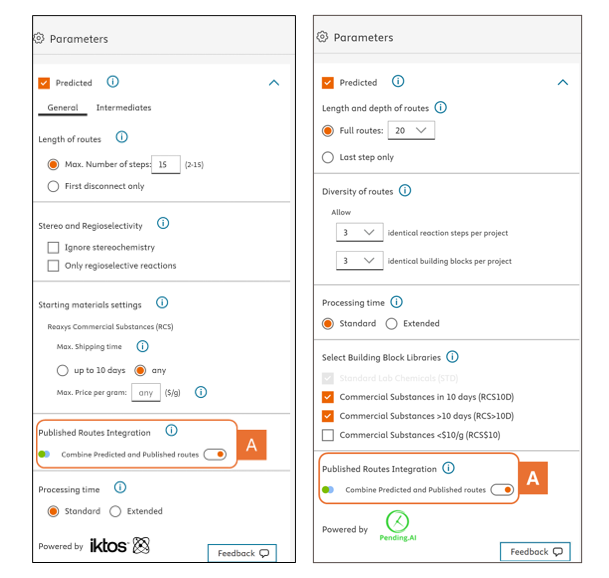
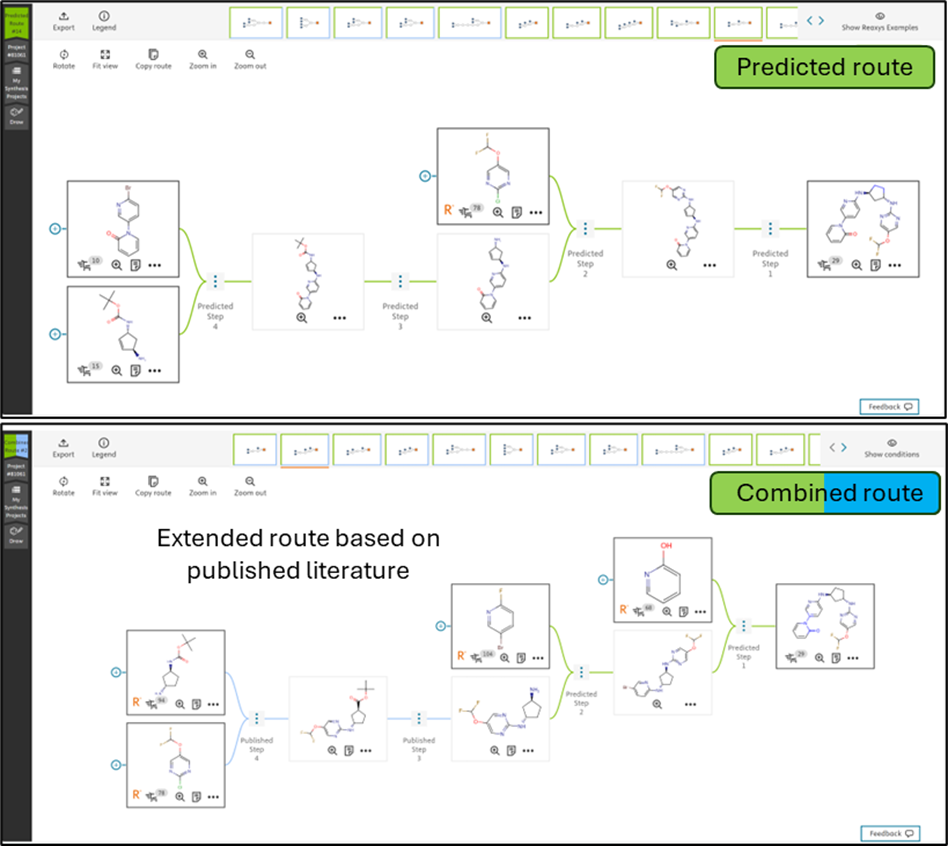
For example, a predicted route may stop at a commercially available substance after a few AI-generated steps. With the Combined option enabled, the route continues by incorporating relevant published reactions for non-commercial starting materials that can be synthesized from literature-reported methods. This extension increases the likelihood that the overall pathway is practical and supported by experimentally validated chemistry.
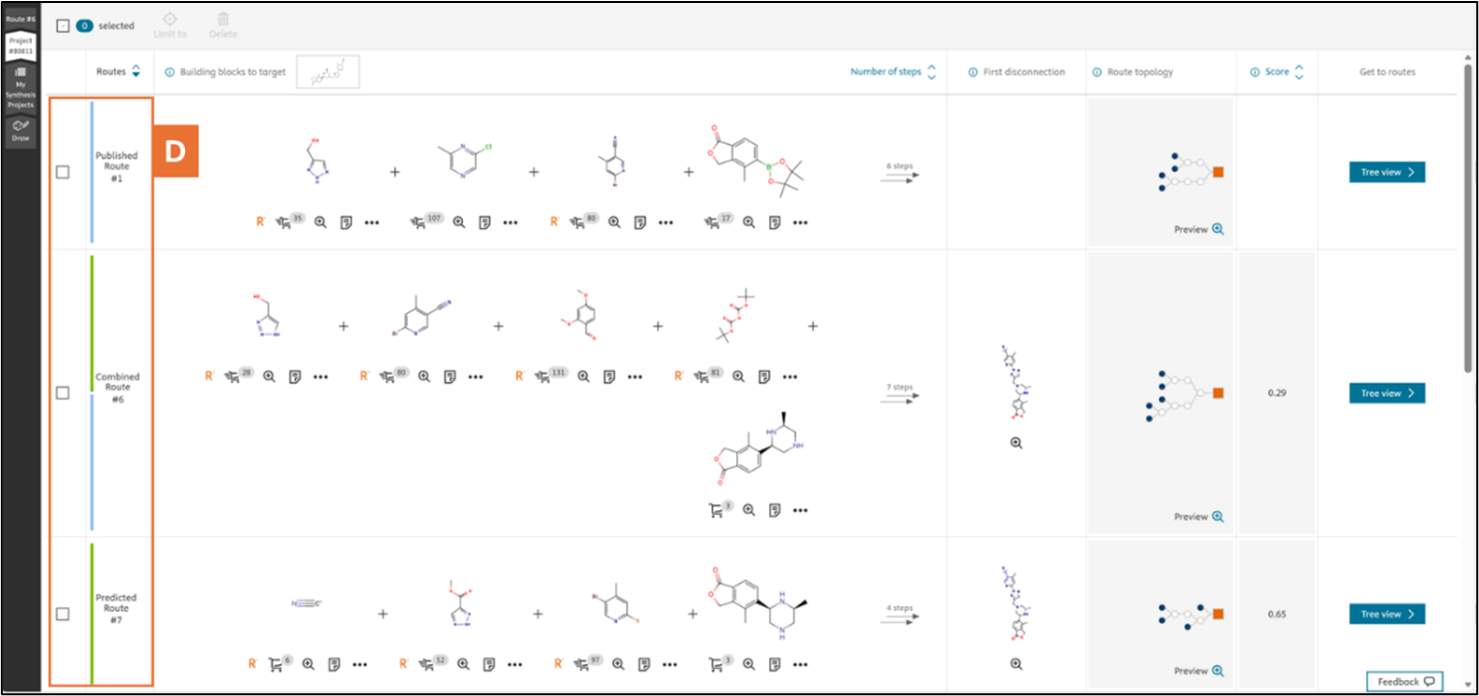
The new combined routes (B) are clearly shown alongside predicted and published routes, on the My synthesis project page. Upon clicking on view (C), each type of route is also clearly indicated on the individual project (D).

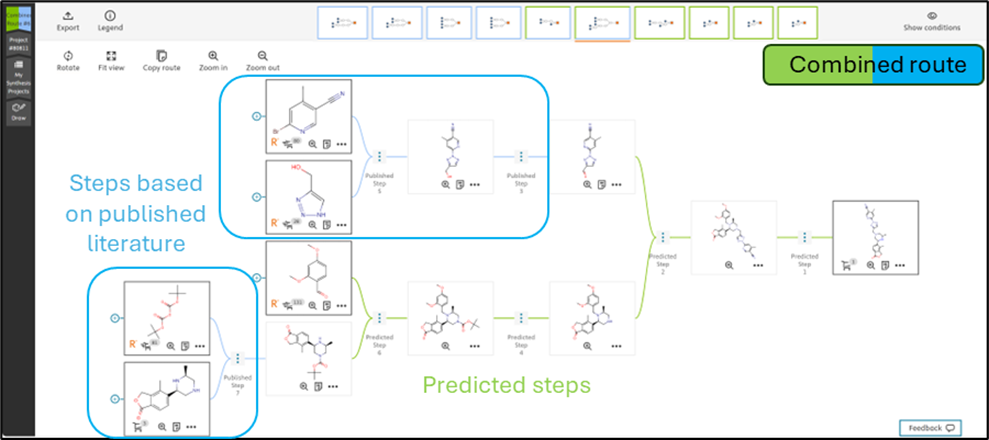
Tree view
In the tree view, for a Combined route prediction, published and predicted steps are clearly indicated in blue and green, respectively.
Updated conditions/example table
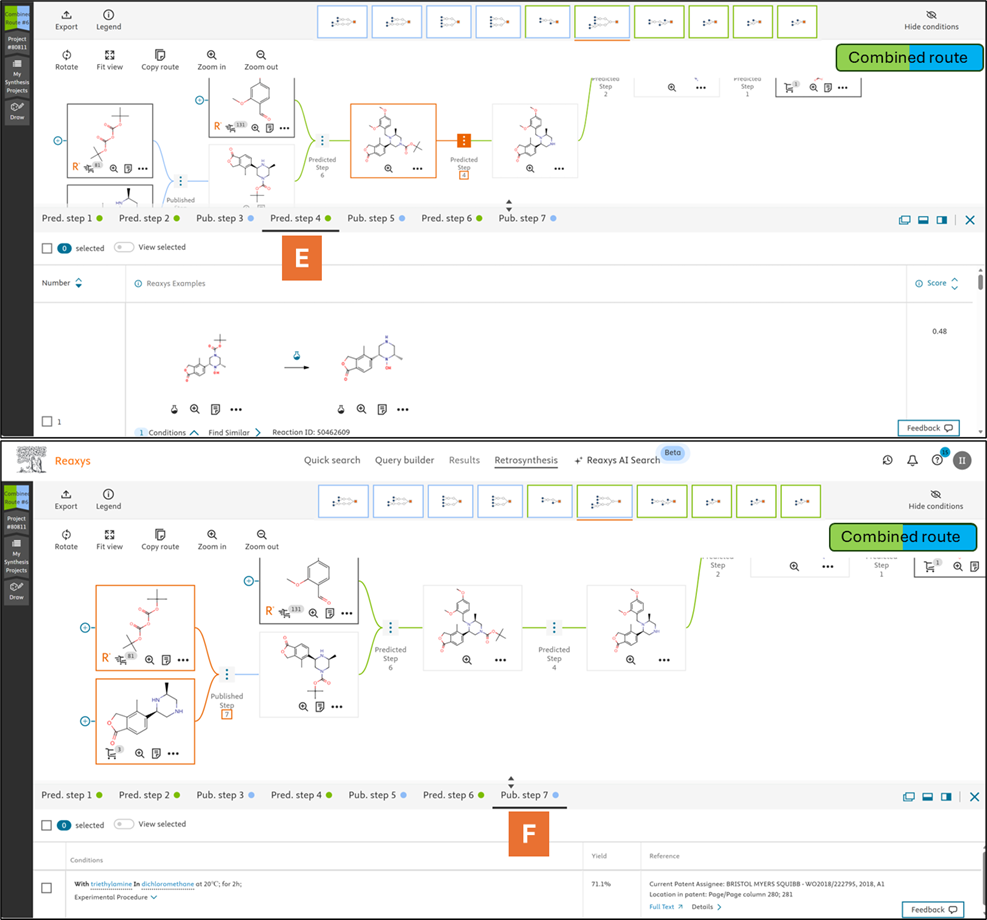
For a combined route, the conditions table clearly labels the origin of each step, so you can quickly identify which steps are predicted (E) and which ones are based on published literature (F).
Route generation continues to respect your preferences for delivery time, cost of starting materials, and other prediction settings. With the Combined route option enabled, if a pathway reaches a non-commercial intermediate, the system automatically extends the plan by incorporating relevant published reactions to connect back to commercially available starting materials. The result is more diverse, experimentally grounded, and practical synthesis routes, helping ensure viable options are not overlooked.
Did we answer your question?
Related answers
Recently viewed answers
Functionality disabled due to your cookie preferences