
View by category
 Back to all metrics
CiteScore is a simple way of measuring the citation impact of serial titles such as journals. Serial titles are defined as titles which publish on a regular basis (i.e. one or more volumes per year). Calculating the CiteScore is based on the number of citations to documents (articles, reviews, conference papers, book chapters, and data papers) by a journal over four years, divided by the number of the same document types indexed in Scopus and published in those same four years.
The calendar year to which a serial title’s issues are assigned is determined by their cover dates, and not the dates that the serial issues were made available online. The method of calculation for CiteScore 2019 is illustrated below:
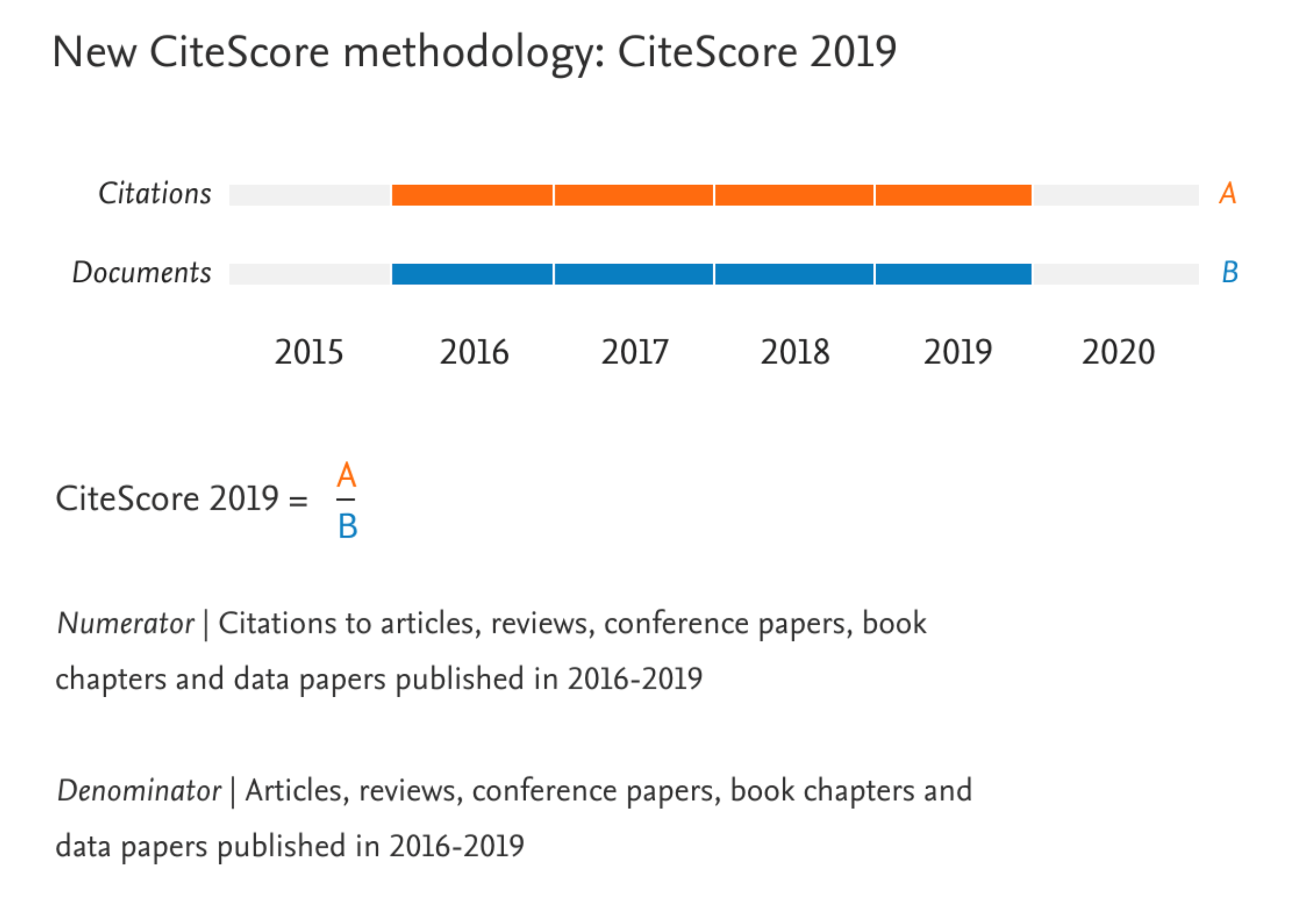
For example, the 2019 CiteScore counts the citations received in 2016-2019 to articles, reviews, conference papers, book chapters, and data papers published in 2016-2019, and divides this by the number of these documents published in 2016-2019.
Four-year window
Peer reviewed bibliometric literature, such as the Journal of Information Scienceopens in new tab/window, shows that a three-year window is long enough to capture the citation peak for the majority of disciplines. However, a four-year window was chosen to allow for a more recent year to be included in the equation, making the calculation more robust and stable. CiteScore uses a 4-year window.
CiteScore metrics are available for all serial titles in the Scopus title list that have enough data available to calculate the metric. There are currently around 25,500 titles in Scopus Sources that have CiteScore metrics. The types of serial titles available are journals, conference proceedings, book series, and trade journals. Newly added journals will receive CiteScore metrics in the next yearly calculation round (usually in June), from the year they are added, but not for any previous years.
- The first journal metric values for CiteScore are available for 2011. For Scholarly Outputs published in the range 1996–2010, the CiteScore Percentile value for 2011 is used.
- Current year journal metric values are published during the course of the following year. For recent items whose journal metric values have not yet been published, the previous year’s journal metric values are used until the current year’s become available.
CiteScore is a:
- Citation Impact metric
Learn more about CiteScore metrics
- Benchmark the Scopus Sources or groups of Scopus Sources that are similar in size and that fall within similar fields of research
- Look at publishing activity in a way that is difficult to manipulate
- Investigate activity during the early stages of a new strategy when publications are just starting to appear, or the scholarly output of early-career researchers – the CiteScore of the journals can be used as a proxy measure of potential citation impact
- Benchmarking the influence of journals or other entities with distinct disciplinary profiles, such as journals that focus on the humanities, vs those that do not
- It is not advisable to use this metric to compare journals or other entities in distinct disciplines without accounting for these differences.
- When comparing journals or other entities made up of a mixture of disciplines, it is advised to create Publication Sets for each journal focusing on one field that is common between all the journals, or to use the CiteScore percentile which will account for disciplinary differences.
- The objective is to judge an entity’s publications based on their actual performance, rather than based on the average of a journal:
- A publication may appear in a journal with a very high CiteScore value, and not itself receive any citations; even the most highly cited journals in the world contain publications that have never been cited.
- A publication may be very influential and have received many citations, without being published in a journal with a high CiteScore, SNIP or SJR value; journals which do not rank very highly in the data universe may still contain very highly cited publications.
- Entities are small and there may be gaps in their output within the Scopus coverage. A single missing publication from a small data set will have a significant negative impact on apparent performance. It is possible that some publications for a journal are not indexed in Scopus. Although in general this can be a small percentage of publications, we advise users to be vigilant and to bear this possible limitation in mind.
- Citation Count, Citations per Publication, Field-Weighted Citation Impact, Scholarly Output, SNIP, SJR, Publications in Journal Quartiles and Publications in Top Journal Percentiles which can give a different perspective into the journal’s performance
- The set of all other “time-independent metrics”, which provide useful, reliable information immediately upon publication and do not rely on the passing of time for useful data to accumulate: Scholarly Output, Subject Area Count, Scopus Source Title Count, Collaboration, and Academic-Corporate Collaboration
Did we answer your question?
Related answers
Recently viewed answers
Functionality disabled due to your cookie preferences