
View by category
SciVal Metric: Field-Weighted Citation Impact (FWCI)
Last updated on November 15, 2024
Also available in
 Back to all metrics
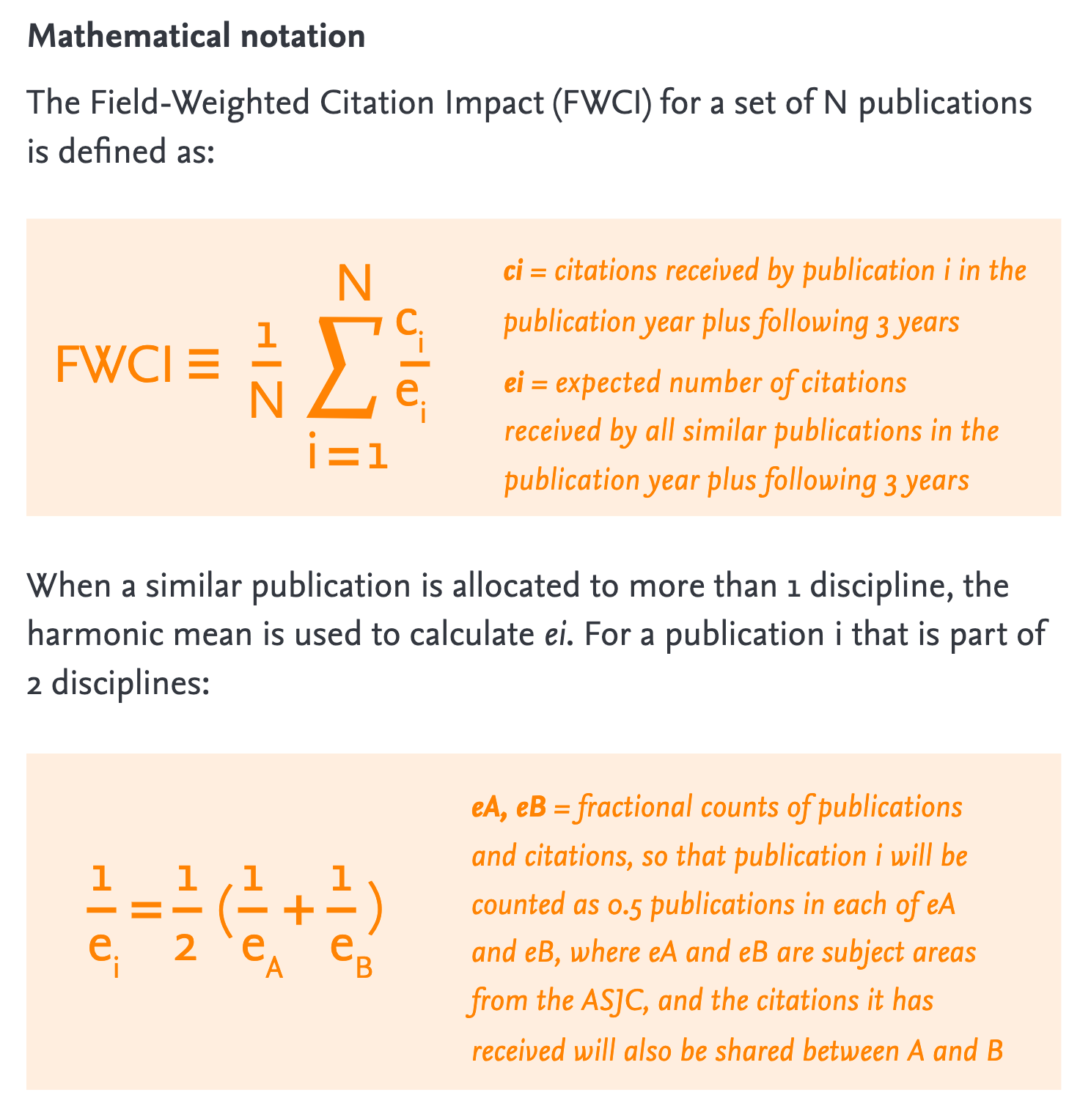
Field-Weighted Citation Impact in SciVal indicates how the number of citations received by an entity’s publications compares with the average number of citations received by all other similar publications in the data universe: how do the citations received by this entity’s publications compare with the world average?
Be careful using this metric when the entity (e.g. a Researcher) has a small number of publications. A few highly cited publications can skew the FWCI value.
- A Field-Weighted Citation Impact of 1.00 indicates that the entity’s publications have been cited exactly as would be expected based on the global average for similar publications; the Field-Weighted Citation Impact of “World”, or the entire Scopus database, is 1.00.
- A Field-Weighted Citation Impact of more than 1.00 indicates that the entity’s publications have been cited more than would be expected based on the global average for similar publications; for example, 2.11 means 111% more than the world average.
- A Field-Weighted Citation Impact of less than 1.00 indicates that the entity’s publications have been cited less than would be expected based on the global average for similar publications; for example, 0.87 means 13% less than the world average.
Similar publications are those publications in the Scopus database that have the same publication year, publication type, and discipline, as represented by the Scopus journal classification system:
- Field-Weighted Citation Impact uses “publication-driven” assignment in SciVal, which means the code looks at that the subject areas allocated to each article to decide on the subject areas with which to compare it. However, it’s important to note that all articles in a journal are allocated the same subject areas as the journal. For example, the Journal of Wine Research is classified in both Horticulture and Food Science. This means that all articles in the journal are also classified in the same two categories.
- Publications are allocated to the classification Sub-category level, and can be allocated to more than one Sub-category. When calculating the expected citations for similar publications, it is important that these multi-category publications do not exert too much weight; for example, if a publication P belongs to both in both parasitology and microbiology, it should not have double the influence of a publication that belongs to only one or the other Sub-category. This is accounted for in SciVal by distributing publication and citation counts equally across multiple journal categories; publication P would be counted as 0.5 publications for each of parasitology and microbiology, and its citations would be shared equally between these Sub-categories.
Field-Weighted Citation Impact is a:
- Citation Impact metric
- Snowball Metric
SciVal often displays Field-Weighted Citation Impact in a chart or table with years. These years are always the years in which items were published, and do not refer to the years in which citations were received. The citations received in the year in which an item was published, and the following 3 years, are counted for this metric.
You can use the Median Field-Weighted Citation Impact as a complementary metric to the FWCI. When the publications for an entity are ordered from highest to lowest by FWCI, the Median FWCI is the middle value.
You can use the Field-Citation Average to understand the expected number of citations for a specific type of Scholarly Output, from a specific subject discipline (or disciplines) for a specific year. This number is used as part of the calculation of the FWCI.
- Benchmark entities regardless of differences in their size, disciplinary profile, age, and publication-type composition, such as:
- An institution and departments (Groups of Researchers) within that institution
- A country and small research institutes within that country
- A geographical region and countries within that region
- Easily understand the prestige of an entity’s citation performance by observing the extent to which its Field-Weighted Citation Impact is above or below the world average of 1.00
- Present citation data in a way that inherently takes into account the lower number of citations received by relatively recent publications, thus avoiding the dip in recent years seen with Citation Count and Citations per Publication
- Gain insight into the relative citation performance of an entity in a discipline with relatively poor Scopus coverage, since gaps in the database will apply equally to the entity’s publications and to the set of similar publications
- Use as a default to view citation data, since it takes multiple variables that can affect other metrics into account
- Look at publishing activity in a way that is difficult to manipulate
- Information about the magnitude of the number of citations received by an entity’s publications is important. In these situations, it is advised to use Citation Count or Citations per Publication.
- Demonstrating excellent performance to those who prefer to see high numbers; Citation Count or Citations per Publication would be more suitable in these circumstances
- Entities are small so that the metric may fluctuate significantly and appear unstable over time, even when there is complete Scopus coverage. Field-Weighted Citation Impact calculates an average value, and these types of calculations are strongly influenced by outlying publications in a small data set. For example one or two highly cited articles will have a much larger effect on an entity made up of 10 articles, than an entity consisting of 1,000 articles, which can lead to an inflated value.
- Entities contain a large proportion of recently published outputs. Both the output universe (publications in the same year, subject area and document type) and the citation universe (publications that are citing the publication universe), can affect FWCI fluctuations which may be seen in the metric values in the period immediately following date of publication. For an output published in the current year, new outputs will be added to the Scopus database during the remainder of the year and so the publication universe for the metric is still being defined. With the citation universe, as citations take time to accrue, this can also lead to greater fluctuations in the initial period after publication. Over time both of these effects will reduce, so smaller fluctuations in the metric should be seen.
- Trust needs to be built in the metrics in SciVal. This calculation accounts for multiple normalizations, and the generation of the average citations for similar publications requires a view on the entire Scopus database which will be difficult for a user to validate. Users are advised to select simpler metrics, such as Citation Count or Citations per Publication, if trust in the accuracy of the SciVal calculations needs to be built.
- Uncovering the performance of publications in the very early stages of a new strategy, or of early-career researchers, where the short time that has passed since publication will reduce the reliability of basing decisions on citation information. It is advised to use on of the time-independent metrics, such as AcademicCorporate Collaboration, in these cases.
- Completely answering every question about performance. FieldWeighted Citation Impact is a very useful metric, but using it to the exclusion of other metrics severely restricts the richness and reliability of information that a user can draw from SciVal
- Citation Countopens in new tab/window and Citations per Publicationopens in new tab/window. They indicate the magnitude of the number of citations received, to complement this relative view offered by Field-Weighted Citation Impact. They are also simple and offer transparency on the underlying data to build trust in SciVal’s metrics calculations.
- The Field-Citation Average to understand the expected number of citations for a specific type of Scholarly Output, from a specific subject discipline (or disciplines) for a specific year. This number is used as part of the calculation of the FWCI.
- The set of “time-independent metrics” that provide useful, reliable information immediately upon publication and do not rely on the passing of time for useful data to accumulate: Scholarly Output, Subject Area Count, Scopus Source Title Count, Collaboration, Academic-Corporate Collaboration, and Publications in Top Journal Percentiles
Scenario: The user would like to calculate the Field-Weighted Citation Impact of an entity that consists of 3 publications. They have not selected any viewing or calculation options.
Click here(Opens in a new tab or window)opens in new tab/window to see a PDF example of the Field-Weighted Citation Impact calculation.
Did we answer your question?
Related answers
Recently viewed answers
Functionality disabled due to your cookie preferences