
View by category
With the December 2024 release, we want to emphasize the importance of engaging and empowering youth in climate action. Young people bring extra energy, innovation, and a sense of urgency to the movement. Together we can nurture a generation of dedicated climate advocates through fostering education and awareness, offering mentorship, supporting youth-led climate projects and celebrating their achievements.
The Youth release brings an improved global entity search methodology, main patent families introduction, Institution’s Funding Bodies by acknowledgement-linked publications analyses and more.
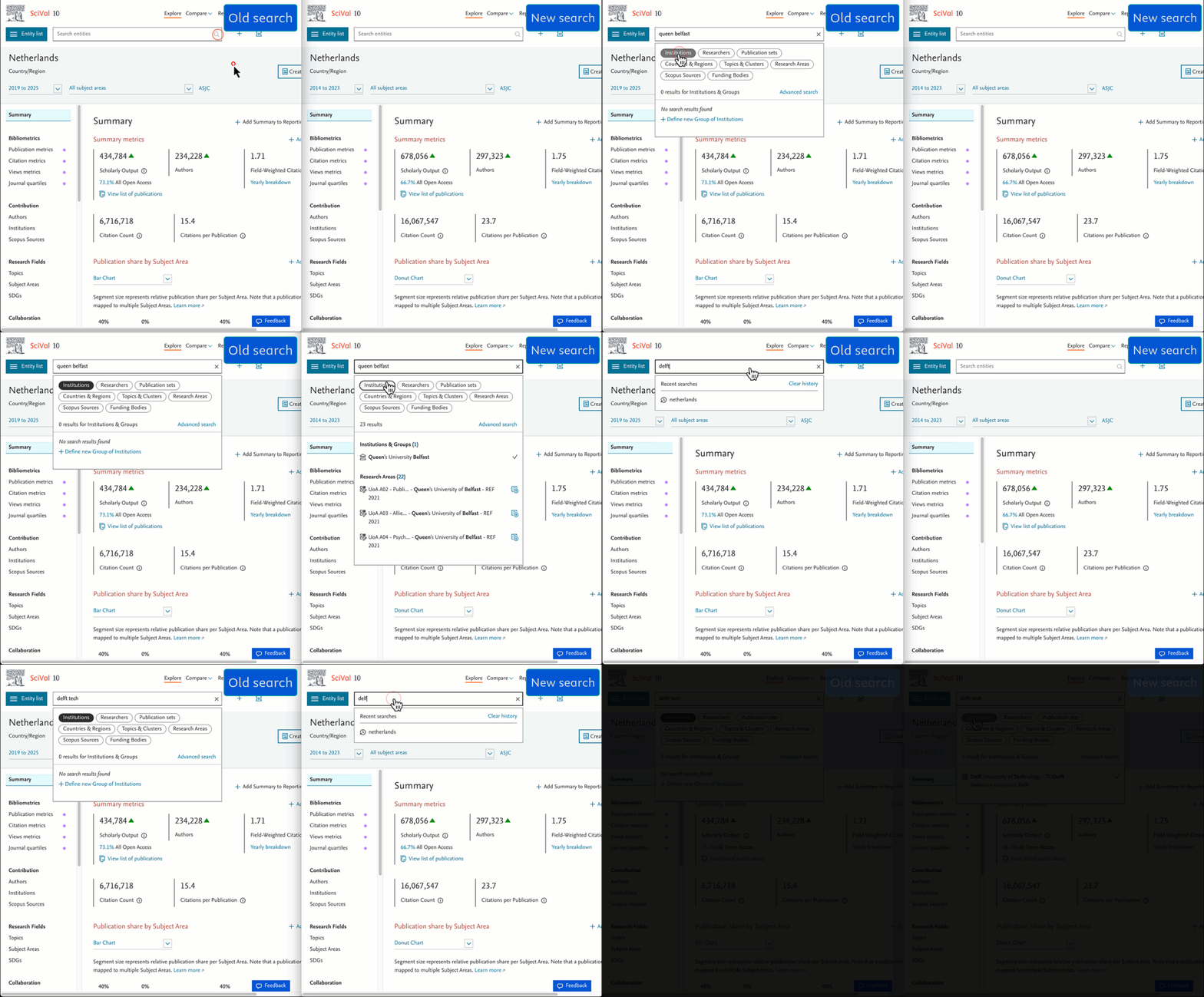
- Improved search methodology in the global search and entity panel
To allow for more flexible search results, the Global Search and entity panel search will now focus on key words within the searched text to show a more comprehensive list of results. In addition to exact matches, the search will now also return partial matches and matches that do not correspond to the order of search terms. It will also allow matching when characters such as commas and apostrophes are omitted. With these improvements, entities will be easier to find even if the search terms do not match the entity name exactly.
The improvements apply to Institutions and Groups, Researchers and Groups, Country Groups, Publication Sets, user-defined Research Areas, and Topic Groups.
- Impact - Uncover Hidden Patent Links with Main Patent Families
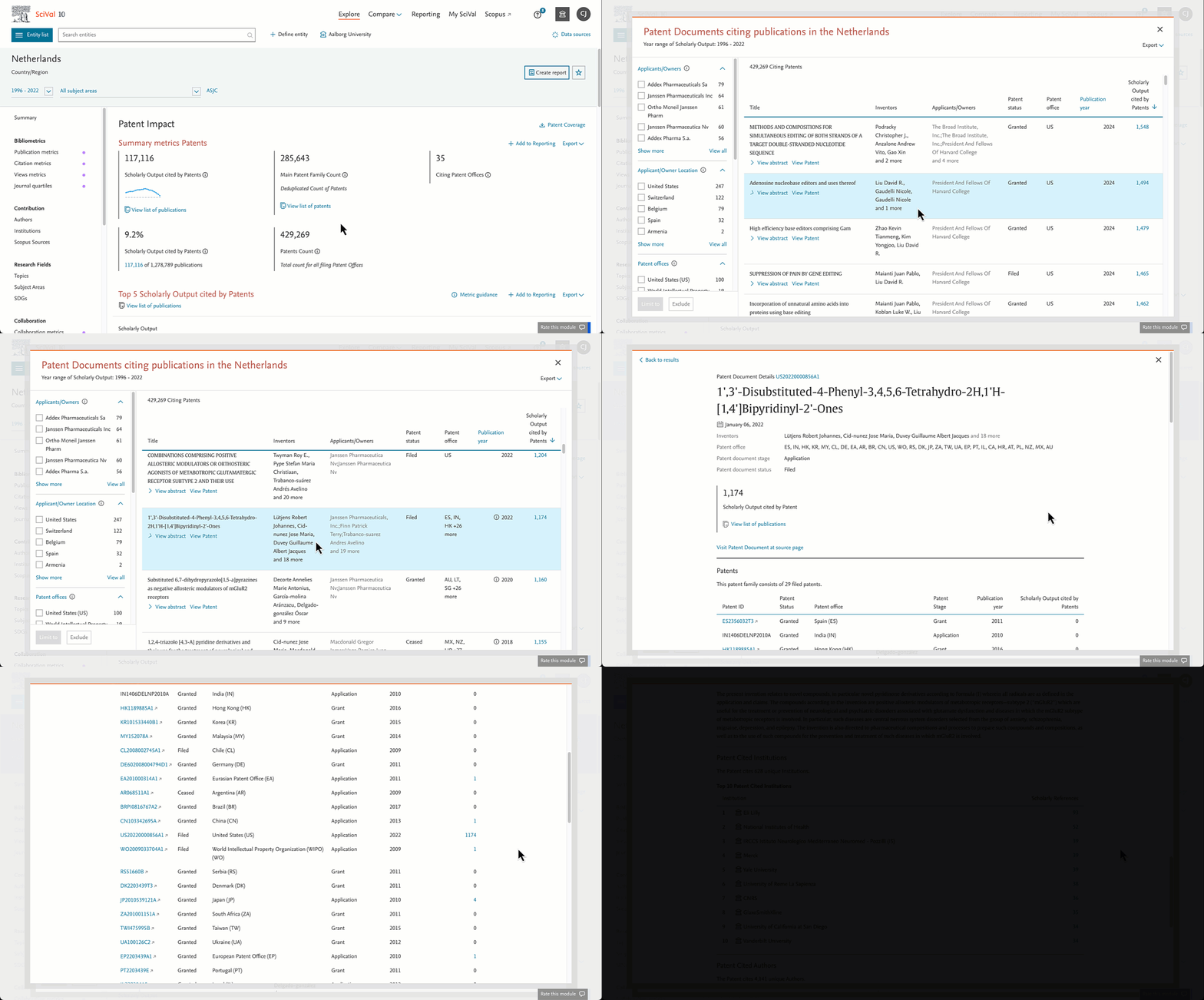
SciVal has added the Main Patent Family* to Impact, offering the following benefits:
- Discover Hidden Patents: Gain insights into patents that are part of a Main Patent Family citing your research. Understand the broader impact of your research with patent offices in countries such as Canada, India, Brazil, Mexico, and 35 others now linked to Main Patent Families citing scholarly outputs.
- Unique Patent Count: Obtain a count of unique patents citing your research. Previously, the patent count could include duplicates when a patent was filed in multiple jurisdictions.
- Alignment with THE WUR Patent Data: SciVal now aligns with the THE WUR patent data, providing a deduplicated view of citing patents in the publication modal. Full details are available in the patent document modal and export options.
*A Main Patent Family is defined when an inventor files the same patent in multiple patent offices. For example, if an inventor files a patent at the European, Canadian, and Irish Patent Offices, the Patent Family for this patent includes all three offices (total count: 3). The Main Patent Family Count in this case would be 1.
- Analyze Institutions’ Funding Bodies by acknowledgement-linked publications
Explore and understand the funding source and wider contributors to a publication through acknowledgment-linked publications. Linked publications are publications where we are able to establish a link to a Funder Organization in our taxonomy. The contribution could be financial or non-financial support to conduct research, development or innovation work.
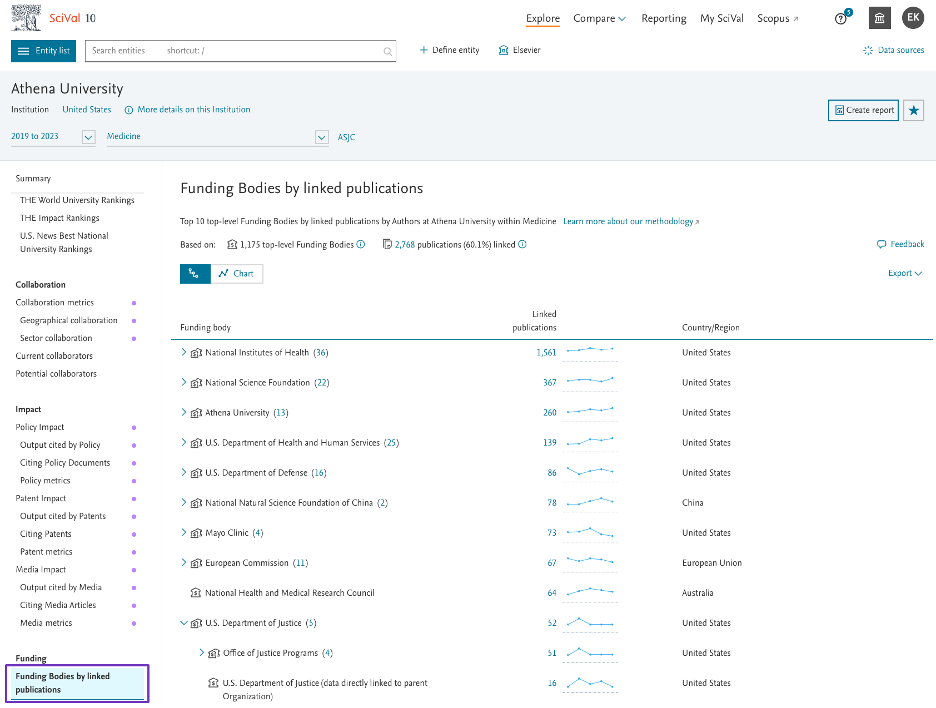
Acknowledgement-linked publications, available on ‘Funding Bodies by linked publications’ page, can be used as a proxy to understand the composition of an Institution’s funding portfolio overall or per Subject Area. It is also possible to further analyze and benchmark an Institution’s linked publications per Funding Body.
The Top 10, top-level Funding Bodies with a 3-level hierarchy are available for Overview subscribers. The full list is available for Grants subscribers.
Learn more
This new analysis - with much broader Funding Body coverage, replaces the Awards analyses previously available outside of the Grants subscription, which were limited to only 20 Funding Bodies.
- Generative AI (GenAI) powered titles for Topics and Topic Clusters
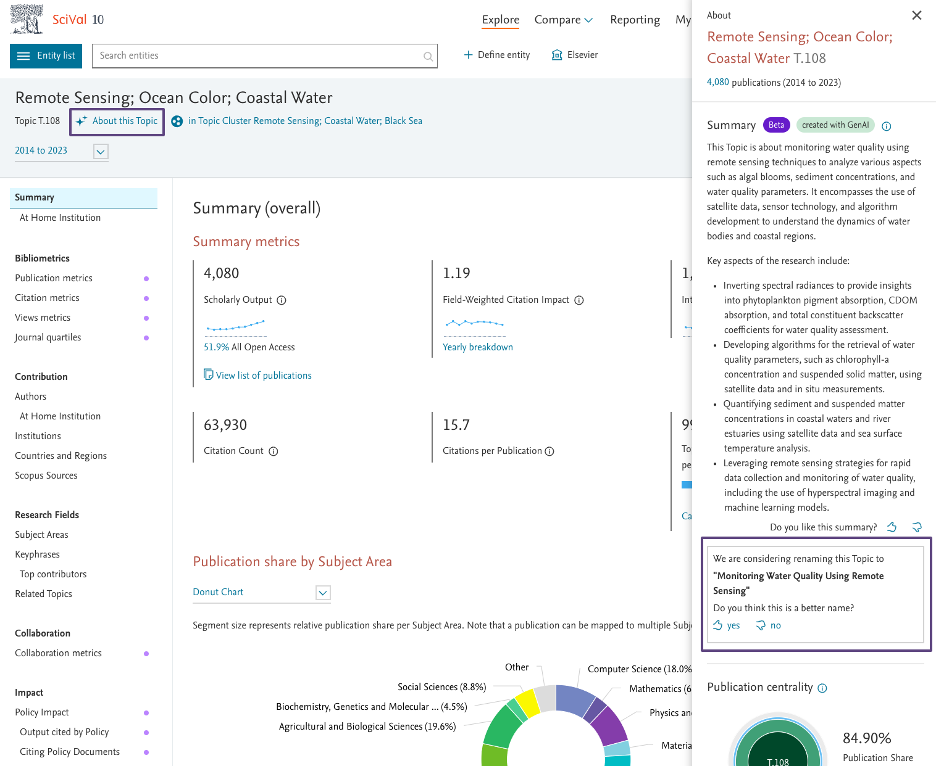
In addition to the summaries, GenAI and LLM powered titles for Topics and Topic Clusters are now available for your feedback. We are considering replacing the current keyphrases-based names with these titles to help you quickly understand the question(s) being addressed within the Topic/Topic Cluster. Learn more about how titles and summaries are created
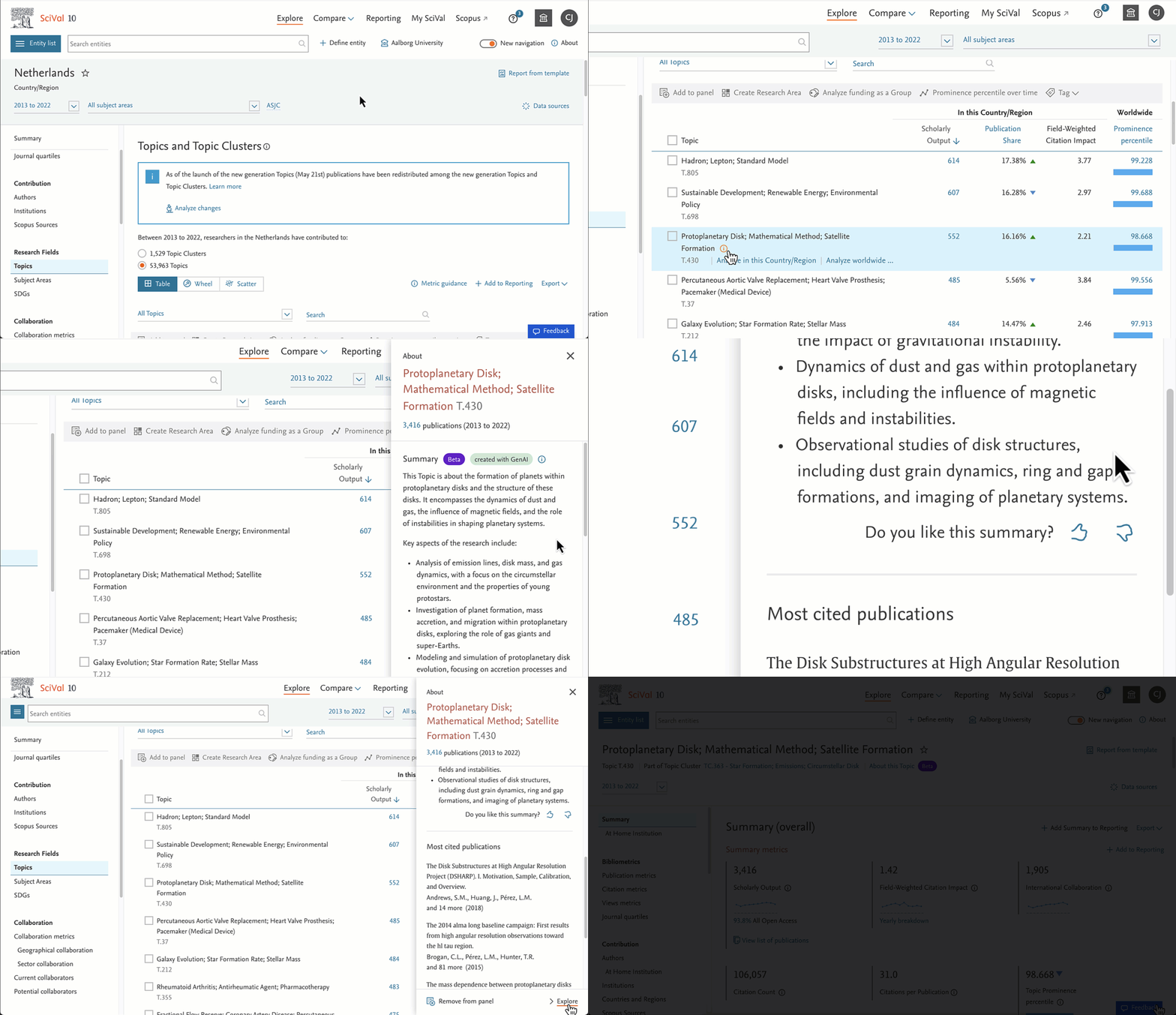
We need your help to evaluate, and further improve on, the titles if needed: you can view the suggested titles and provide your feedback by clicking the “About this Topic/Topic Cluster” link in the Topic entity header, or ‘i’ icon in the Topics’ listings. You can also view them on the Topic/Topic Cluster Summary and Keyphrases pages underneath the keyphrases word cloud.
- Share metric sets with others at your Institution
Share your saved metric sets with colleagues at your Institution. You can now share the sets of metrics you have defined in Benchmark (All metrics) with others who may want to conduct the same Benchmark analysis.
You can share the sets from the Metric Sets page in your Settings to any user at your same home institution. As with other entities, metric sets can be shared with view (use) or edit rights.
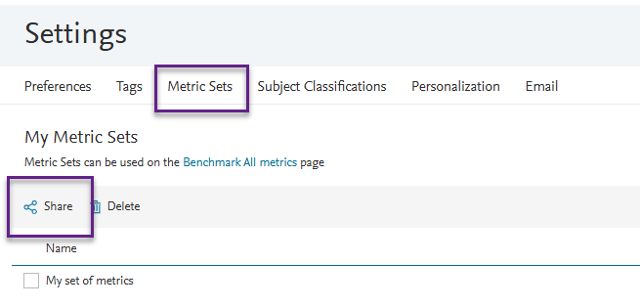
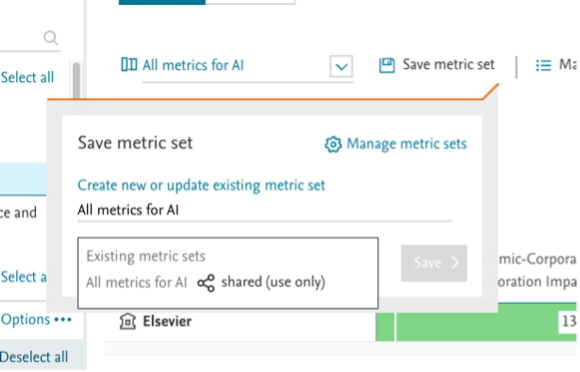
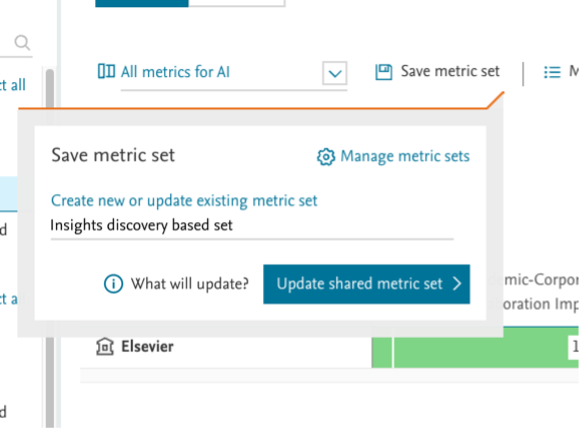
For the , it will indicate in Benchmark (All metrics) that the metric set was shared and whether it can be used or edited.
- Flexible year ranges and additional subject classifications on the Authorship metrics page
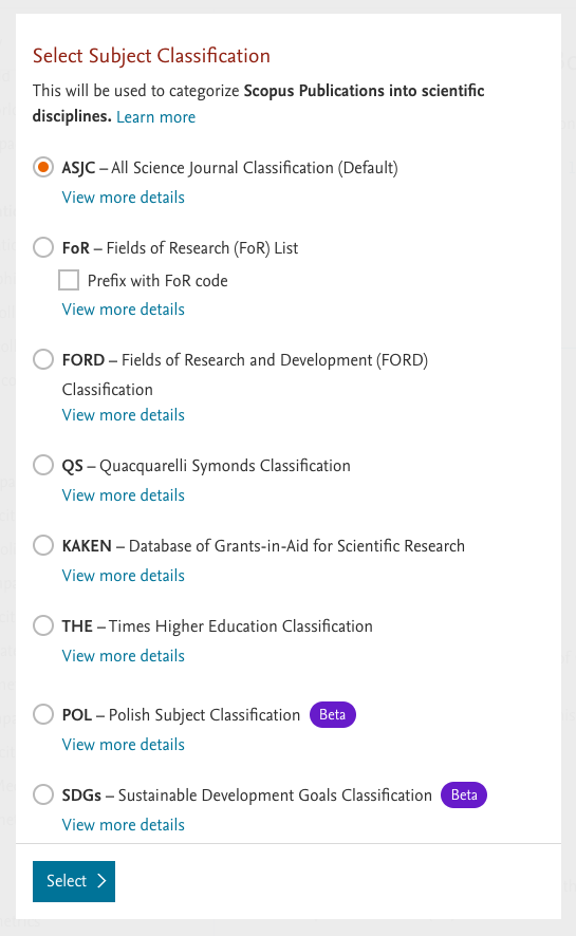
As more SciVal metrics are migrated to new technologies, we are able to offer additional flexibility and functionality on a growing number of Explore pages. With the latest migration, the Authorship metrics page (available for Researcher entities) now offers the flexible year range and additional subject classifications including the Sustainable Development Goals (SDGs).
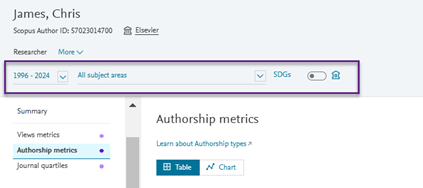
Pages carrying these enhancements are indicated with a purple dot in the left-hand navigation panel in Explore.
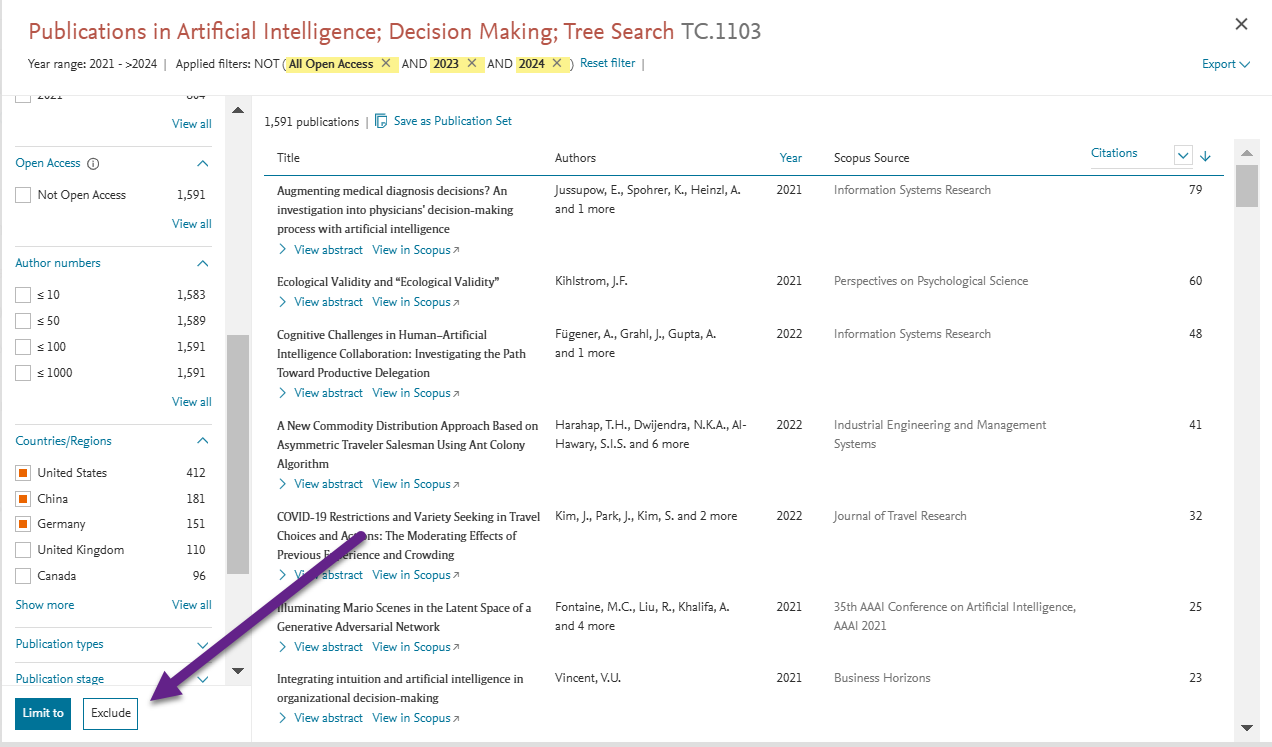
- Enhanced filtering options in publication modals and in Impact fly-ins
You can now view detailed lists of publications with more specific options by using the new filter feature available in all publication modals, as well as in the filter fly-ins on Impact pages. In addition to the ability to limit results based on filter selections, it is now also possible to exclude values from the results.
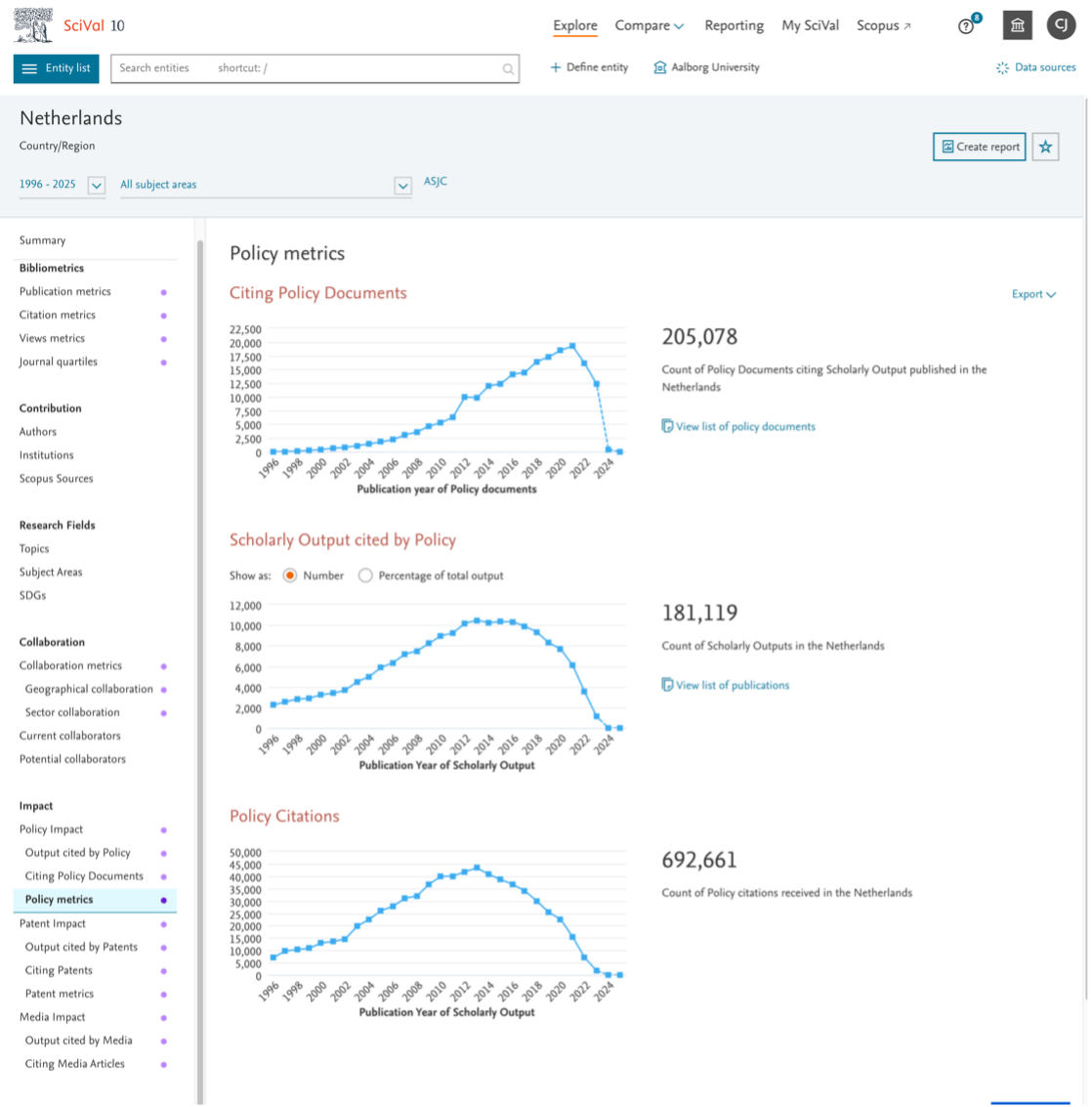
- Policy Metrics page in Impact
Understand the policy impact of your research with new metric visualizations. View citing policy documents, scholarly outputs cited by policy, and policy citation charts all on one page, and export the data for further analysis.
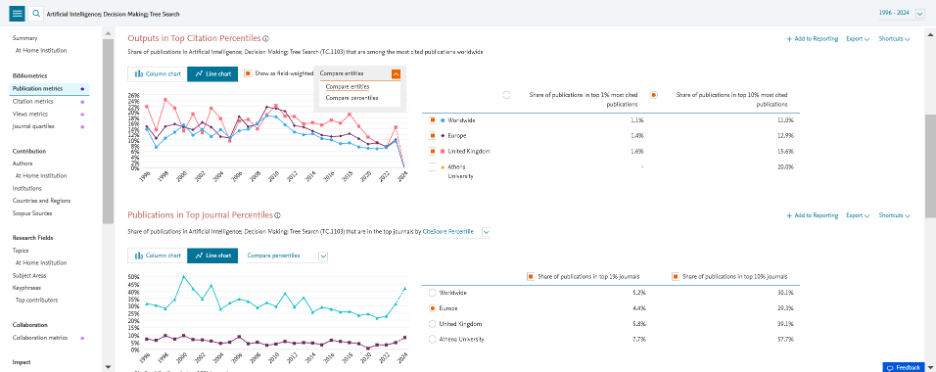
- Updated and additional chart visualizations across Explore pages
We have enhanced several visualizations on the Explore pages to make the charts easier to read. These changes help accommodate the wider year range available on select Explore pages and offer more options for users to choose from.
Depending on the entity and metric you look at, we have either replaced existing column charts with line charts or have added line charts in addition to existing column charts as a second option. The latter applies to charts that offer regional breakdowns and the option to compare different metric percentiles (Output in Top Citation Percentiles, Publication in Top Journal Percentiles, Output in Top Views Percentiles for Custom Research Areas, Topics, and Topic Clusters). These line charts offer the option to compare either entities, or percentiles, against each other.
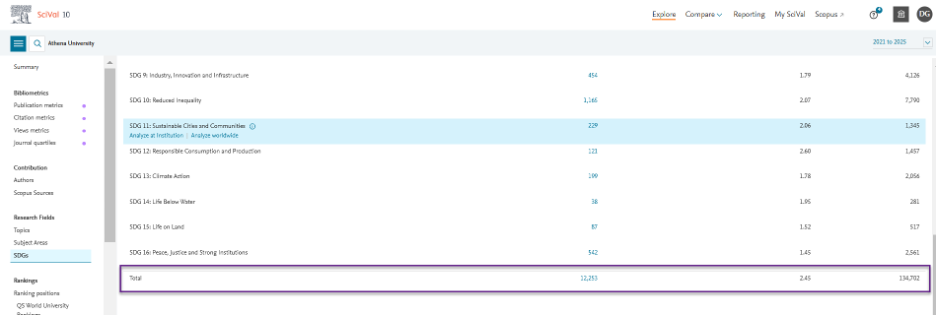
- Analyze all publications that contribute to the Sustainable Development Goals for Institutions
From the SDGs page in Explore, you can now analyze the total deduplicated Scholarly Output that an institution has contributed to the SDGs, as well as the overall Field-Weighted Citation Impact and Citation Count. The Scholarly Output metric supports the publications modal, allowing you to drill down further into the underlying publications.
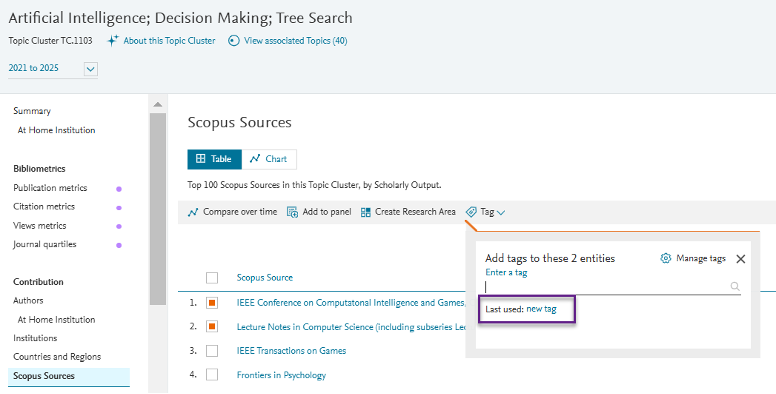
- Improved tagging functionality: “Last used” tag option
SciVal now remembers your last used tag and offers it for selection when tagging entities across the product, making it quicker to reuse the same tag across different entities without the need to repeatedly type it.
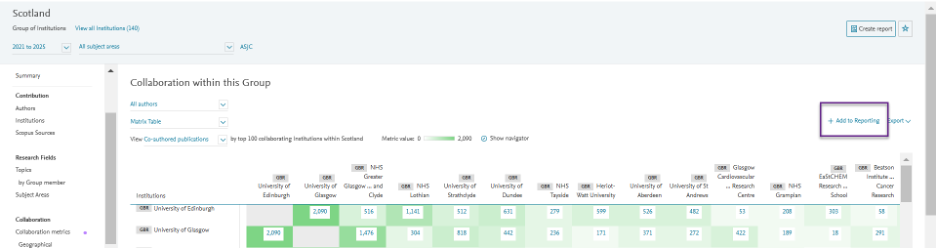
- “Add to Reporting” for all Institution Groups on the “Collaboration within this Group” page
Previously, Reporting functionality for Institution Groups on the “Collaboration with this Group” page only supported Groups with less than 20 members. This restriction has now been lifted, allowing you to create Reporting analyses for Institution Groups of any size.
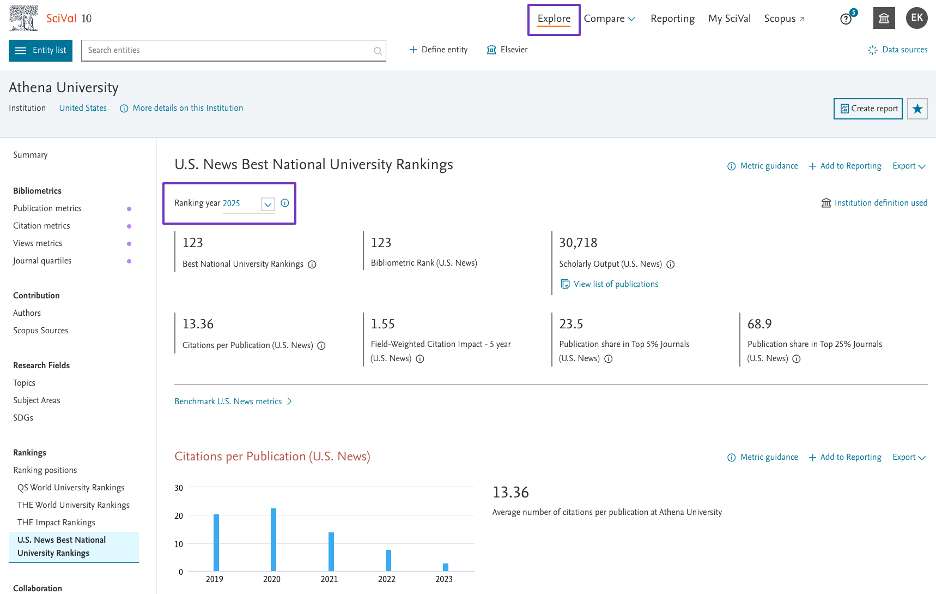
The second phase of the Xeriscape release adds the bibliometric dataset underlying U.S. News Best National University Rankings 2025.
- U.S. News Best National University Rankings 2025 bibliometric dataset is available to analyze
Building on the recent launch of the U.S. News Rankings 2024 bibliometric dataset in SciVal, you can now analyze the bibliometric dataset used in the U.S. News Best National University Rankings 2025 (released on September 24th, 2024). Get a deeper understanding of the drivers behind the U.S. News specific bibliometrics (Citations per Publication, FWCI, Publication shares in top 5% and 25% journals by CiteScore) contributing 4% to the overall ranking.
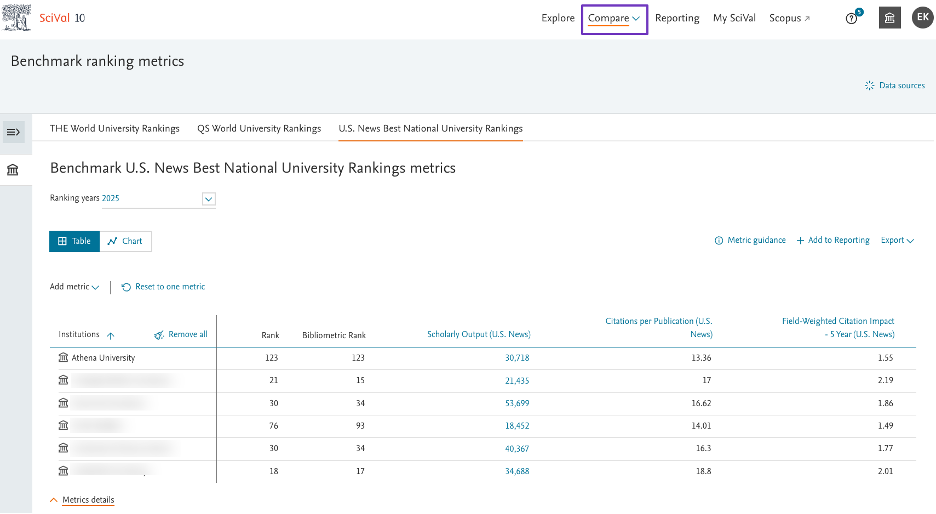
Compare the performance of peer institutions in Benchmarking using the rankings data from 2024 and 2025, and easily export this data for comprehensive reporting and informing rankings strategies.
The October 2024 release is dedicated to xeriscaping – the method of landscaping and gardening to reduce the need for irrigation, emphasizing the use of plants appropriate to the local climate such as drought-resistant plants. By reducing or eliminating the need for irrigation, xeriscaping contributes to water conservation, reduced energy use and a lower carbon footprint.
The Xeriscape release brings you the bibliometric dataset underlying the THE World University Rankings 2025, enhancements to Collaboration analyses across SciVal, Policy Impact improvements and more.
Stay alert for the soon to follow release enabling you to explore the bibliometric dataset underlying the U.S. News Best National University Rankings 2025.
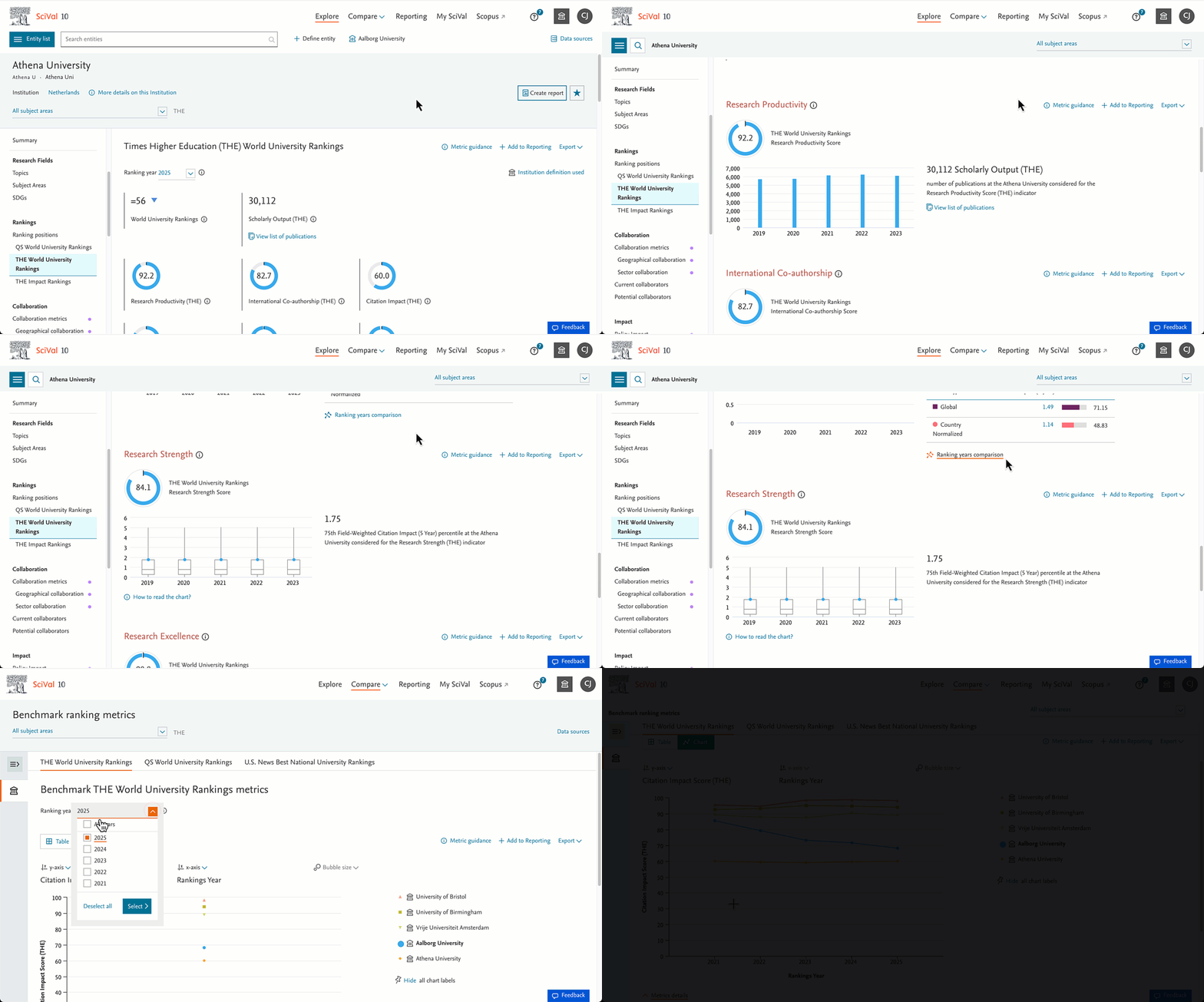
- THE World University Rankings 2025 bibliometric dataset is available for analysis and benchmarking
We are excited to provide access to the bibliometric dataset underpinning the THE World University Rankings 2025 (announced on October 9th, 2024) in SciVal. Gain insights into the bibliometric dataset underlying your institution’s rankings scores and analyze the factors that contribute to 40% of the overall ranking. Compare your performance to peer institutions in Benchmarking across multiple ranking years and easily populate the comparison table using the predefined metric sets.
- Collaboration analyses improvements
We have made a number of enhancements to Collaboration analyses across SciVal:
Collaboration matrix:
- New layout of the header section to increase usability: Most notably, it is now possible to remove hyper-authored papers from your analysis across a number of preset limits, in addition to setting a custom limit.
- Start from any level of a Researcher Group hierarchy to select subgroups for analyses: The chevron beside the Group in the entity panel will open the hierarchy of sub-groups to select for analysis.
Geographical and sector collaboration:
- Addition of the home institution filter to researcher pages: It is now possible to filter results to show only publications affiliated to the home institution on both pages.
- The yearly breakdown on the Geographical Collaboration page now supports publication links to Scholarly Outputs.
- Enhancements to exports and Reporting analyses: these will now reflect the selections made on the yearly breakdown table and include the totals.
- Policy Impact improvements
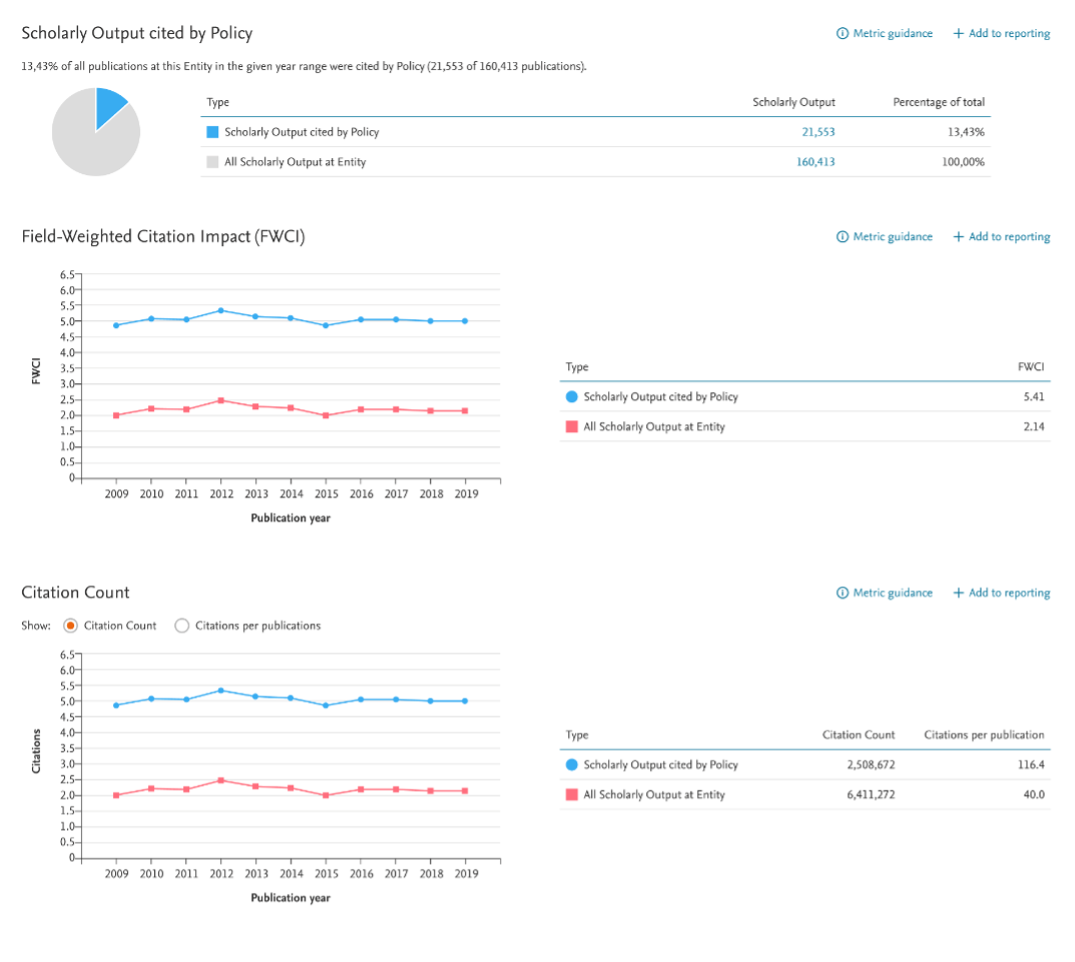
We have enhanced the "Analyze in More Detail" section in the Policy Impact page with an expanded set of metrics. You can now view academic citation and FWCI trends over time for publications cited in policy documents, compared to all publications from the entity.
- Other release items:
- Additional export options for Overview analyses: you can now export page specific analyses from the Overview module, to limit the export to the page you are exporting from. “Summary” page export remains available to export all Overview module analyses across all pages in one go.
- Topics page: You can now export the full list of an entity’s Topics or Topic Clusters, removing the previous 500 Topic limit.
- Entity header redesign: we have updated the entity headers for all entity types in Explore, to make it easier to find relevant information about the selected entity. In addition, we have added the Scopus author id for Researchers for transparency.
- And standby for some follow up Xeriscape release items next week allowing you to analyze the U.S. News Best National University Rankings 2025 bibliometric dataset.
With the September release we want to encourage you to opt for a walk instead of a drive when possible. Walking offers multiple physical and mental health benefits, while also reducing your carbon footprint.
The Walk release brings you flexible year ranges and additional subject classifications on several Explore pages, U.S. News Best National University Rankings 2024 bibliometrics insights, expanded institutional sharing functionality and more.
- Enhance your analyses with flexible year ranges and additional subject classifications on several Explore pages
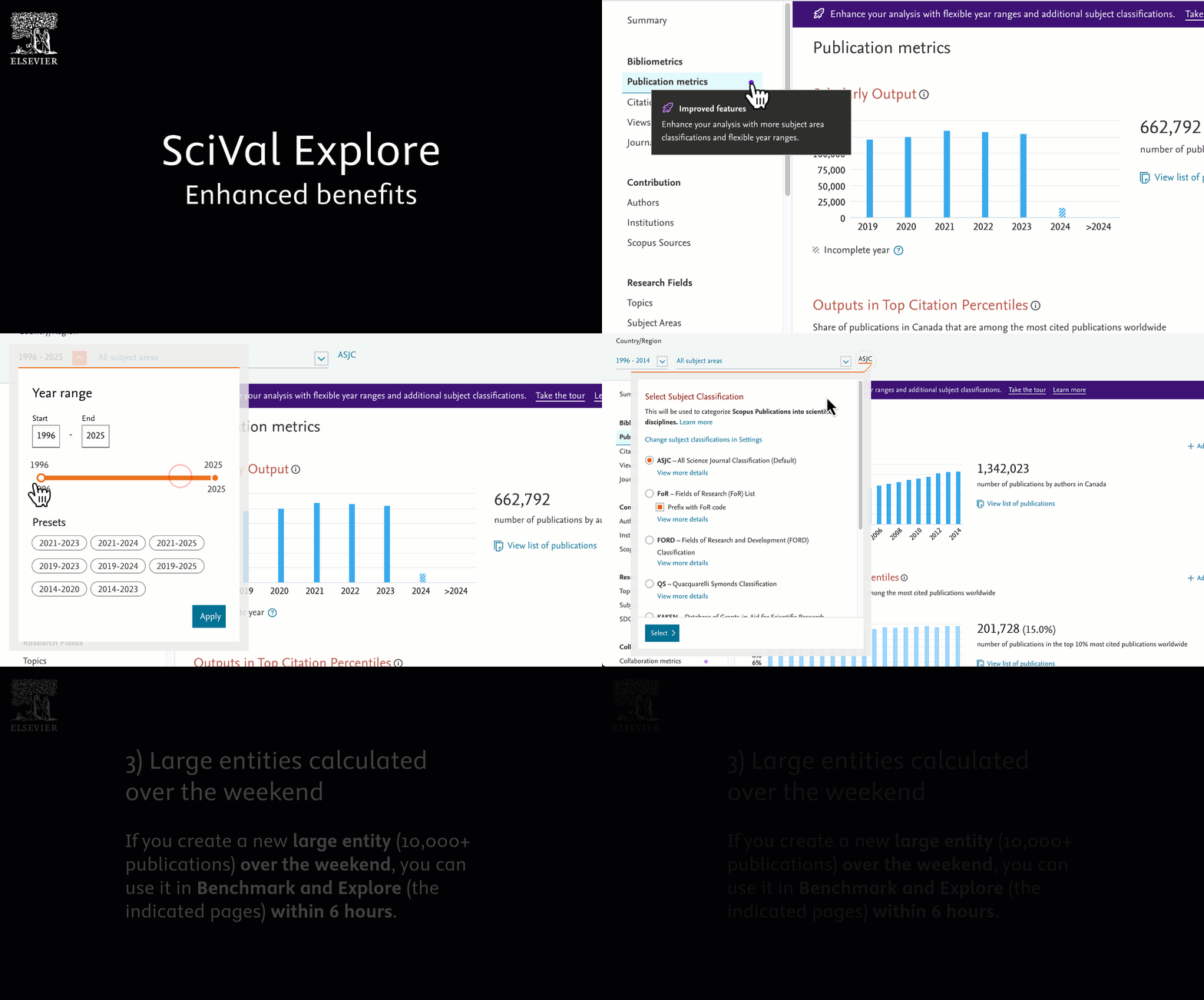
As SciVal metrics are migrated to new technologies, we are able to offer additional flexibility and functionality on Explore pages. With the latest migrations, for the Bibliometrics, Collaboration metrics and Impact pages, you can now get:
- Flexible year ranges: Chose any year range between 1996 to present or select from preset year ranges suggested by SciVal.
- More subject classifications: Select the Sustainable Development Goals (SDGs) and Polish subject classifications to filter your analyses.
- Quicker access to these analyses for your user-defined entities during the weekend as large user-defined entities (10k to 200k publications) can be computed during the weekly calculation process (Fridays to Mondays) and will become available within 6 hours.
Pages carrying these enhancements are indicated with a purple dot in the left-hand navigation panel in Explore and a banner at the top of the page.
We will continue to expand the number of pages benefiting from the new technologies over time.
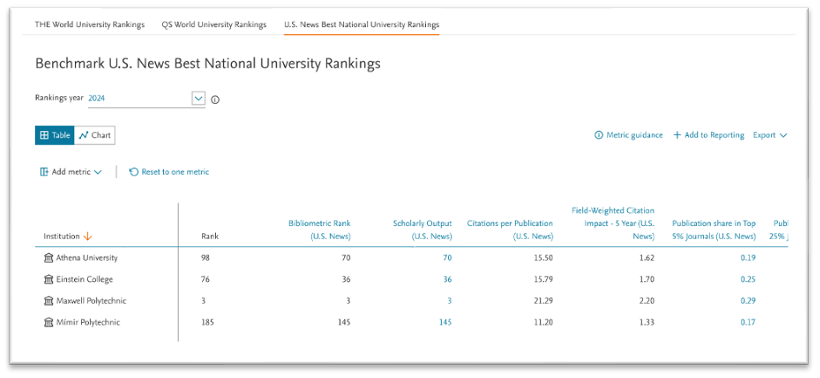
- U.S. News Best National University Rankings 2024 bibliometrics
We are excited to launch access to the bibliometric datasets used in the U.S. News Best National University Rankings (part of the U.S. News Best Colleges Rankings) 2024 in SciVal. Now, you can generate insights based on the actual bibliometrics considered by U.S. News & World Report for over 443 colleges in the US (announced on September 18th, 2023). Analyze the drivers behind the U./S. News specific bibliometrics (Citations per Publication, FWCI, Publication shares in top 5% and 25% journals by CiteScore) contributing 4% to the overall ranking. Export the data and add to reporting to explore further or produce management-level summaries.
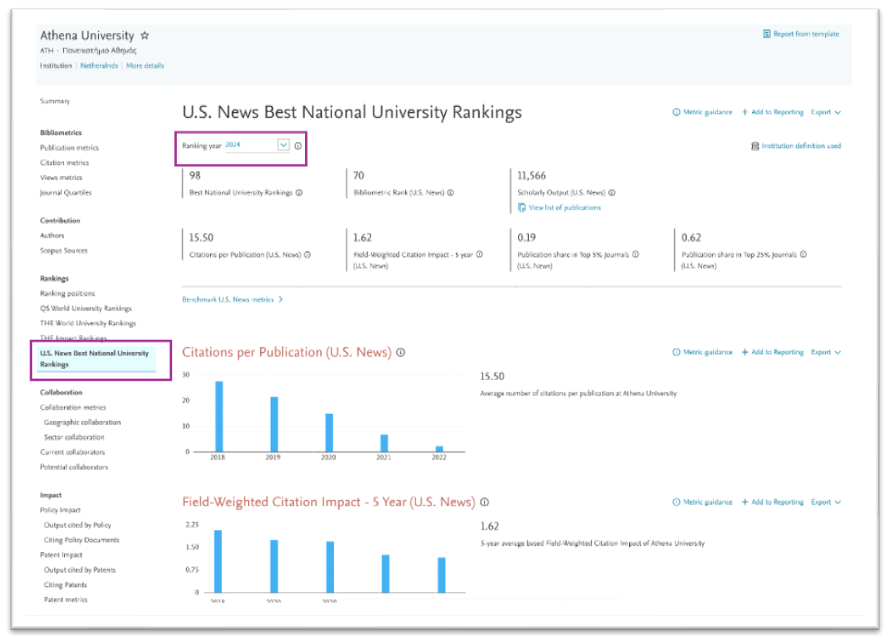
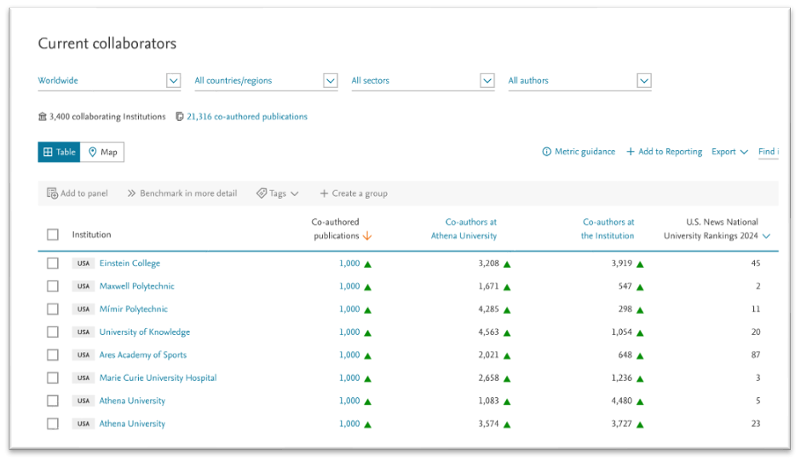
Benchmark your institution’s performance against peers with 7 U.S. News indicators in Compare and access the U.S. News ranking performance as a new metric in collaboration.
- Share Research Areas and Publication Sets with users across your institution (SciVal Admins)
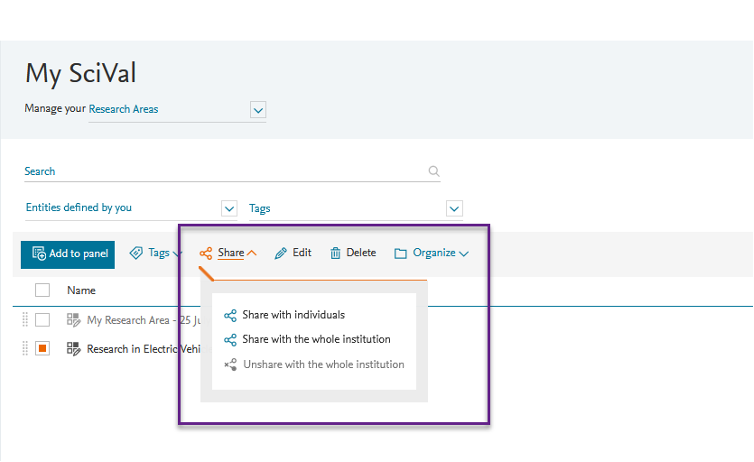
Institutional sharing, which was previously limited to Researchers and Groups, and Report Templates, has been expanded to Research Areas and Publication Sets. SciVal users with admin privileges can now make their Research Areas and Publications Sets available to all users at their institution. To share the entities institution wide, select them in My SciVal and choose “Share with the whole institution”.
- Analyze your total output from collaborations with non-academic sector partners
The yearly breakdown on the sector collaboration page now features a “Total” row, facilitating analyses on all outputs from collaborations with non-academic sectors, or any combination of sectors. Totals are available for Scholarly Output and citation metrics.
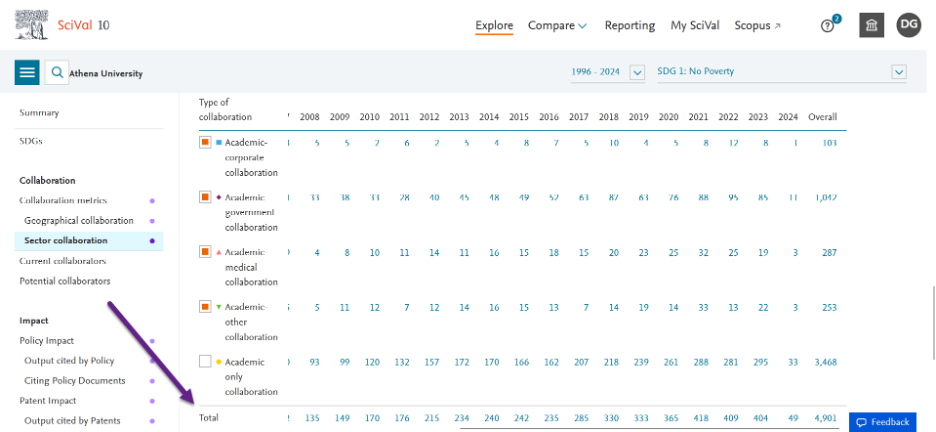
The sector collaboration page is available to users with a Collaboration module subscription.
The theme of the July release is vegetables. With sustainable farming practices, vegetable production results in lower greenhouse gas emissions and requires less land and water per equivalent unit of food compared to animal products. Vegetables are also a rich source of vitamins, minerals, fiber and antioxidants making them a key component of a healthy diet that would be great to increase the consumption of.
The Vegetable release brings you quicker access to large user-defined entities during the weekly calculation, QS World University Rankings 2025 enhancements, ability to analyze an Institution’s acknowledgement linked publications by Funding Body across all subject classifications and more.
- Quicker access to large user-defined entities for Benchmarking and Impact analyses
New technology means large user defined entities from 10k to 200k in size can now be calculated during the weekly calculation (Fridays to Mondays) meaning they are available earlier in Benchmark (all entities) and Impact subscription related pages.
You will receive an email once your entity is available in Benchmarking and Impact, and a second email when it’s available everywhere. To manage your email preferences, go to Settings, ‘Email’ tab.
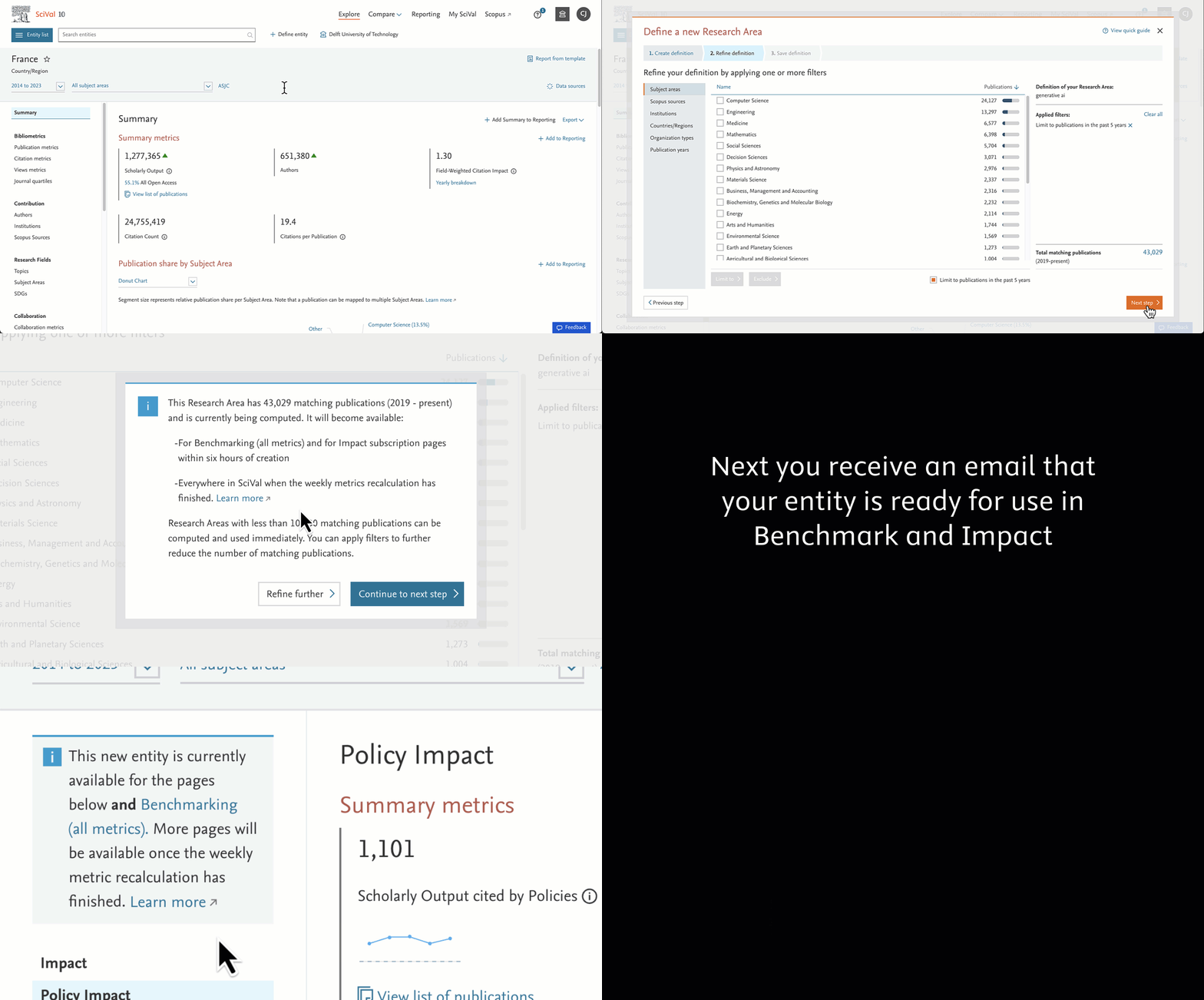
- QS World University Rankings 2025 enhancements
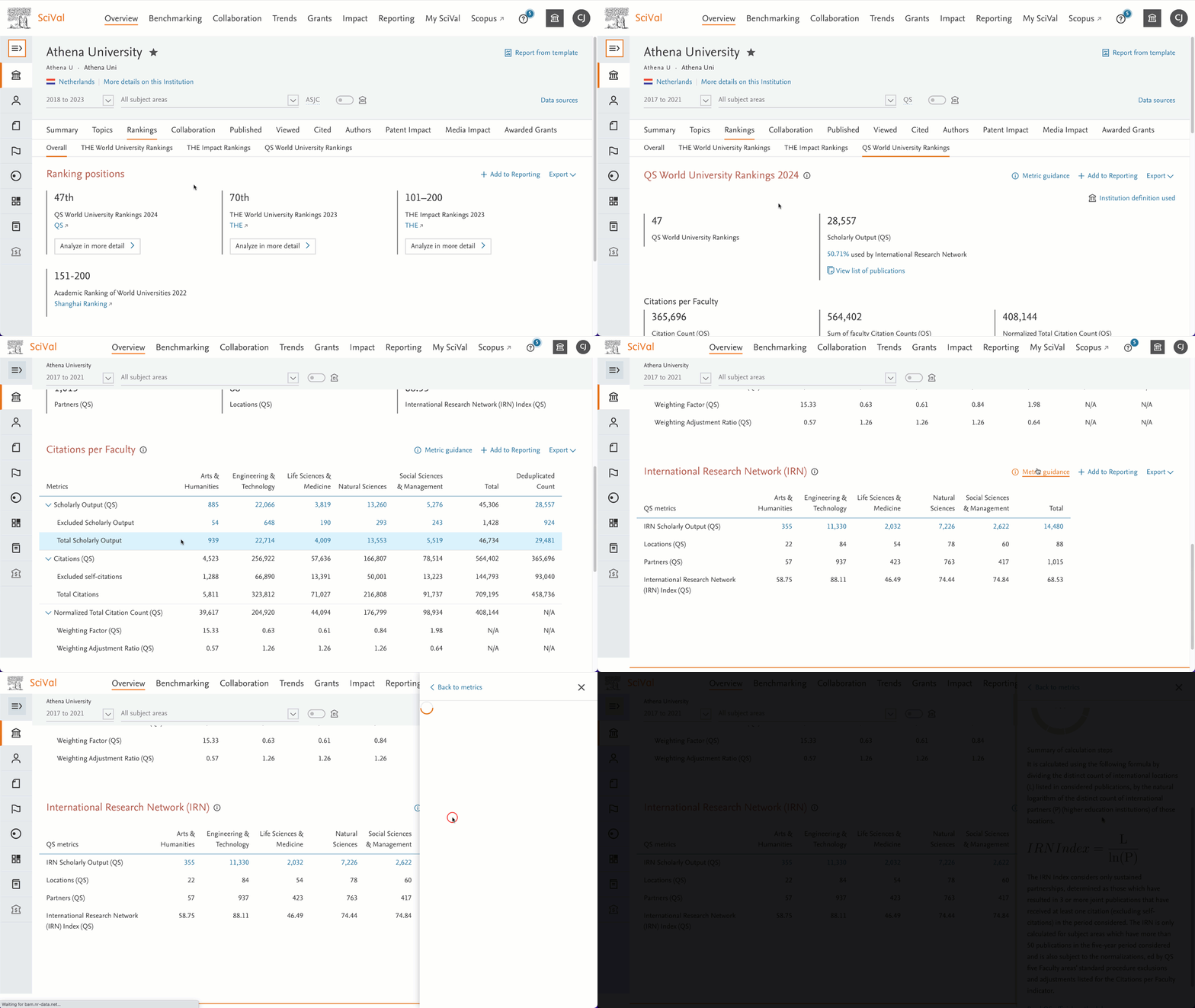
Discover the newly added enhancements to the QS World University Rankings 2025, designed to provide more transparency and enable deeper analysis.
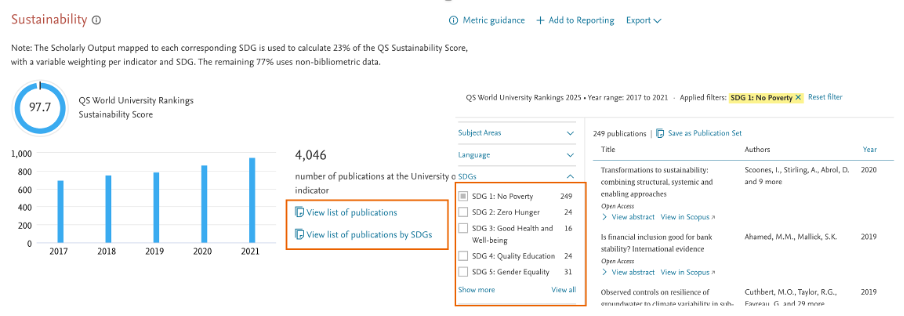
New Sustainability section
Contributing 5% to the overall methodology, you can now analyze the underlying publications for each SDG considered for the Sustainability indicator. View the list of publications per SDG using the filter facets in the left-side panel or by clicking the “View list of publications by SDGs.”
We have also added a new “Sustainability metrics” set in Benchmark to load predefined metrics related to the QS Sustainability indicator.
Ranking Scores for the Bibliometric indicators
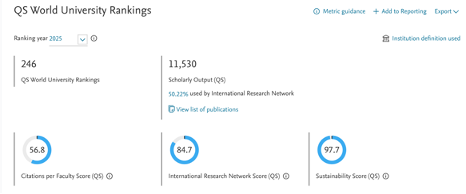
Ranking Scores for each of the bibliometric indicators, including “Citations per Faculty,” “International Research Network (IRN) Index,” and “Sustainability,” have been added to enhance the information and analyses available. Benchmark these scores in Compare using the pre-defined metric set to evaluate your performance to peer institutions.
Locations and Partners
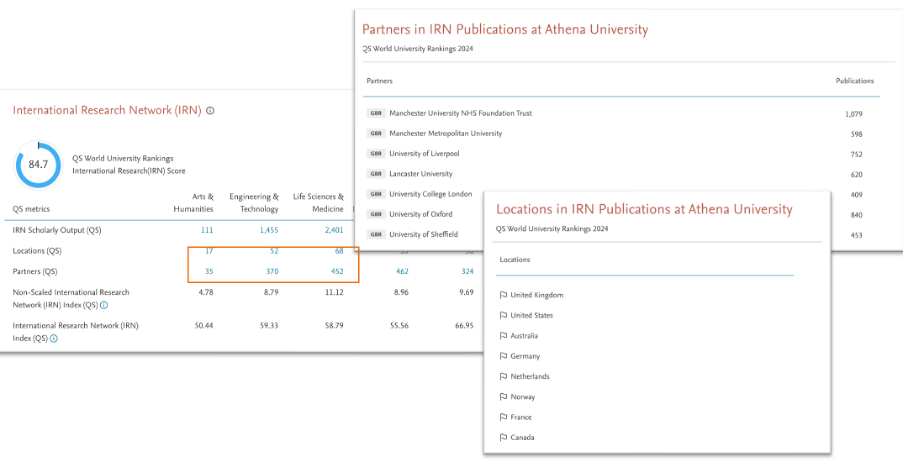
The actual list of Partners and locations considered by QS in the International Research Network (IRN) score has been added for greater transparency and more detailed insights.
- Analyze an Institution’s acknowledgement linked publications by Funding Body with more subject classifications including SDGs
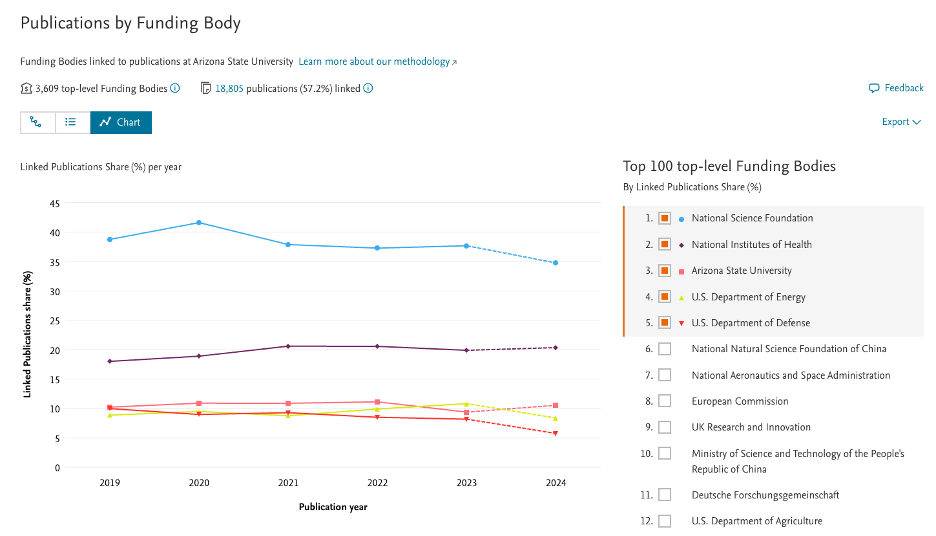
Explore and understand the funding sources and wider contributors to publications related to areas such as the SDGs via the acknowledgment linked publications on Publications by Funding Body page available with the Grants subscription. Available as an overall analysis or per subject area using any subject classification in SciVal, including the UN SDGs, linked publications can be used as a proxy to explore the profile of an Institution’s funding portfolio.
You can also easily analyze the Top 100 acknowledged Funding Bodies and trends over time with the newly added Chart view.
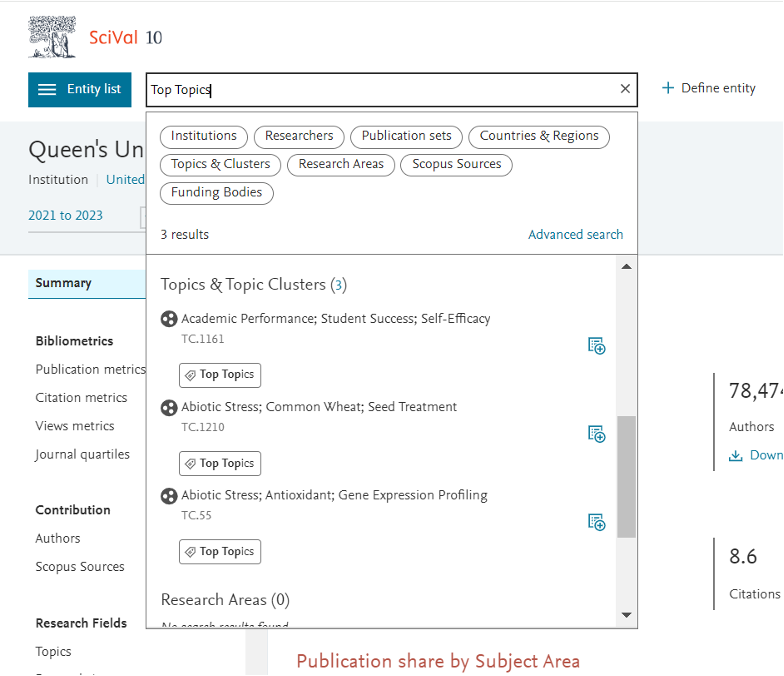
- Search for entities by tags in the Global search
It is now possible to search entities based on tags in the Global search functionality. Simply start typing the tag name and retrieve the top 3 results carrying the tag across all entity types.
- Add the Collaboration matrix to your report templates
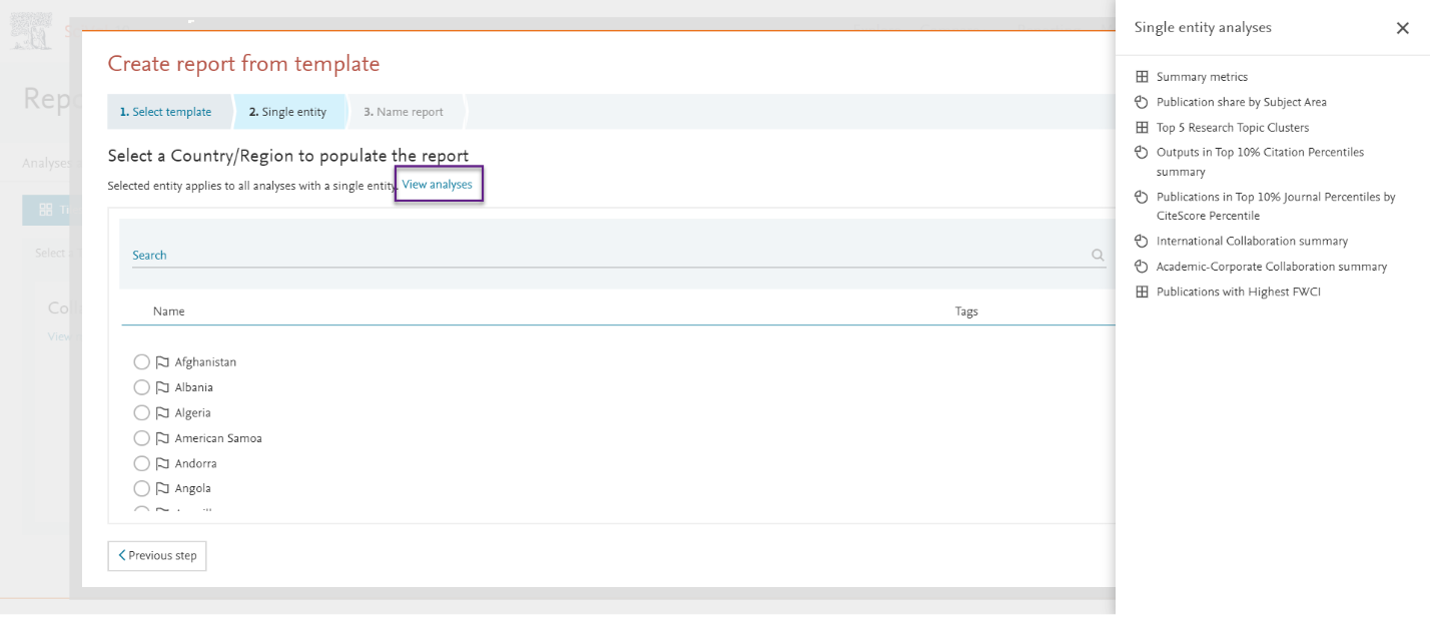
The Collaboration matrix is now available to use in Report templates, letting you save Reports including the matrix as a template which can then be populated with dynamic Researcher Groups of interest.
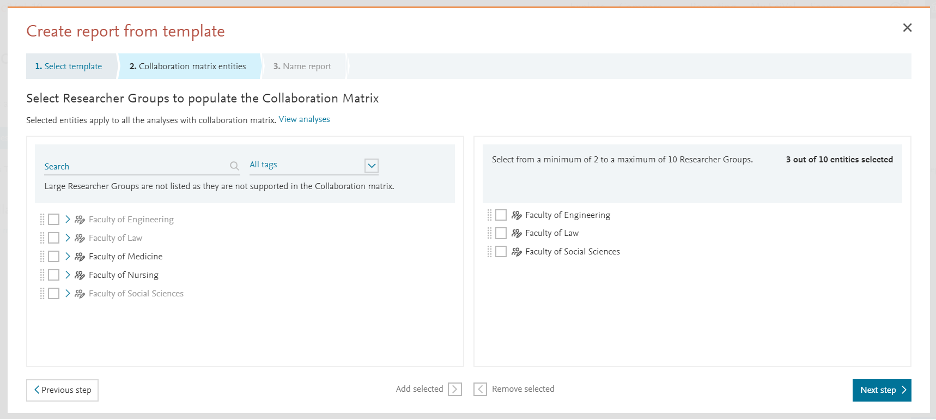
Additionally, we increased transparency in the Report template flow: The “View analyses” link shows you at each step of the flow, which analyses are included and will be applied to your entity selection.
With the June release we want to encourage you to unplug your unused equipment as many electronic devices consume energy even when they are turned off. Every bit of energy conserved helps in the broader effort to combat climate change.
The Unplug release brings you the QS World University Rankings 2025 and THE Impact Rankings 2024, enhancements to the new Topics including “Publication centrality”, and the ability to search across all entity types in Explore with the Global search. Furthermore, the yearly rollover brings you updated year ranges, the latest CiteScore, SNIP and SJR values as well as recalculated Prominence percentiles for Topics and Topic Clusters.
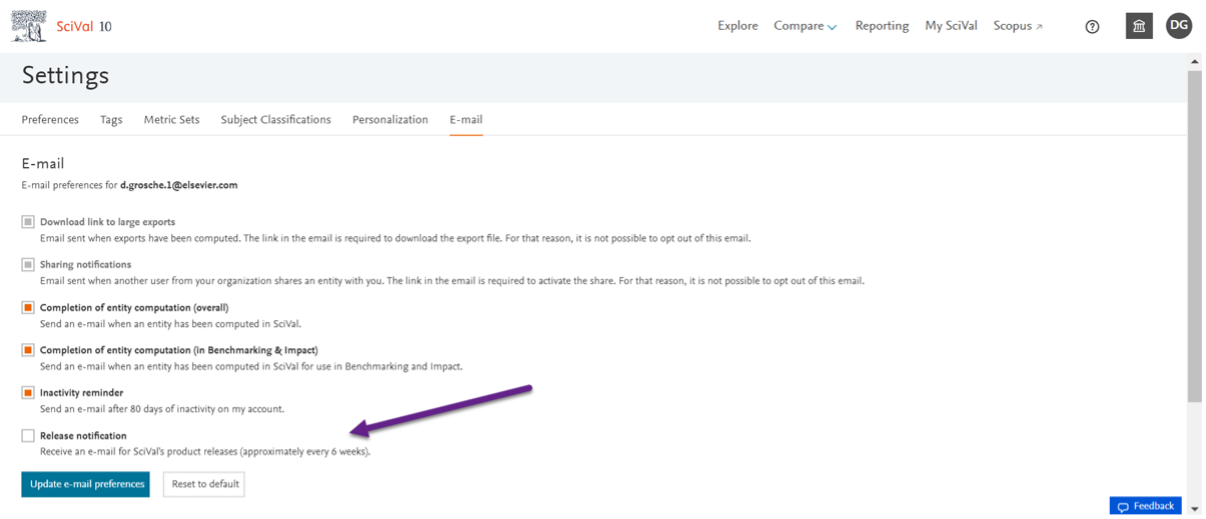
Would you like to stay informed about our upcoming releases? You can turn on email notifications for SciVal releases in your E-mail settings.
- QS World University Rankings 2025
Analyze the bibliometric dataset considered in the recently published QS World University Rankings 2025 (published on June 4th, 2024). Get a deeper understanding of the Citations per Faculty and International Research Network which contributes 25% to the overall ranking. Compare peer institution’s performance in Benchmarking and use the predefined metric sets to effortlessly populate the comparison table.
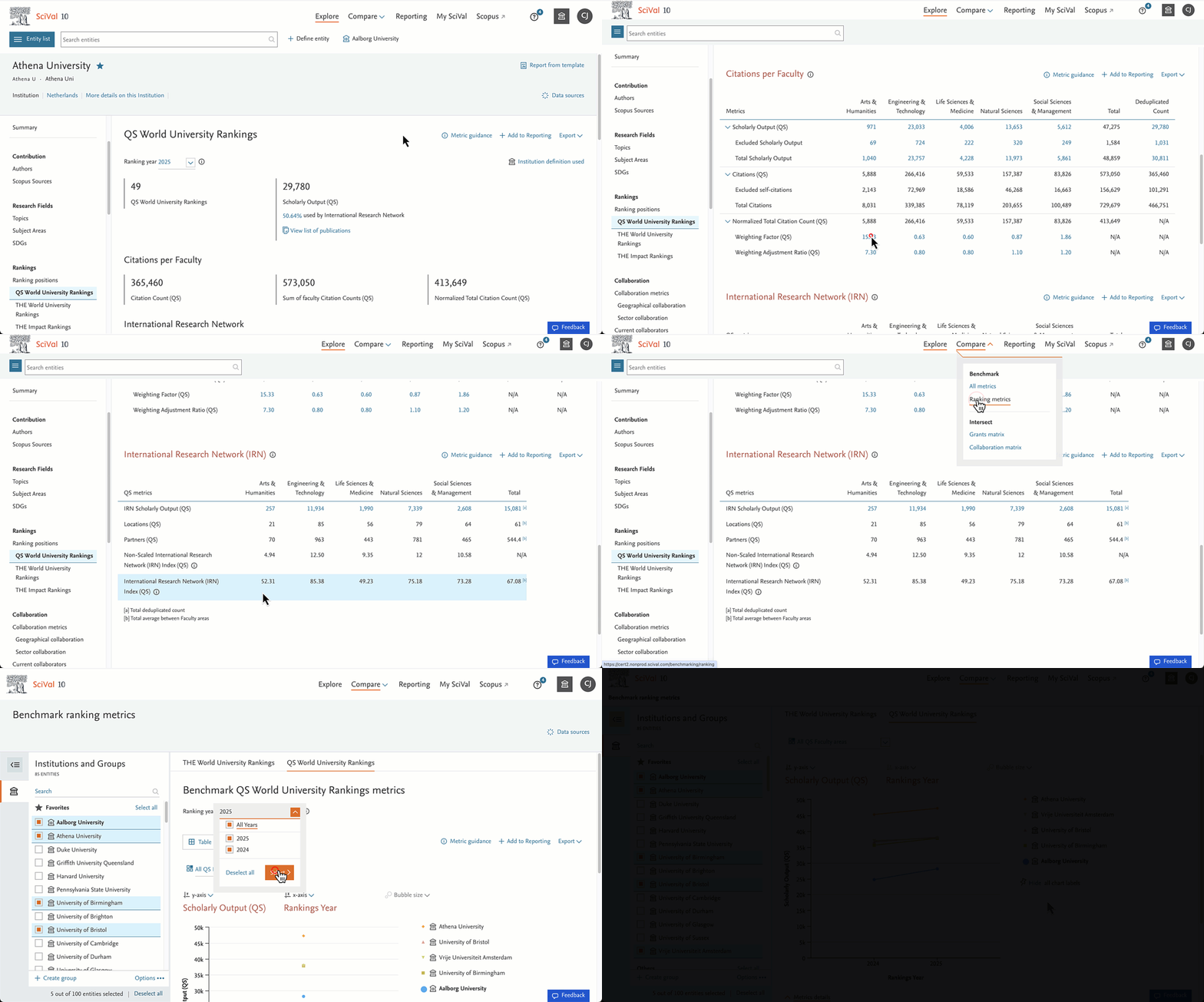
The next release will include enhancements providing more transparency around Locations and Partners. The newly added sustainability performance lens will also be included which contributes 5% to the overall ranking.
- THE Impact Rankings 2024
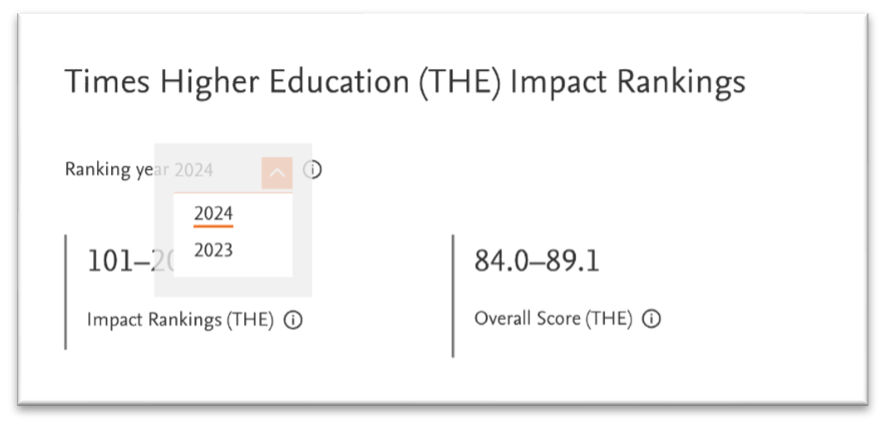
Gain insights on the THE Impact Rankings 2024 centered around the UN Sustainable Development Goals (published on June 12th, 2024). Analyze the research metrics per SDG and the underlying publication set.
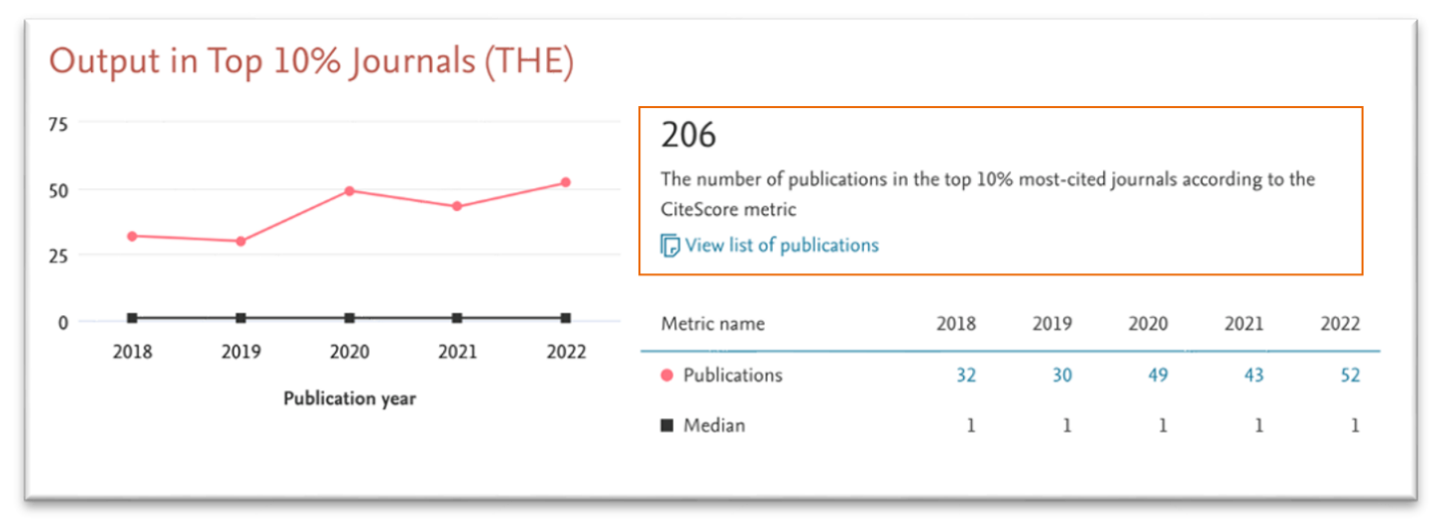
You can now also analyze the publications considered to be in the top 10% of most-cited Journals by CiteScore for greater clarity on the publications being considered in the THE Impact Rankings calculations.
- Search across all entity types with the Global entity search
The Global entity search in Explore eliminates the need to specify which type of entity you are looking for – simply enter your search terms and retrieve the top 3 results across all entity types such as Institutions, Topics and Research Areas. Want to search a specific entity with your search terms, or see all results for an entity type? You can select the respective entity from the search modal to get the full listing.
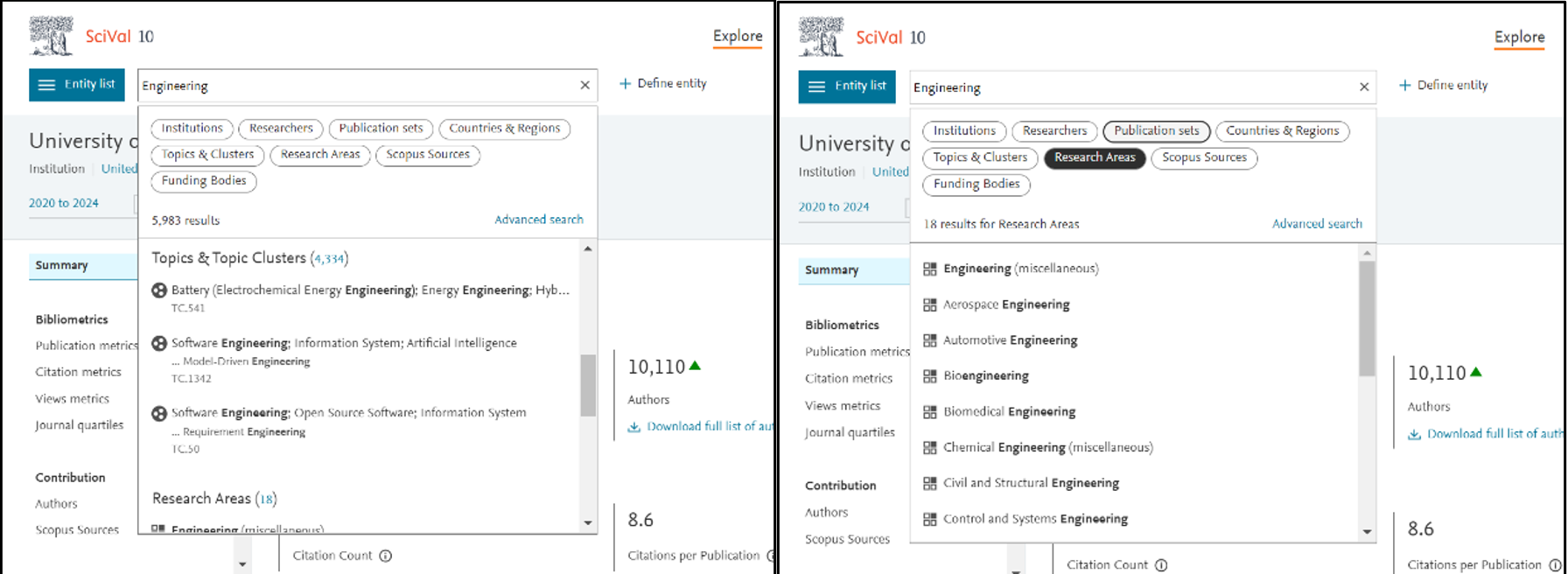
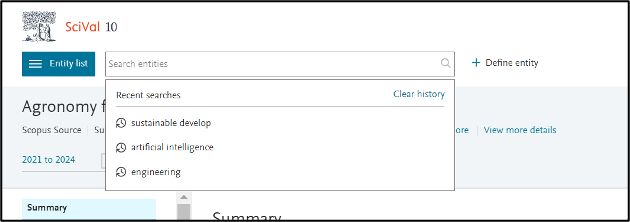
In addition, the new search functionality also captures your search history for the session, making it simple to go back to previous searches instead of having to rerun a search. The search history only captures searches that resulted in the selection of an entity.
The search functionality within the entity selection panel remains available, allowing you to search within a specific entity type as usual.
- Analyze your contribution to newly emerged research fields
Find out if you have contributed to 70 newly emerged Topics, 2024. Newly emerged Topics represent areas of research that have seen a significant growth in recently published outputs, citations and a grant acknowledgement in the past 3 years. You can filter on “Newly emerged Topics for 2024 worldwide” on the Topics page available for subscribers to the Overview module.
Learn more about newly emerged Topics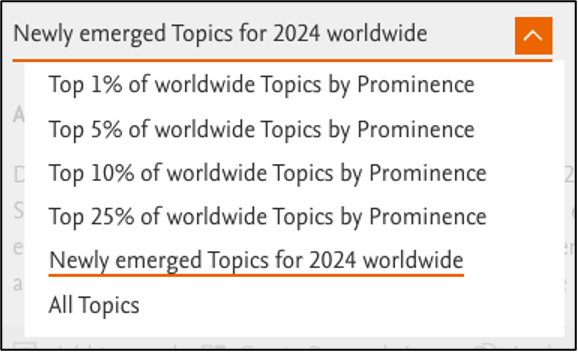
- Uncover adjacent areas of research with related Topics
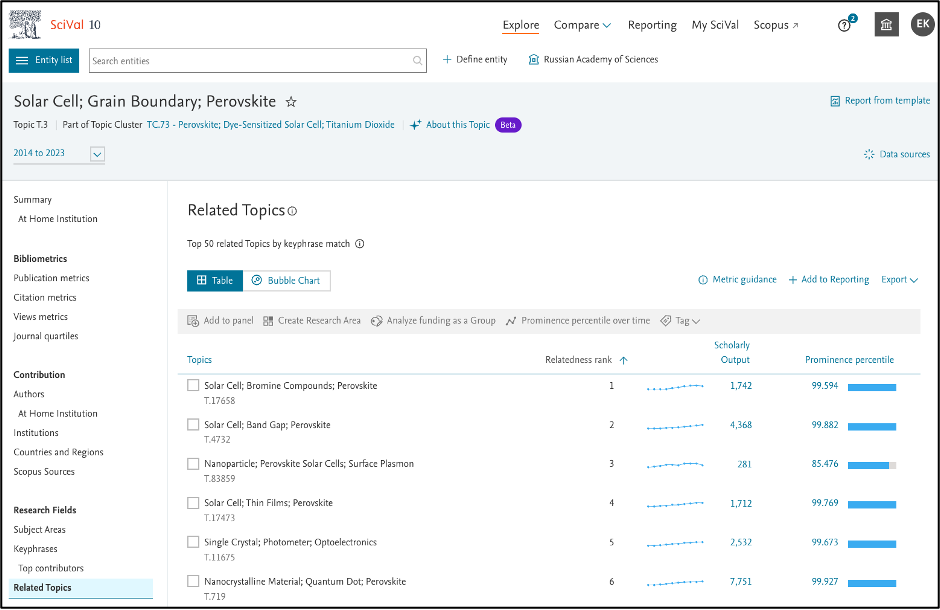
Uncover adjacent fields of research with related Topics that aren't necessarily citing your area of interest. Related Topics cover a similar research interest to the Topic you are looking at based on text analysis. The related Topics page is available for subscribers to the Trends module for the Topic entity. Evaluate the funding landscape in the adjacent fields of research using the funded related Topics page which is available with a Grants module subscription.
Learn more about related Topics
- Identify core and more peripheral publications in a Topic with publication centrality
Understand how condensed or diffused a Topic is by analyzing how strongly publications are linked to a Topic. You can distinguish between core or more central and more peripheral publications in a Topic based on the strength of their link to the Topic and analyze them further. The centrality details can be accessed by clicking the “About this Topic” link in the Topic entity header, or ‘i’ icon in the Topics’ listings.
Learn more about publication centrality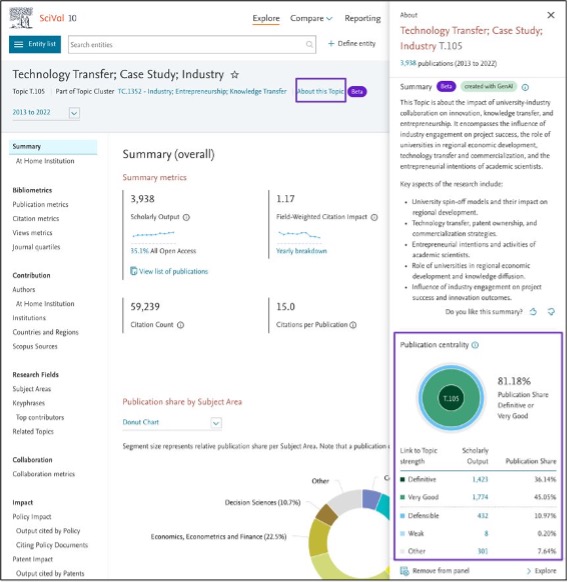
- Yearly rollover
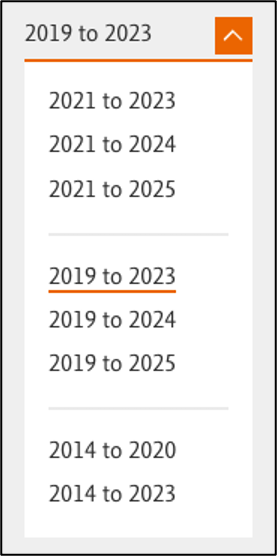
Each year in June, the Scopus content for the previous year (i.e. 2023) is over 95% complete. This is the point we consider it a “complete year” and we move our pre-defined time ranges for the pages which are part of an Overview, Collaboration, Trends and Grants subscription, forward by one year. The new ranges are used to calculate the latest metric values, update the latest CiteScore, SNIP and SJR values and recalculate the Prominence percentiles for all Topics and Topic Clusters.
Learn more about the yearly rollover
Other release items:
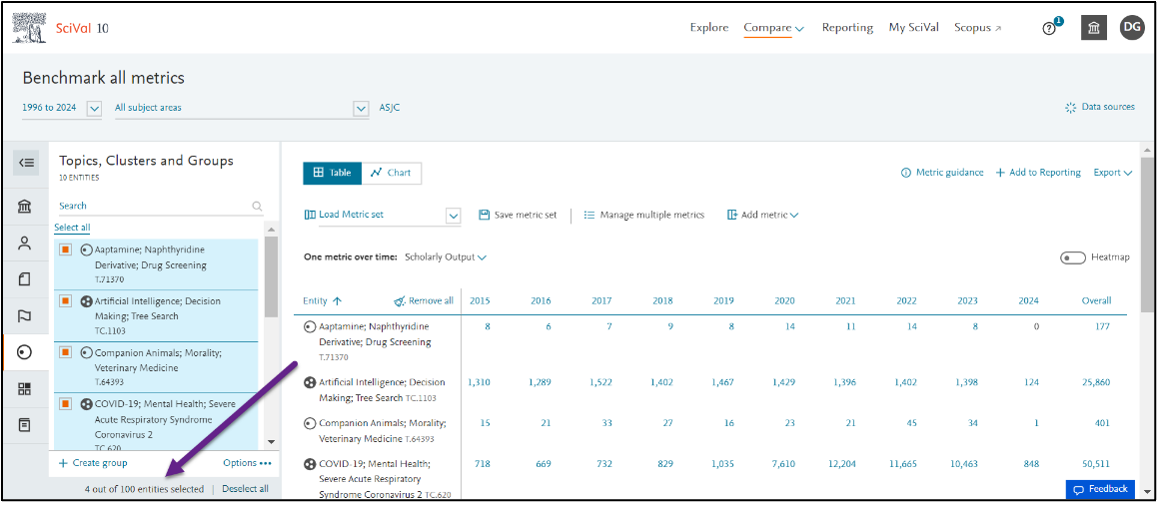
- Entity panel enhancements: Greater transparency into the maximum number of entities supported on Compare pages.
With the May release we want to encourage you to Turn down heating to help mitigating climate change. Warm indoor clothing, improved insulation, programmable thermostat or zone heating will help you stay comfortable while saving energy and reducing your carbon footprint, as well as your heating bills.
The Turn release brings you next generation SciVal Topics, the ability to analyze collaborative links between research groups, an improved Grant-to-Topic mapping to more accurately reflect funding profiles across Topics and much more.
With the Turn release you can also turn on email notifications for SciVal releases in your E-mail settings.
- Enrich your portfolio analysis and understanding of global research fields with the next generation SciVal Topics including GenAI powered summaries
Drawing upon recent methodological advances, we are delighted to announce the launch of the next generation SciVal Topics.
The new updated set of Topics are more cohesive with significantly higher proportion of publications strongly linked to the Topic, providing greater relevance and precise insights, in addition to other benefits, such as:
- Beta: generative AI (GenAI) and LLM technology powered summaries for Topics and Topic Clusters help you quickly understand the research fields and questions being addressed within the Topic. You can access the summaries by clicking the “About this Topic/Topic Cluster” link in the Topic entity header, or ‘i’ icon in the Topics’ listings. We also welcome your feedback.
- More granularity and precision for Topics that have grown very large over time.
- Improved names for Topics and Topic Clusters.
As communicated previously, with the launch of next generation Topics, the old Topics are no longer available. During the next 6 months functionality is available to help you transition.
Please note, Related Topics and Newly emerged Topics functionality is temporarily unavailable for next generation SciVal Topics, it will be re-enabled with the next release.
Want to know more about the next generation Topics?
Check the FAQs in the Support Center:
Join us for the next generation Topics webinar by registering for one of the sessions below:
- Session 1, Tuesday, June 25, 2024 · 8:00 a.m. Amsterdam (GMT +1:00)
Register here for Session 1. - Session 2, Tuesday, June 25, 2024 · 4:00 p.m. Amsterdam (GMT +1:00)
Register here for Session 2.
- Analyse how your Researcher Groups are collaborating in the Collaboration Matrix
Evaluate the collaborative links between up to 10 dynamic groups across four metrics (Scholarly output, FWCI, Citation count and Citations per publication), flexible date ranges from 1996 to present, and all subject classifications. Filter down the outputs included in your analysis, such as filtering on outputs published in affiliation with your home institution or excluding publications with more than a certain number of co-authors.
Built in SciVal's new technologies, the matrix supports the flexible year range from 1996 to present, and all 8 subject classifications available in SciVal, including the Sustainable Development Goals, helping to answer questions such as “How do the faculties or departments at my Institution collaborate with each other towards achieving the UN SDGs”?
The Collaboration matrix can be found in the “Compare” section of SciVal. The page is available in the new navigation only, for subscribers to the Collaboration module.
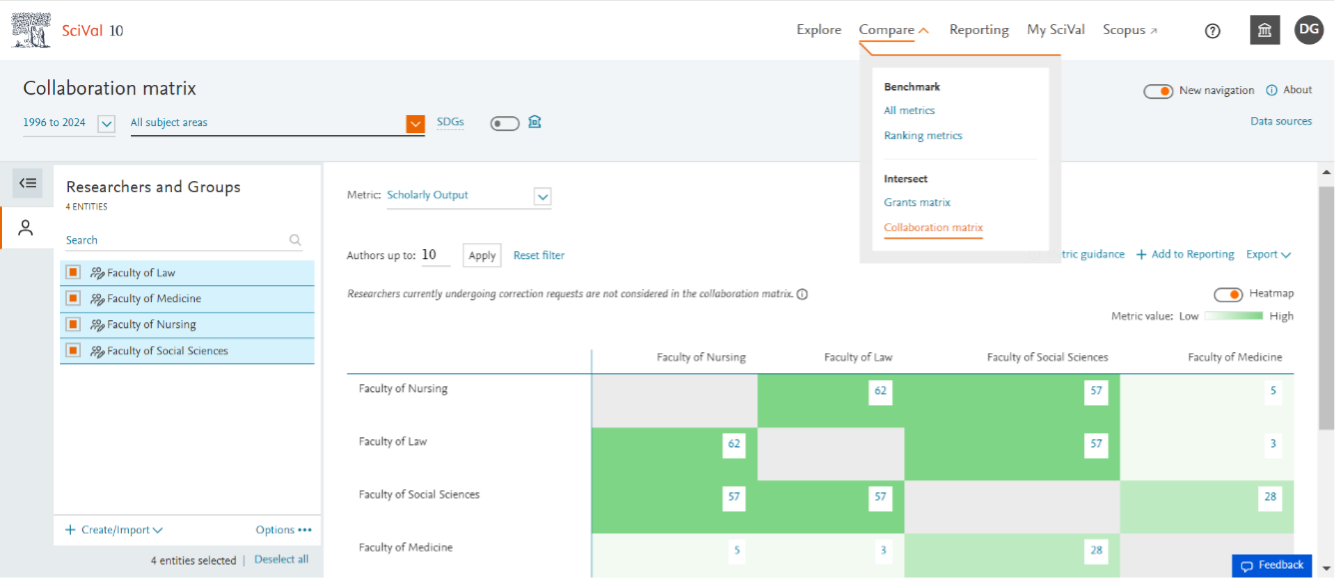
Visit the Collaboration Matrix in SciVal or read more about how it works in the Support Center.
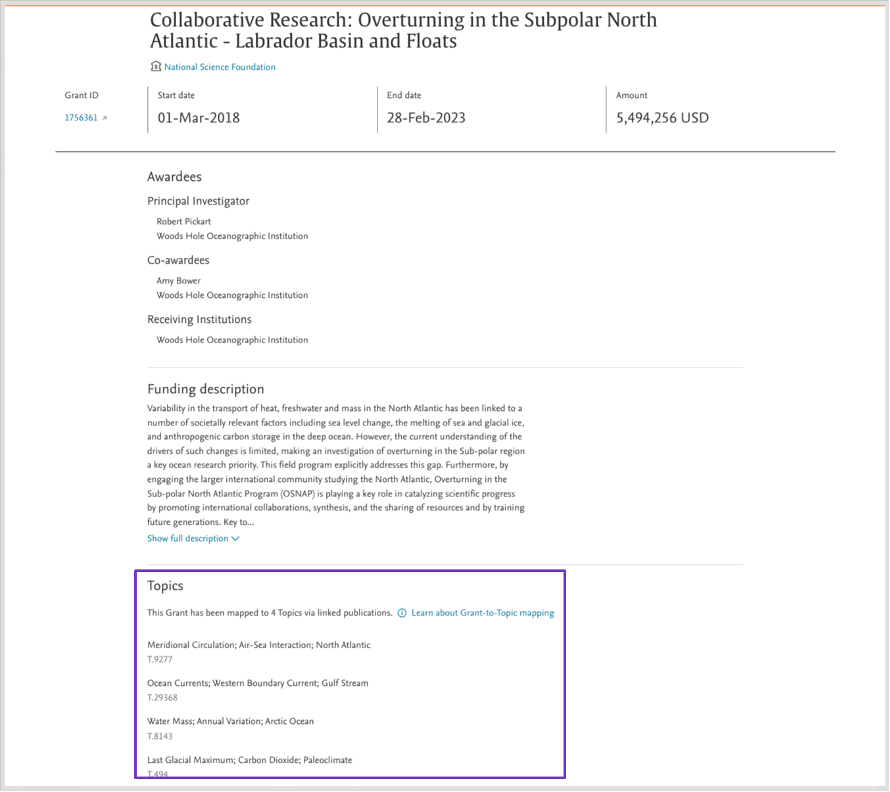
- Improved Grant-to-Topic mapping on pages available with a Grants subscription to more accurately reflect funding profiles across Topics
While previously a Grant was linked to one Topic only, the new mapping model enables Grants to be linked to more than one Topic (up to 10) better representing the reality of where Grants are being spent which is usually across projects linked to several SciVal Topics. Funded Topics are the Topics which have awarded Grant money linked to them and the full Awarded Grant Value is assigned to each Topic it is linked to. The Grant value is deduplicated on the Topic Cluster level.
Semantic Grant-to-Topic linking continues to be used for Grants which we don’t have linked publications available for. For Grants with linked publications available, SciVal Topics composed of these publications are now used for the Grant to Topic mapping, as we know the grant funded the publications within a Topic.
You can see which method was used in the Grant preview window, alongside the Topic(s) mapped to the Grant. Learn more about Grant-to-Topic mapping
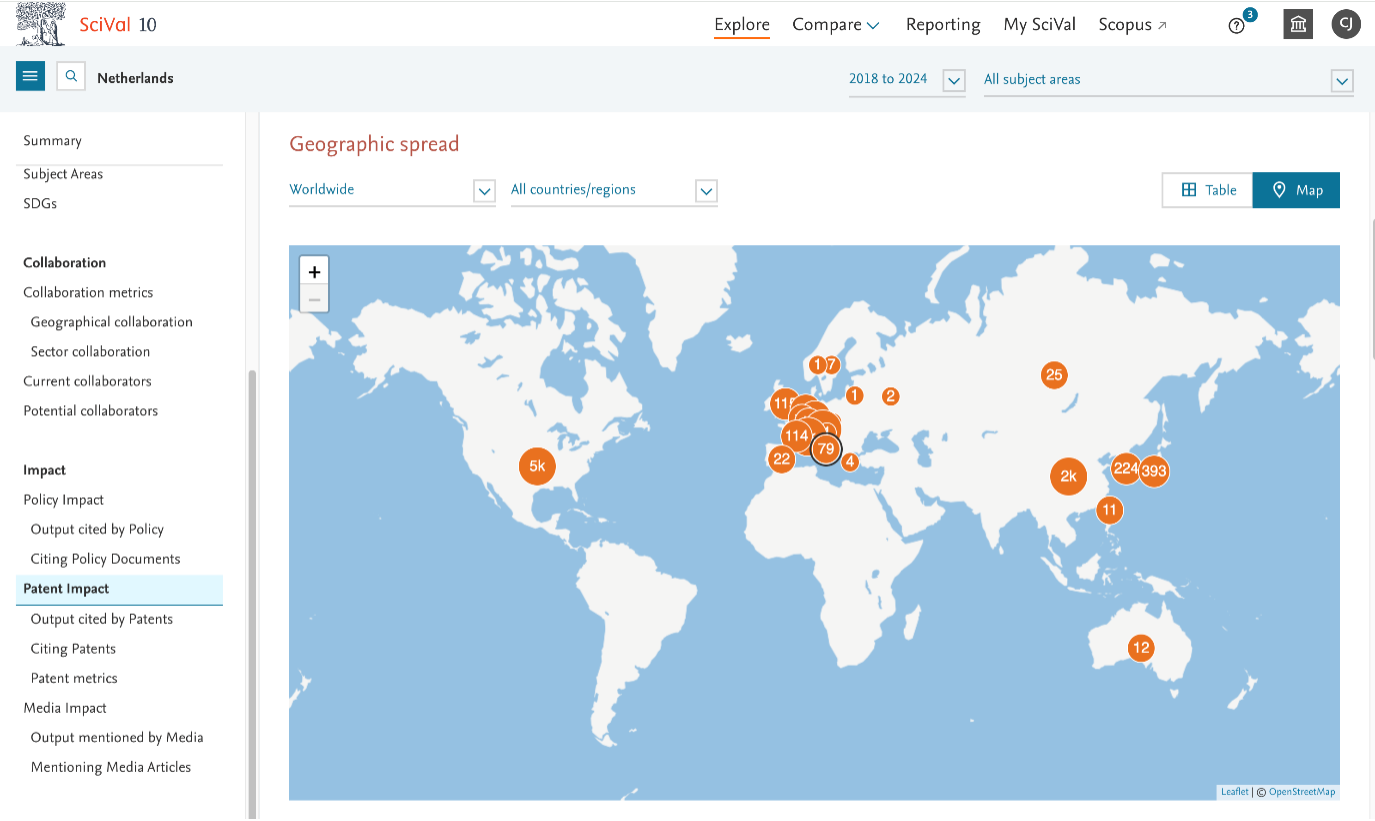
- Geographic spread for Patent analyses available with Impact subscription
Explore the global reach of your innovations and technological impact of your Scholarly Output by examining the patents that reference them. Easily visualize this information through a world map or a table, which displays the locations of patent offices where patents that have cited the scholarly output from your selected entity have been granted or are patent pending. Try it in SciVal.
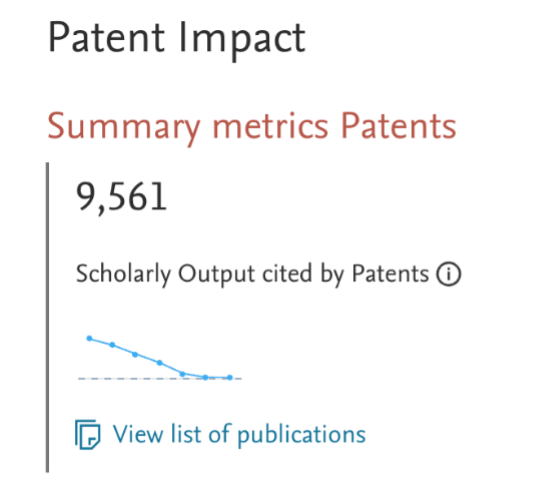
- See a trend of the Scholarly Output cited by Patents with the new sparkline.
- Stay informed about new developments by subscribing to release notes
It is now possible to subscribe to release notifications, which will send you an email for every major SciVal release (approximately every 6 weeks). To sign up, select the “Release notifications” option in your Email settings and update your preferences. It is of course possible to unsubscribe at any time, by deselecting the option.
- Reminder: All users will be switched to the new navigation on June 4, 2024
In March, we released the new navigation in SciVal, and are very happy to see that the great majority of our customers have already switched to it!
For those still using the previous navigation, we would like to remind you that the transition period is ending shortly and encourage you to familiarize yourself with the new interface. On June 4, all users will be permanently switched over to the new navigation and the previous navigation will no longer be available.
The April 2024 release is dedicated to solar power, a form of renewable energy converting energy from sunlight into electricity or heat. With advancements in solar technology it becomes a more widespread and affordable alternative to fossil fuels, helping reduce greenhouse gas emissions and mitigate air pollution.
The Solar release brings:
- SciVal’s 10th anniversary

SciVal turned 10 this year and we celebrate this with a fun look back over the yearsopens in new tab/window!
The release also brings you the ability to save metric sets for Benchmarking, greater insights into FWCI metric with median FWCI launch and advanced sector collaboration analyses. - Save metric sets in Benchmarking to easily re-use them in your analyses
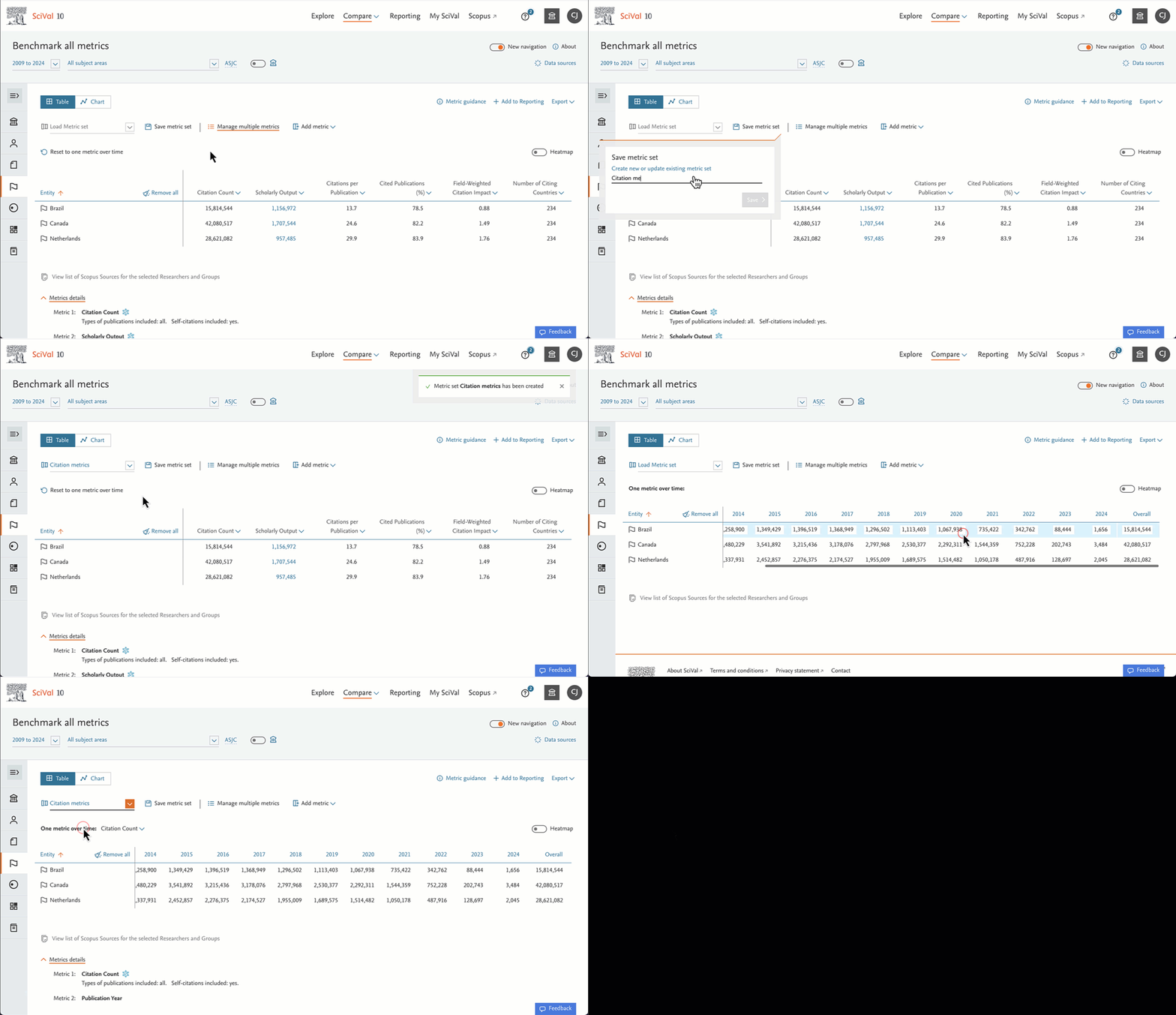
Once you have populated your Benchmark (all metrics) analyses with the required metrics, you can save the set as a template analysis to easily load next time you need it, removing the need to configure from scratch. The ‘Save metric set’ button is available on the main analyses page, as well as in the multiple metrics management screen. You can manage your metric sets in Settings, ‘Metric Sets’ tab.
- Gain a greater understanding of the FWCI metric with the median FWCI value
The median FWCI value is now available for analyses and benchmarking in addition to the original FWCI, which is the mean, to provide greater transparency and understanding of the metric values. The new metric is available on the summary page (under the yearly breakdown) and as an option in Benchmarking when selecting the FWCI.
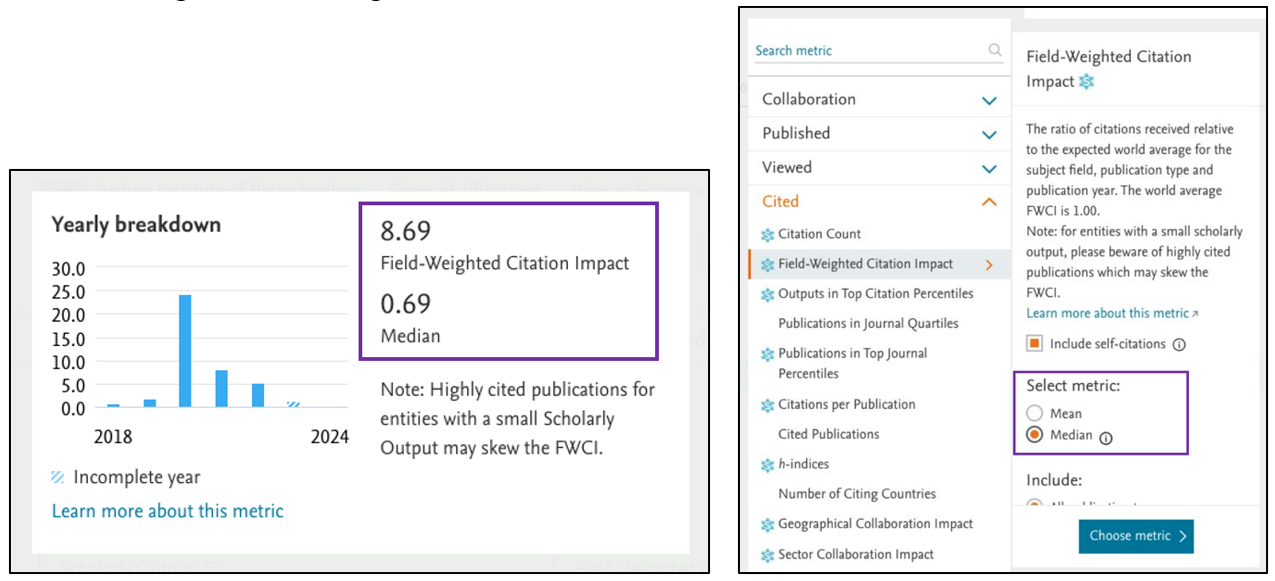
The median FWCI can be used to understand if there are any highly cited publications, for example, that are potentially skewing the FWCI and is an additional complementary metric to support decision making.
Learn more about the FWCI metricopens in new tab/window - Analyze academic collaborations with authors across all sectors on the Sector collaboration page
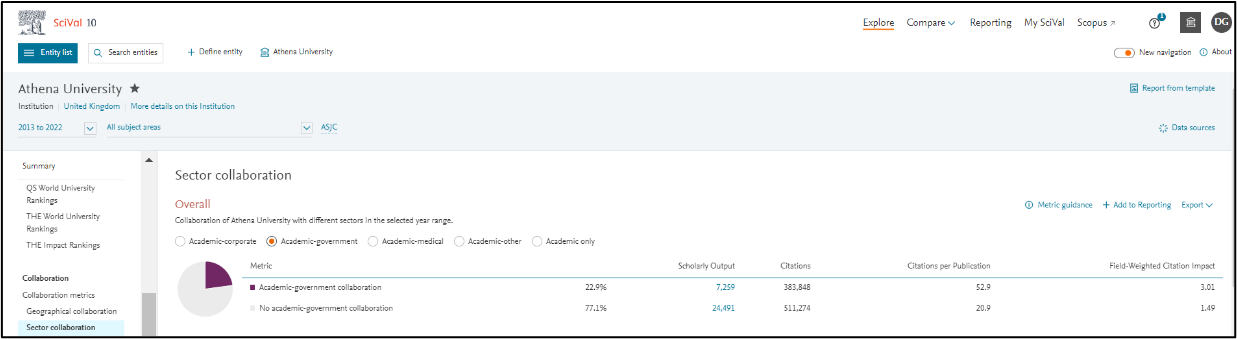
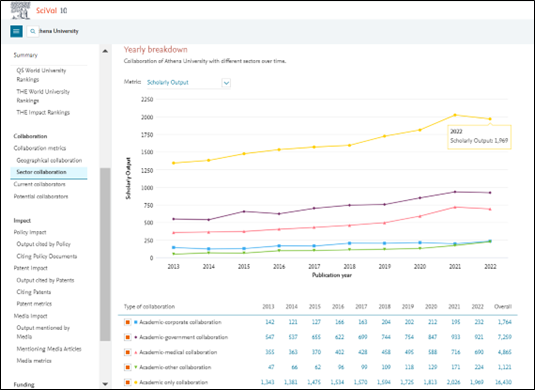
Analyze and explore the output and impact of academic collaborations with authors across all sectors (corporate, medical, government, other sector, or academic only) on the sector collaboration page. The chart and table provide a yearly breakdown of the different cross-sector collaborations, illustrating growth or decline over time, as well as providing a direct comparison of the Scholarly Output and selected metrics.
The page is available for subscribers to the Collaboration module for Researchers, Institutions, Countries, and Institution & Country Group entities provided by SciVal.
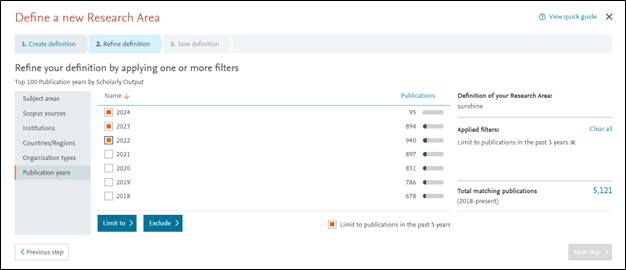
- Greater granularity for your Research Area definitions with the Publication Year filter
It is now possible to filter on specific publication year(s) when defining a Research Area, allowing you to specify the exact timeframe you would like to analyze. The option to limit to the past 5 years remains available also.
Please note that Research Areas that are manually filtered on years will not update to capture the latest publication year with the yearly roll-over. Research Areas using the preset 5-year window, however, will continue to be updated to the latest year with the yearly roll-over.
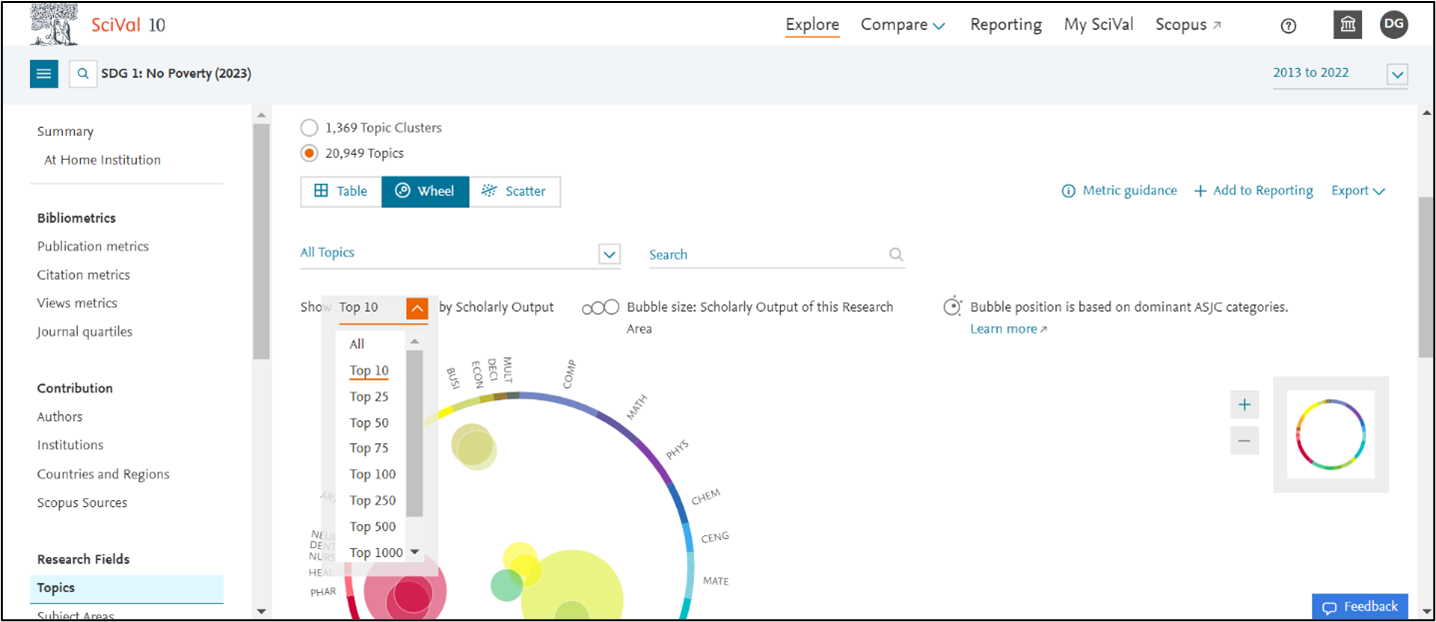
- Drill down further into the Topics wheel and scatterplot visualizations
The additional filter options for the Wheel and Scatterplot visualizations for Topics and Topic Clusters allow you to populate the visualizations more specifically with options to filter down to different intervals from the Top 10 to the Top 2000 by Scholarly Output.
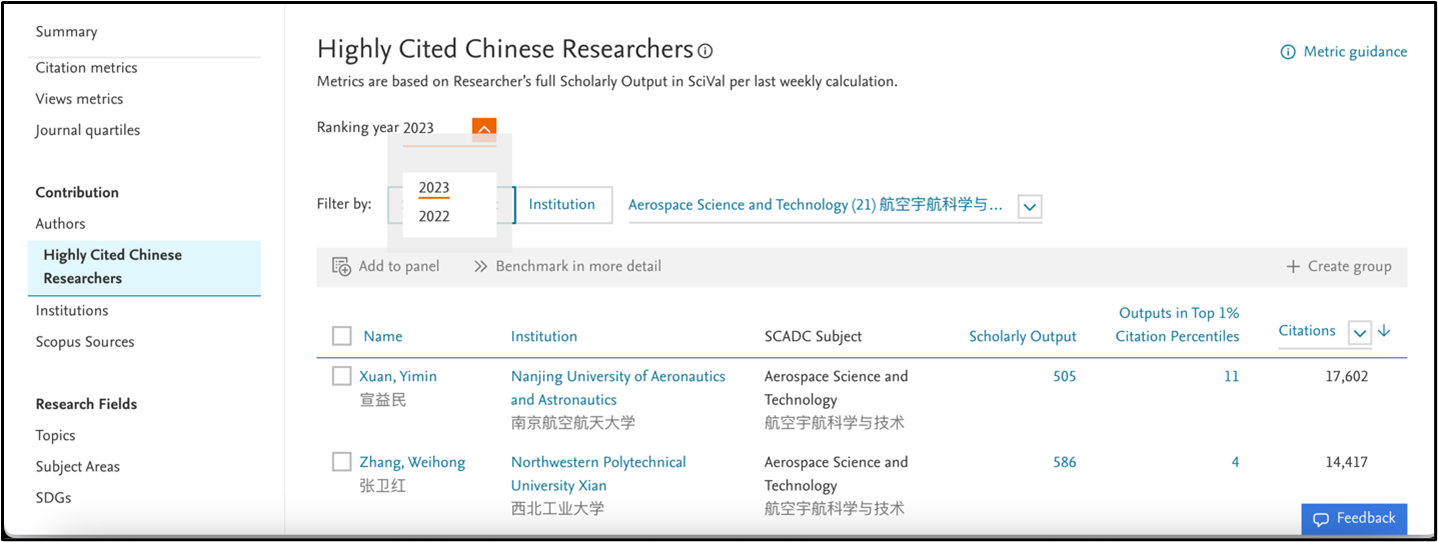
- Highly Cited Chinese Researchers available with more visibility
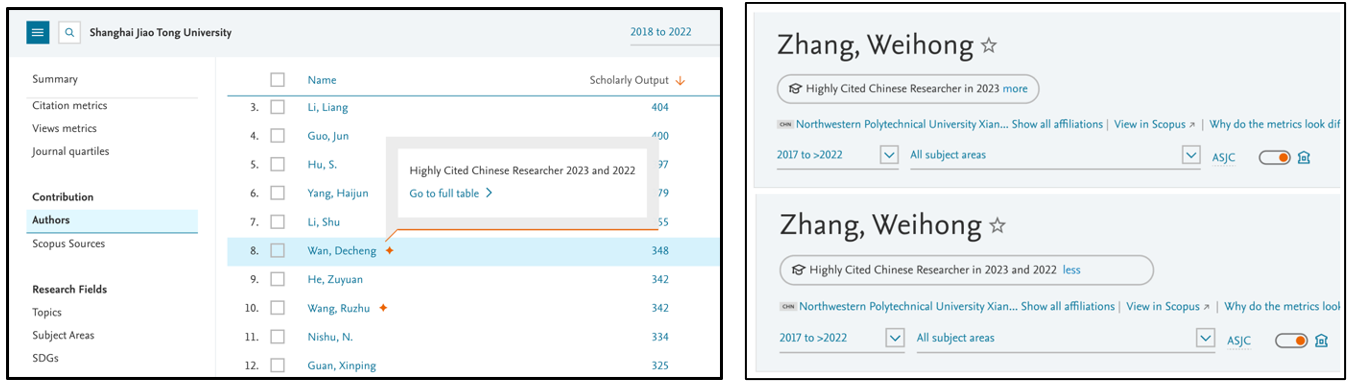
Check out the recently announced list of Highly Cited Chinese Researchers for 2023, categorized by subject area and institution. This list, released on March 27, 2024, is a collaboration between Elsevier and ShanghaiRanking consultancy. You can quickly see the highly cited researchers affiliated with institutions in China through the star icon. Hovering over the star icon and clicking the link provides access to the full list in the authors tab. Additionally, researchers now feature badges indicating the years they were considered Highly Cited Chinese Researchers, click "more" to expand and view the details.
- New navigation now the default in SciVal
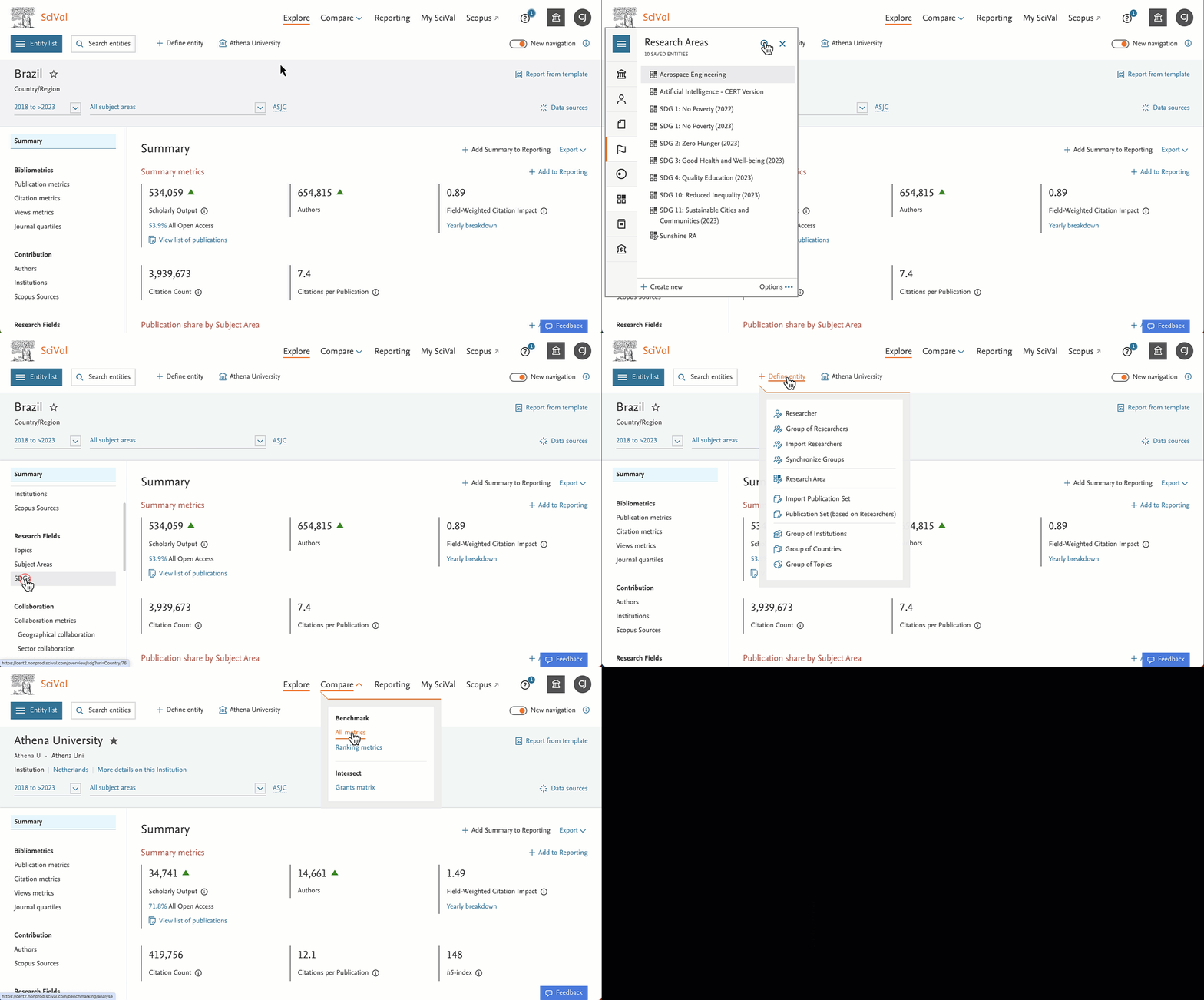
On April 16, 2024, we switched the default on SciVal to the new navigation. The updated Quick Reference Guideopens in new tab/window is now also available, reflecting the changes to the interface.
It is still possible to return to the previous navigation by using the toggle on top of the page but the previous navigation will not be available after June 04, 2024.

- Download full list of authors in more places
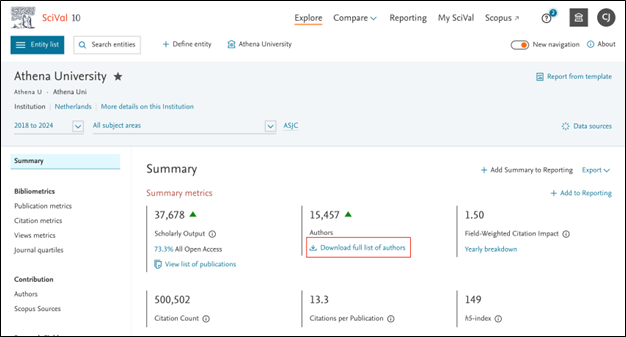
We’ve added an option to download a full list of authors for any institution in SciVal when you go to the Summary tab. We’ve also made the option more obvious in the Authors, export option. The spreadsheet not only contains a full list of the authors from the institution from the past 10 years, but also metrics such as the first and last publication years (so you get an idea on the Researcher’s career stage and experience), along with the full h-index and other metrics.
Impact – Patent improvements
- We’ve added metric guidance for the Applicant/Owner name and locations, when looking at the list of patents citing Scholarly Output.
- We’ve improved the patent family resolution so that very old patents (from early 1900s) that are incorrectly linked to a patent family, are no longer visible.
Other release items
- Publication Sets: Author count for Institutions has been added to the “Export up to 5,000 Institutions with limited metrics” export option on the Institutions page.
- Entity panel: show or hide tag preferences are now remembered across sessions.
The March 2024 release is dedicated to recycling. Recycling plays an important role in resources conservation, reducing energy consumption and minimizing waste. Remember to check your local recycling regulations and practices.
The Recycle release brings you the ability to find content easier with the new navigation and THE World University Rankings 2024 available for benchmarking.
- Improved findability of content with the new navigation
To make SciVal easier to navigate and content easier to find, we have reorganized the pages in SciVal into 2 main analysis sections: “Explore” and “Compare”, while keeping Reporting and My SciVal.
“Explore” combines the pages from modules which analyze entities one by one (Overview, Collaboration, Trends, Impact and Grants) into one place. When you select an entity, you automatically see all the available pages, regardless of which module they come from. Your Institution’s module subscription determines which pages are available to you.
“Compare” contains pages that support the selection and analysis of multiple entities: the pages previously grouped under Benchmarking, as well as the Grants Dashboard for subscribers to the Grants module.
Switch to the new navigation using the banner and toggle option at the top of the page. The previous interface will remain available alongside the new one for 3 months. During that time, you can easily switch between both interfaces to familiarize yourself with the new navigation. After 3 months, the previous interface will be sunset.
Want to know more about the new navigation? Visit the new navigation FAQ in the support centeropens in new tab/window or join us for the new navigation webinar by registering for one of the sessions below:- Session 1, Wednesday, March 27, 2024 · 10:00 a.m. Amsterdam (GMT +1:00)
Register here for Session 1opens in new tab/window. - Session 2, Wednesday, March 27, 2024 · 4:00 p.m. Amsterdam (GMT +1:00)
Register here for Session 2opens in new tab/window.
- THE World University Rankings 2024 metrics are now available for Benchmarking (rankings metrics)
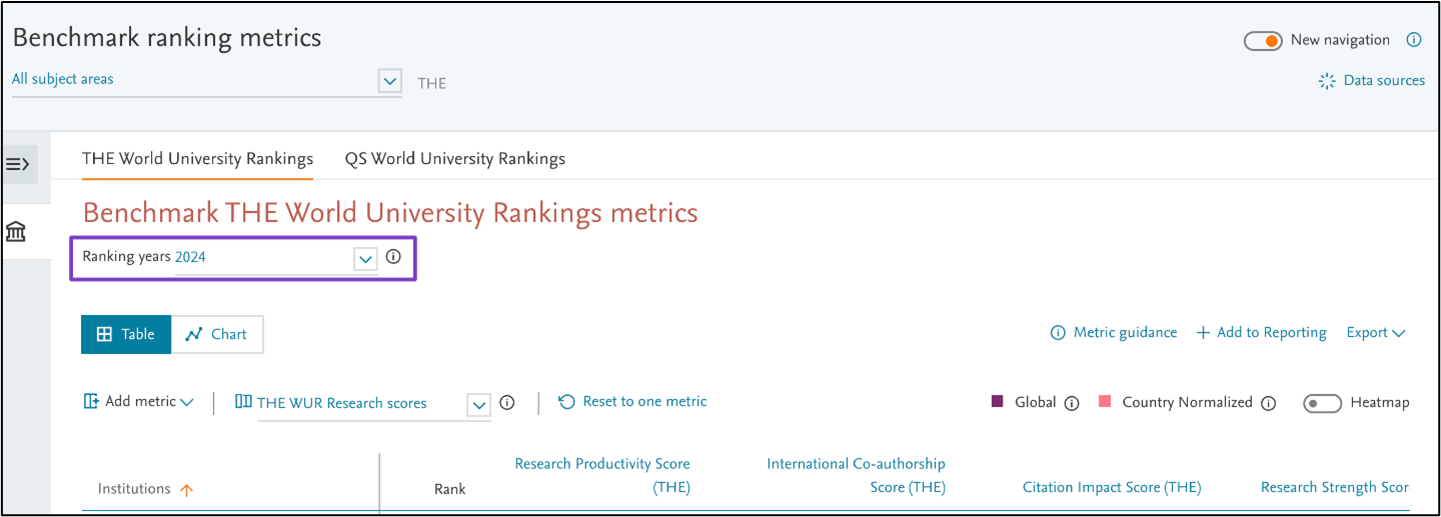
Compare Institutions using metrics from the THE World University Rankings 2024 (announced on September 27, 2023) in Benchmarking. Create a comparison effortlessly using predefined metric sets, then export and generate reports with just a few clicks.
- Prepare for the launch of next generation SciVal Topics
We are happy to pre-announce that the next generation of SciVal Topics are on their way. We expect to launch the new SciVal Topics in Q2 2024.
Drawing upon recent methodological advancements, the new updated set of Topics will be more cohesive, providing greater relevance and more precise insights.
Once the next gen Topics and Topic Clusters are launched, the current Topics and Topic Clusters will no longer be available. We will provide functionality to help you transition your analyses to the next gen Topics.
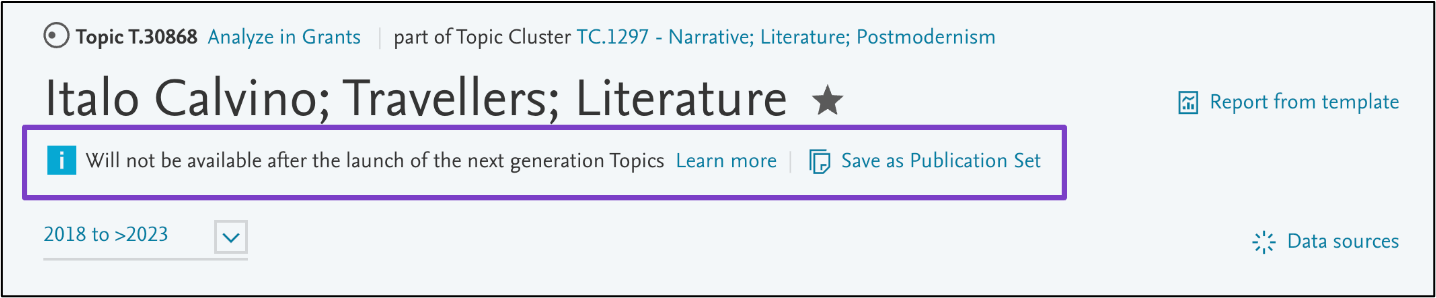
To prepare upfront, you will find a link in the header of each Topic / Topic Cluster that will help you convert it to a Publication Set. You can also export your Reports/Analyses or save Reports snapshots.
Learn more about next generation SciVal Topicsopens in new tab/window
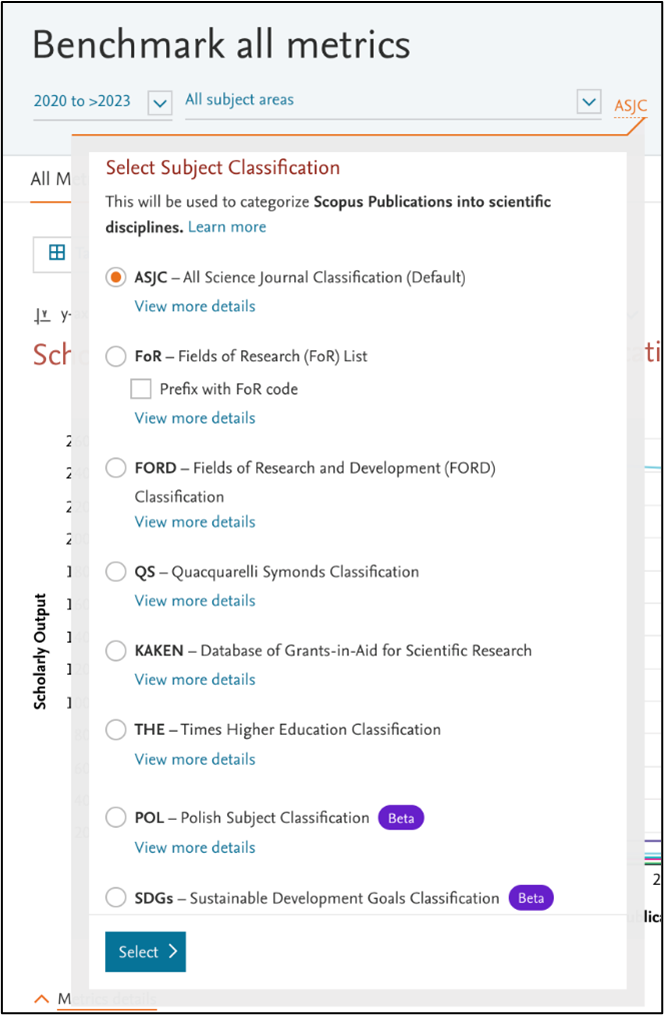
- All subject classifications directly available for Benchmarking and Impact analyses
Discover and explore all available subject classifications for Benchmarking (all metrics) and pages that are part of the Impact subscription. Previously you could only choose 4 subject classifications, but new technologies in SciVal remove that limitation in Impact and Benchmarking (all metrics), giving you additional flexibility in your analyses.
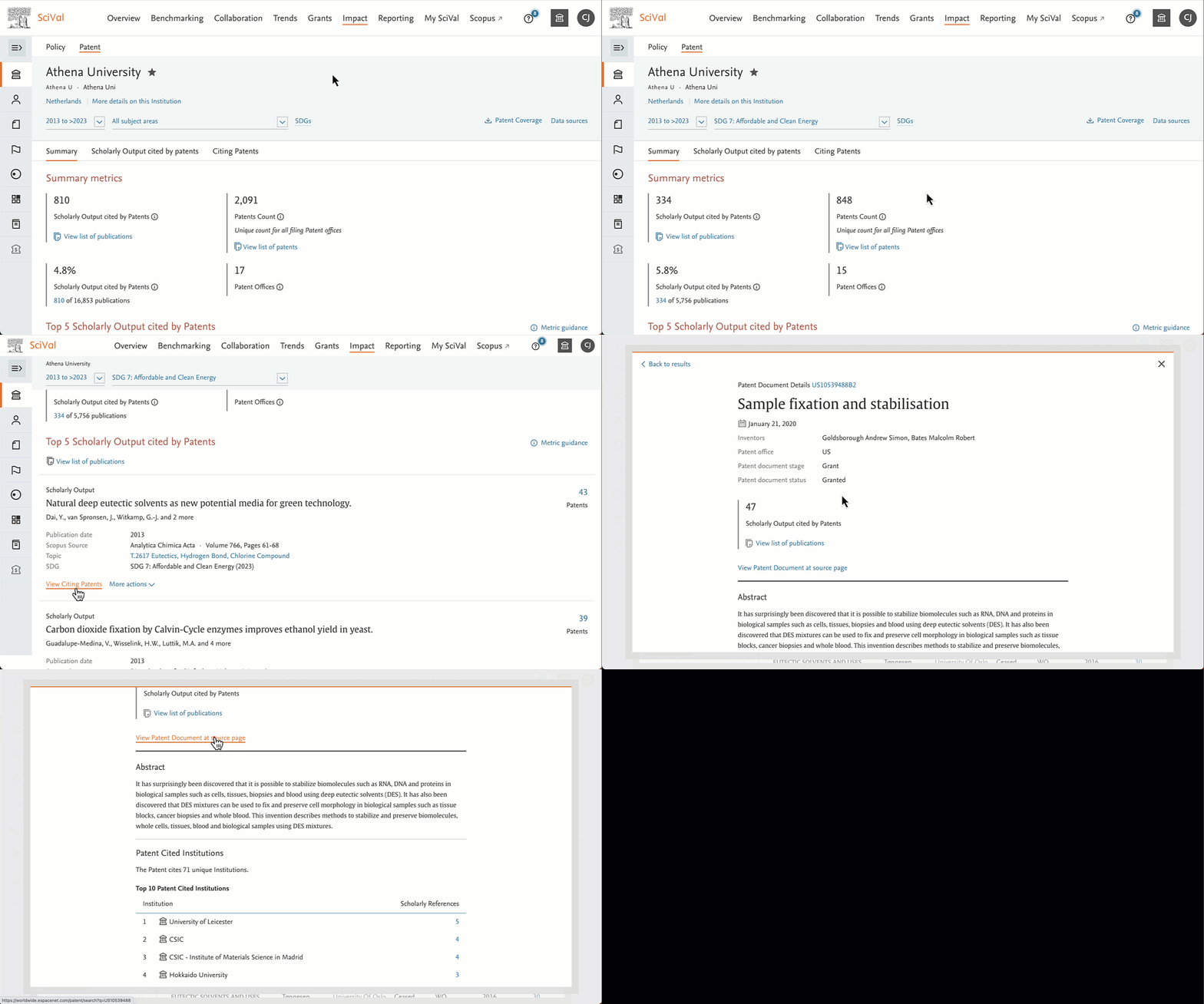
- Impact module updates
A couple of improvements have been made to the Impact module, including the ability to add lists of Scholarly Output cited by Patents and Citing Patents to Reporting and shorter Patent Office names (making them easier to read).
The last release of 2023 is dedicated to plants for their crucial role in battling climate change. They absorb carbon dioxide during photosynthesis using it to produce oxygen, they participate in soil stabilization and water filtration, they offer a more sustainable source of food compared to animal-based products as well as providing many other benefits. Besides, they are just beautiful, so let’s treasure them together.
The Plant release brings you the ability to analyze your technological impact through Patent citations in the Impact module, more insights into your contribution towards SDGs, larger entities available for immediate analyses and an overview of Institutions’ publications linked to Funding Bodies through acknowledgements in the Grants module.
- Patent data in the Impact module
Evaluate and understand your innovation pathways and potential technological and economic outcomes and impact through patent analyses. With the addition of data from 43 Patent Offices to the Impact module, you can use SciVal to analyze and identify technological outcomes and impact and build narratives to demonstrate your broader research impact. The new analyses are also available to further benchmark to peers using the Benchmarking module.
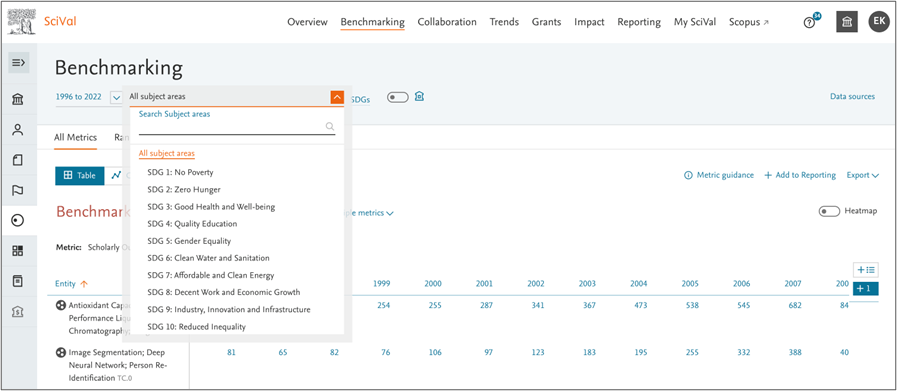
- Understand your contribution towards the UN SDGs through SDGs as a subject classification
The new SDG subject classifications in the Impact and Benchmarking modules expands the ability to understand and showcase your impact and contribution towards each of the SDGs (Sustainable Development Goals). Explore your potential societal, political, technological and economic impact in areas related to the SDGs and benchmark your outcomes and impact to your peers.
- Analyze entities with up to 10,000 publications immediately with the increased limit for dynamic entities
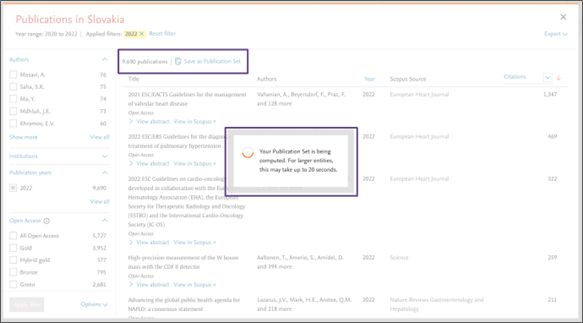
The publication limit for real-time computation has been doubled from 5k to 10k for self-defined Publication Sets, Research Areas and Researcher Groups, allowing you to start analyzing them immediately without the need to wait for them to be processed.
- Analyze Institutions’ acknowledgement Linked publications by Funding Body
Explore and understand the funding source and wider contributors to a publication through acknowledgment Linked publications in SciVal Grants. Linked publications are publications where we were able to establish a link to a Funder Organization in our taxonomy. The contribution could be financial or non-financial support to conduct the research, development or innovation work.
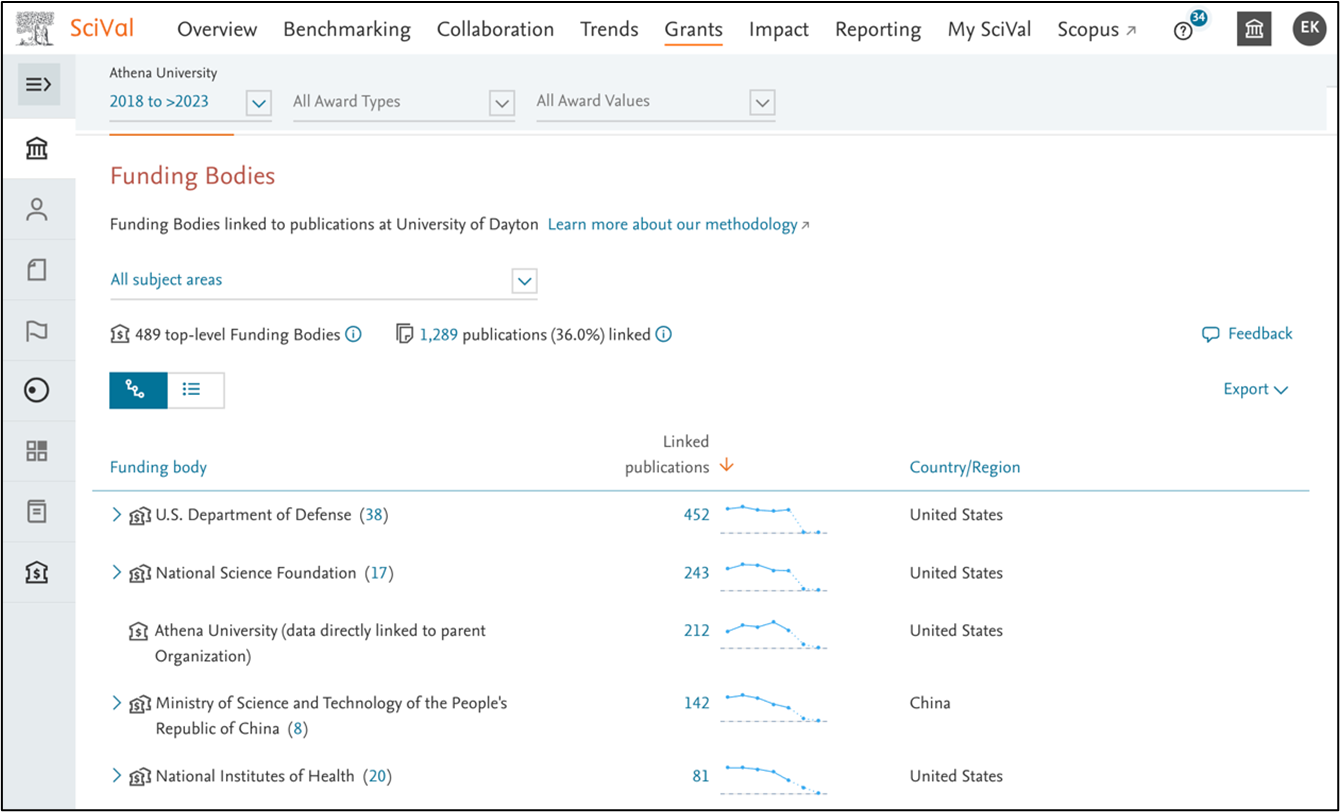
Linked publications can be used as a proxy for an Institution’s funding portfolio, overall or per Subject Area. It is also possible to further analyze and benchmark an Institution’s Linked publications per Funding Body.
Learn moreopens in new tab/window - View Journal metrics in Scopus Source listings in the Trends module
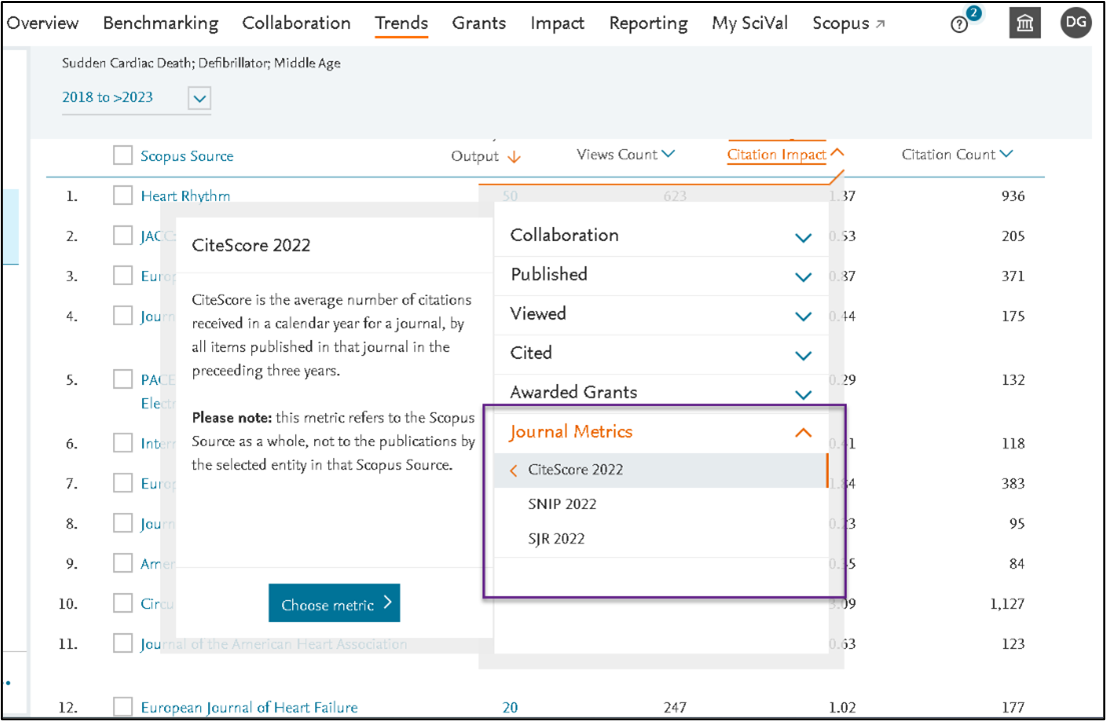
It is now possible to select CiteScore, SNIP and SJR in the metric selector to populate the table when looking at Scopus Source listings in Trends, providing additional insights into the performance of the sources of interest.
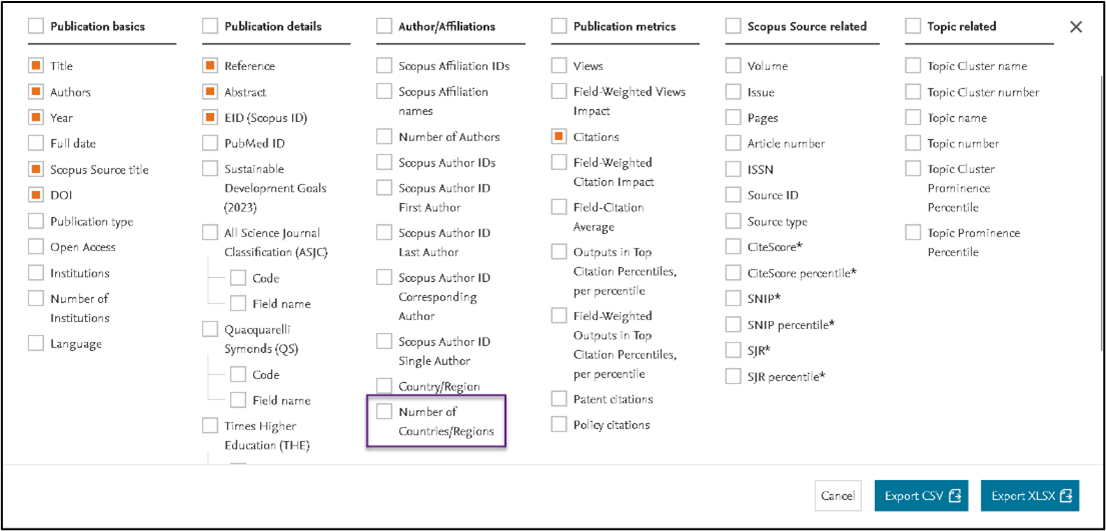
- New export option for publications: Number of Countries/Regions
We have added the option to include the number of Countries/Regions that contributed to a publication in the export file, making it easy to identify if international collaboration has taken place and how many countries have been involved.
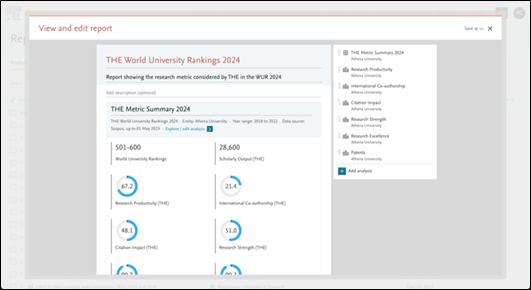
- Add to Reporting for the THE World University Rankings 2024
The reporting functionality has been incorporated into the THE World University Rankings 2024, facilitating the seamless generation of reports.
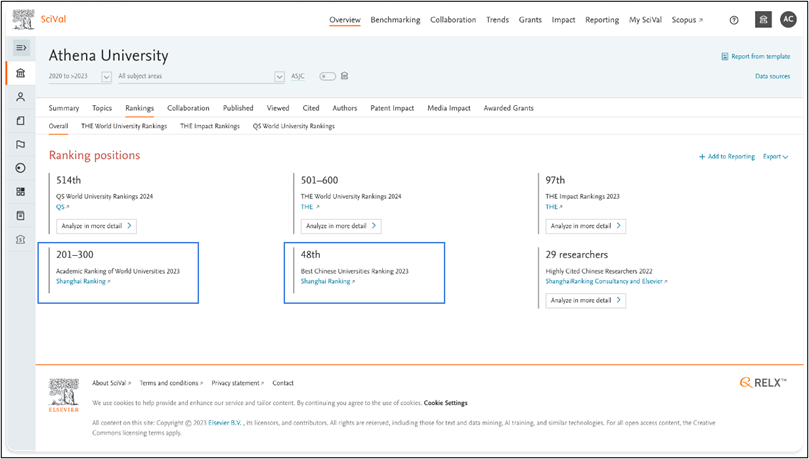
- ARWU & BCUR 2023 - Shanghai Rankings
Two of the Shanghai Rankings, namely the Academic Ranking of World Universities (ARWU) and Best Chinese University Rankings (BCUR), are now accessible for the year 2023 in the Overview module in “Overall” tab under Rankings.
- Artificial Intelligence Research Area (based on Elsevier AI Report methodology) has been updated with new publications
The Artificial Intelligence Research Area is based on Elsevier AI Report methodology and it has been updated with the latest publications based on the October 2023 data snapshot.
The theme of the October release is organic food. While organic farming and its contribution to battling climate change is a complex topic, choosing local organic produce will help reduce emissions from transportation and support local communities.
The Organic release brings you the bibliometric dataset underlying THE World University Rankings 2024, the ability to compare Institution’s performance in QS World University Rankings metrics in Benchmarking, as well as QS Subject Classification update to match QS WUR 2024, and more insights into cross-sector collaboration.
- THE World University Rankings 2024 bibliometric dataset, including the four new metrics, is available to analyze
Gain a deeper understanding of the bibliometric dataset underlying your institution’s ranking scores in the THE World University Rankings 2024 (announced on September 27, 2023). Analyze the drivers behind the scores, including the four new metrics introduced this year and learn about the new ranking methodology with our extensive metrics guidance. Overall Rankings scores are now also available when looking at institutional comparisons in the Collaboration module.
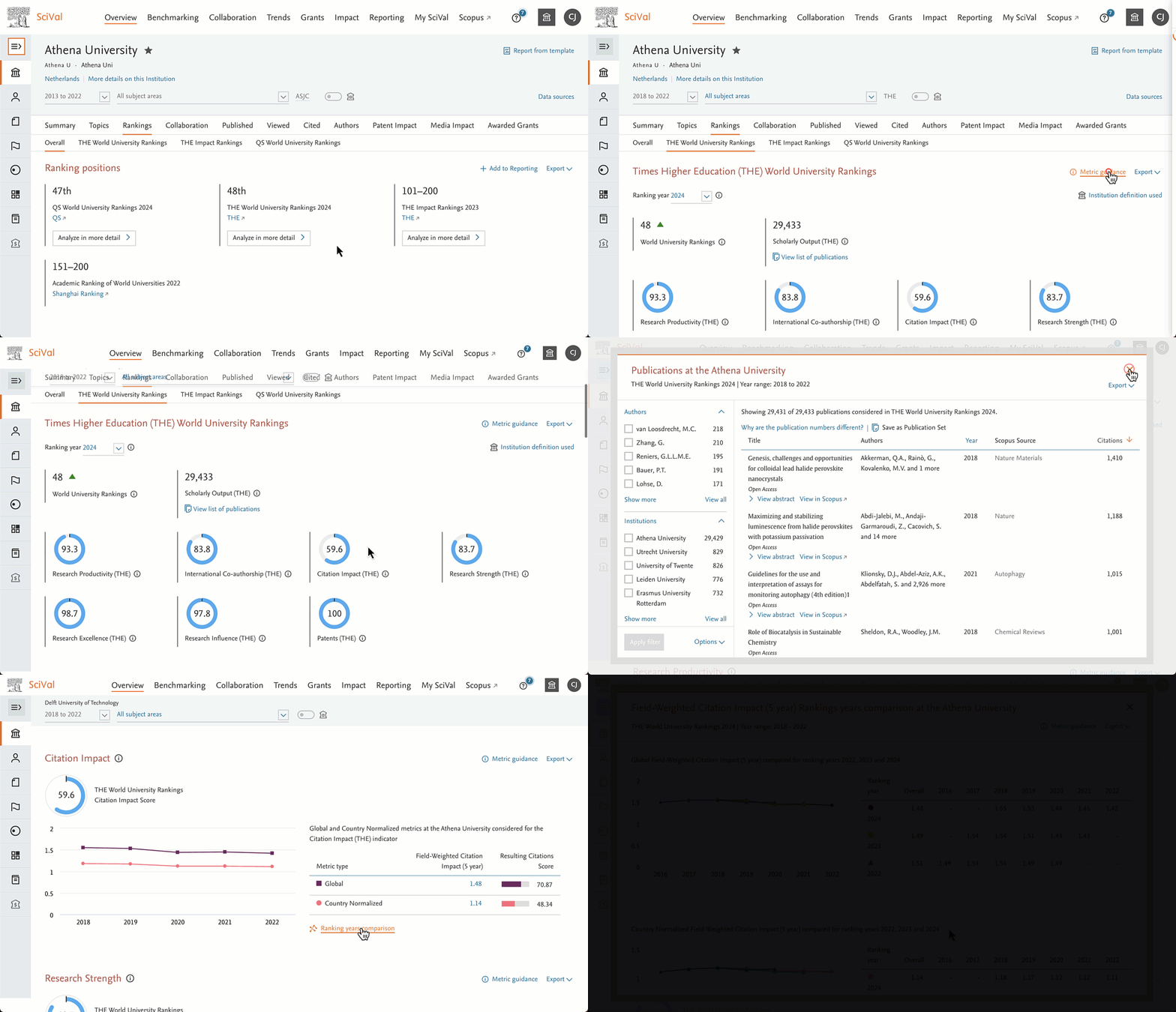
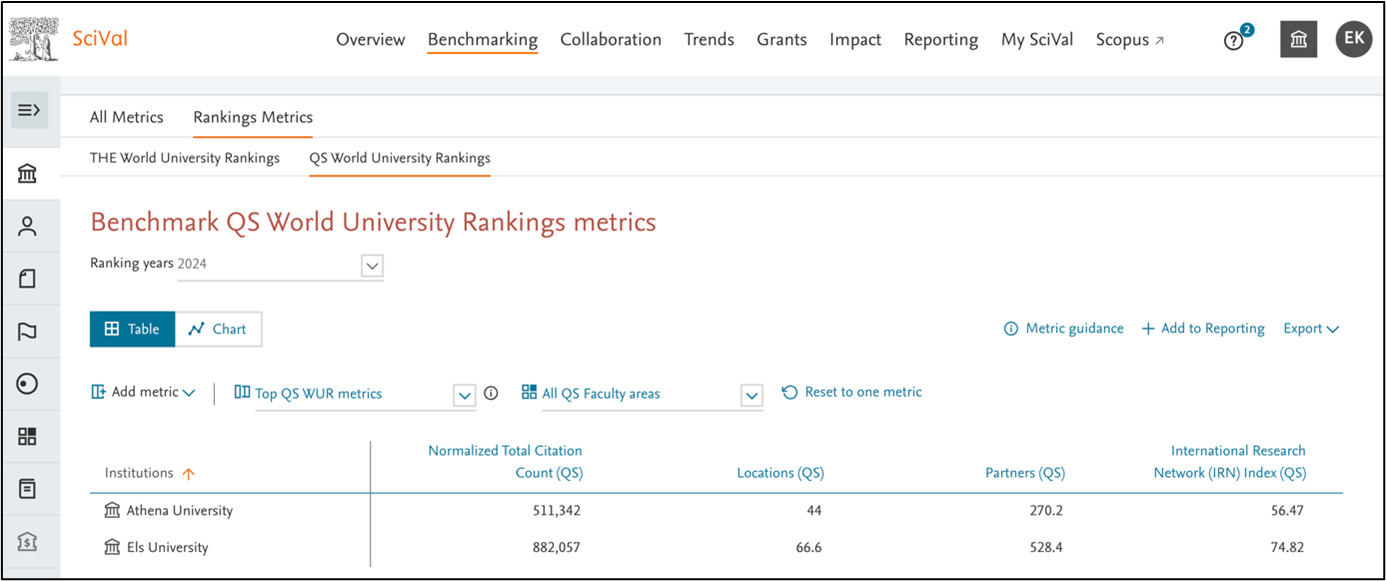
In the next release, you will be able to compare ranking metrics across institutions, as we will add the THE WUR 2024 metrics to the Benchmarking module. - QS World University Rankings 2024 bibliometrics in Benchmarking
Compare up to 100 institution’s performance in one or more of the QS WUR metrics in Benchmarking. Choose from individual metrics, or load a pre-selected metric set to quickly populate the Benchmarking table.
- QS subject classification update
We’ve updated the QS subject classification to match the QS WUR 2024. Marketing and Data Science subject areas have been added to the classification, along with some adjustments to the existing subject areas. Learn moreopens in new tab/window - Analyze the output and impact of academic collaboration with all other sectors in the Benchmarking module
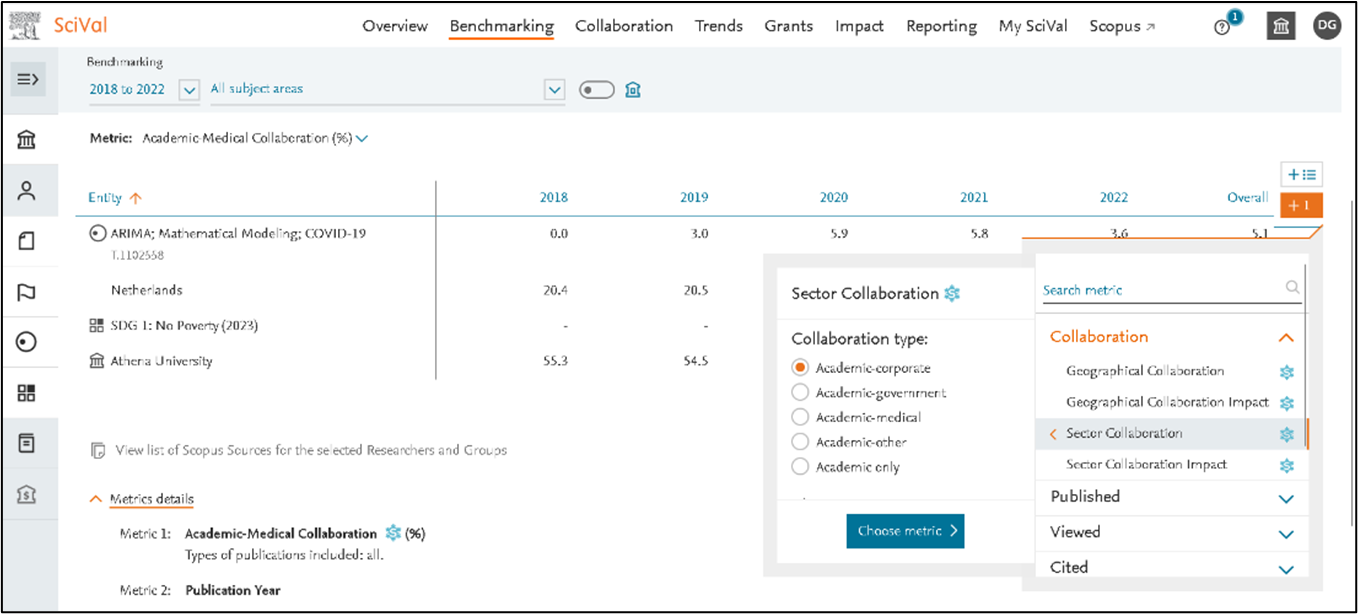
It is now possible to analyze the output and impact of academic collaborations with all sectors. In addition to the academic-corporate collaboration metric already available in SciVal, we have expanded the sector collaboration metrics to include academic-government, academic-medical, academic-other, and academic-only collaborations. The new sector collaboration metrics are available for all entity types in the Benchmarking module:
- Highly Cited Chinese Researchers available to analyze
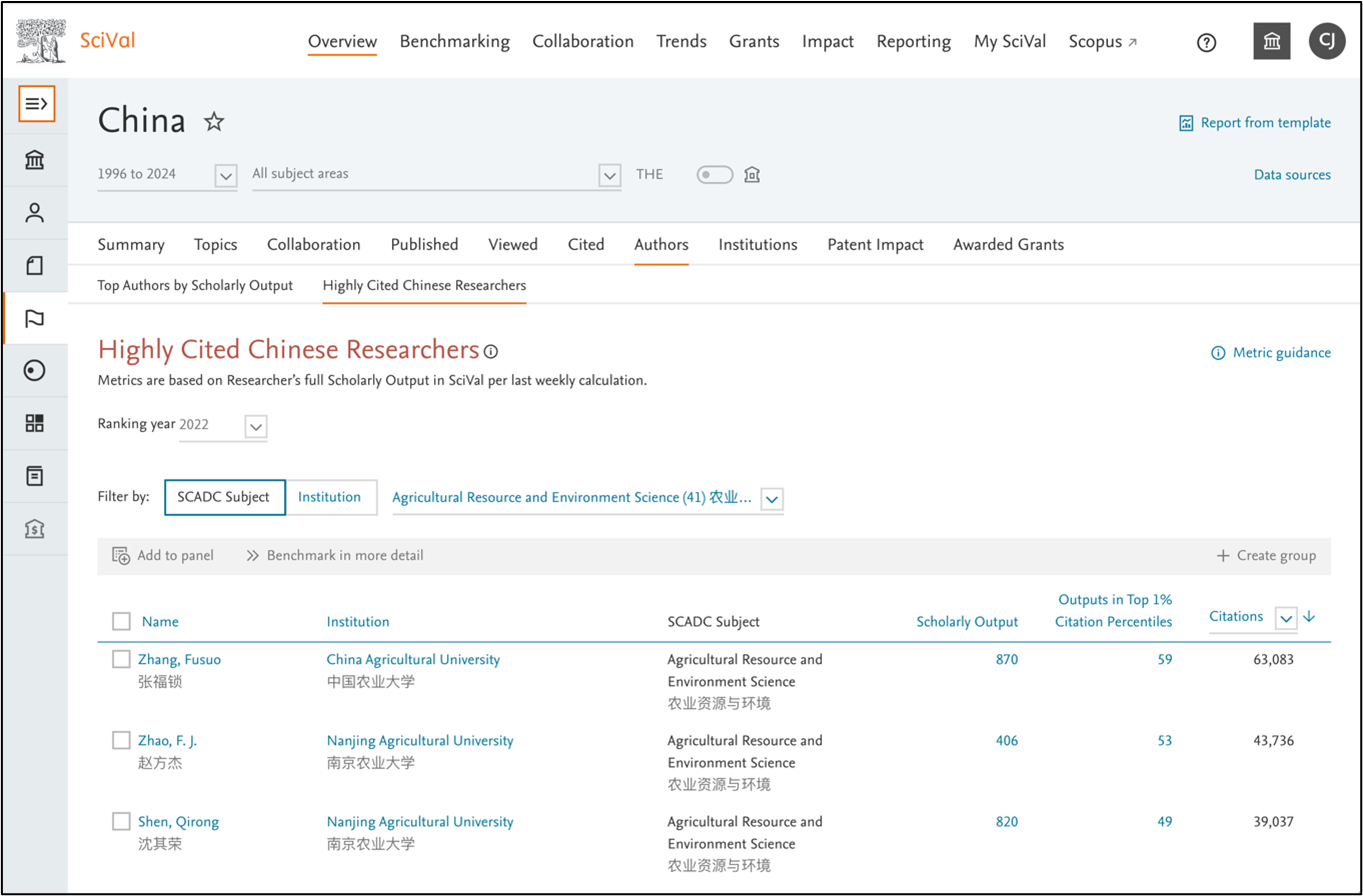
See the most highly cited Chinese researchers by subject area or institution. Released jointly by Elsevier and the ShanghaiRanking Consultancy, the Ranking uses Scopus® data and a methodology developed by the ShanghaiRanking Consultancy and includes researchers affiliated to Institutions based in mainland China. To see the full list, go to the author tab in the Overview module when China is selected.
- Review suggested authors in the Import Researcher flow
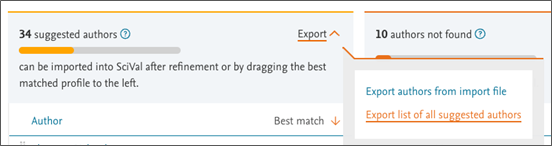
The new Export in the Import Researcher flow allows you to review details of all suggested authors that could not be matched directly.
- Analyze Topics by Publication Share in the scatter chart
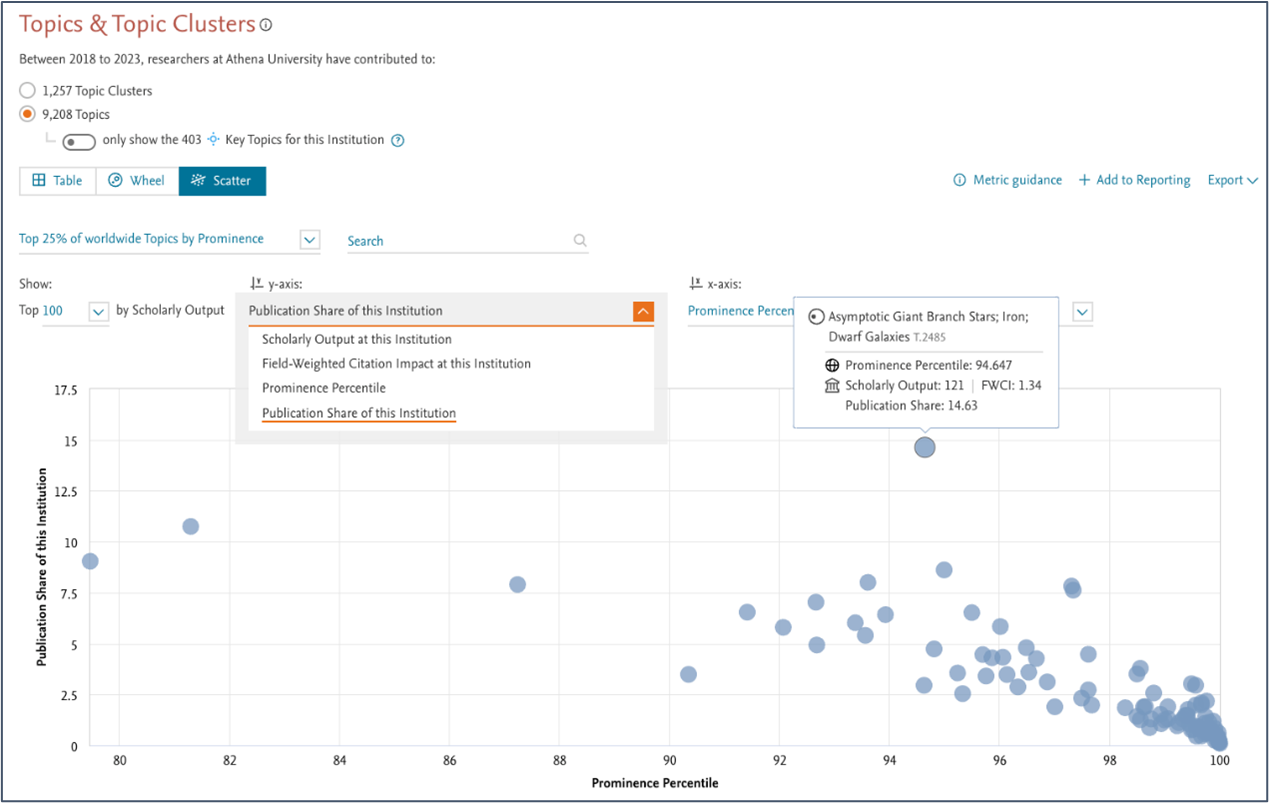
The scatter chart for Topics and Topic Clusters now offers Publication Share option to easily map out Topics of interest by this metric against FWCI, Prominence Percentile or Scholarly Output.
Collaboration module
- New look and additional data for analysis in the Collaboration details modals
The Research performance tab in the details modals for collaborating Institutions and Countries/Regions has been redesigned to provide a clearer overview and insights into the performance of the collaboration as well as the context of the collaboration partners. The details modals are now structured into three sections; the Collaboration Summary, Performance Comparison and Institution/Country Comparison. The newly added relative share of collaborated output and authors indicate how the number of documents collaborated on, and the number of authors engaged in the collaboration, compare to the total of the respective Institutions or Countries / Regions. We have also added the ranking position for QS WUR, THE WUR, THE Impact and the Shanghai Rankings to the details modal for Institutions.
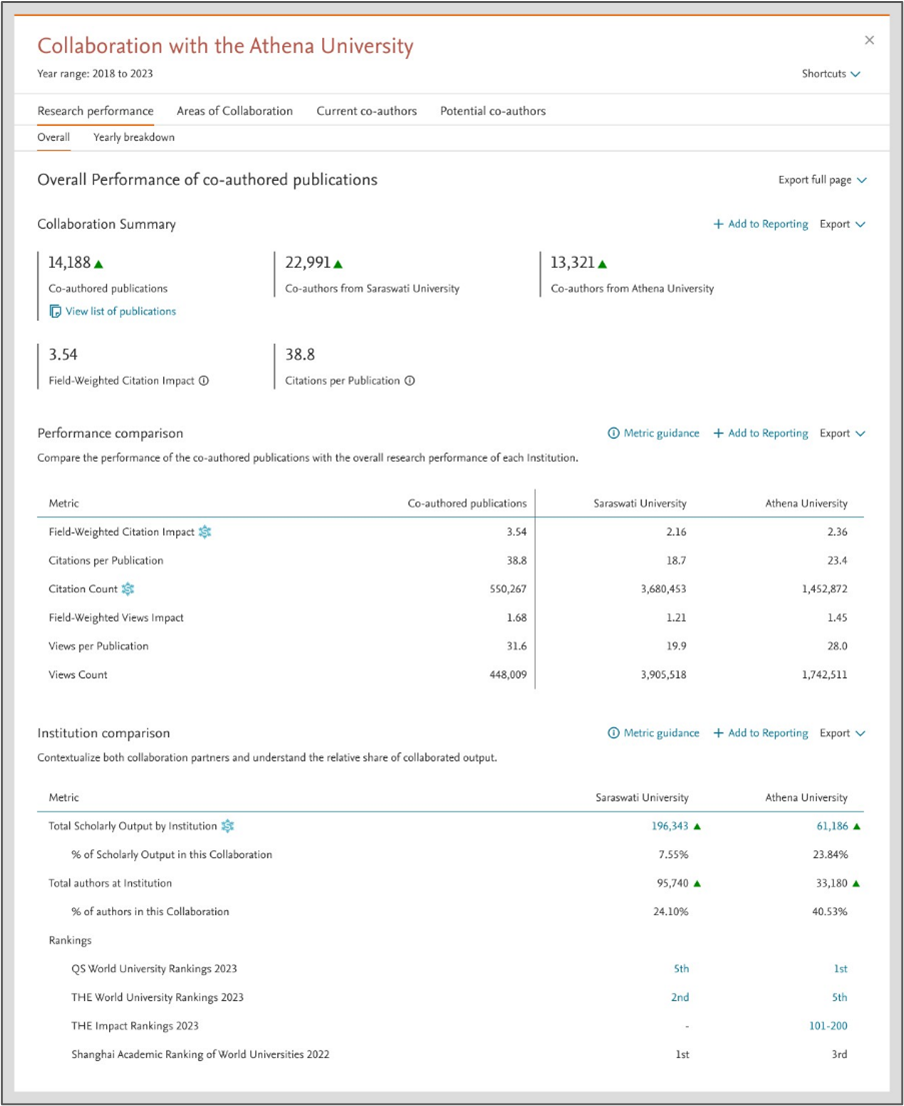
- Table actions for Institutions and Countries / Regions in the Collaboration table view
It is now possible to add entities from the table directly to the left-hand panel for further analysis, freely select the entities you would like to Benchmark, add tags or create a group.
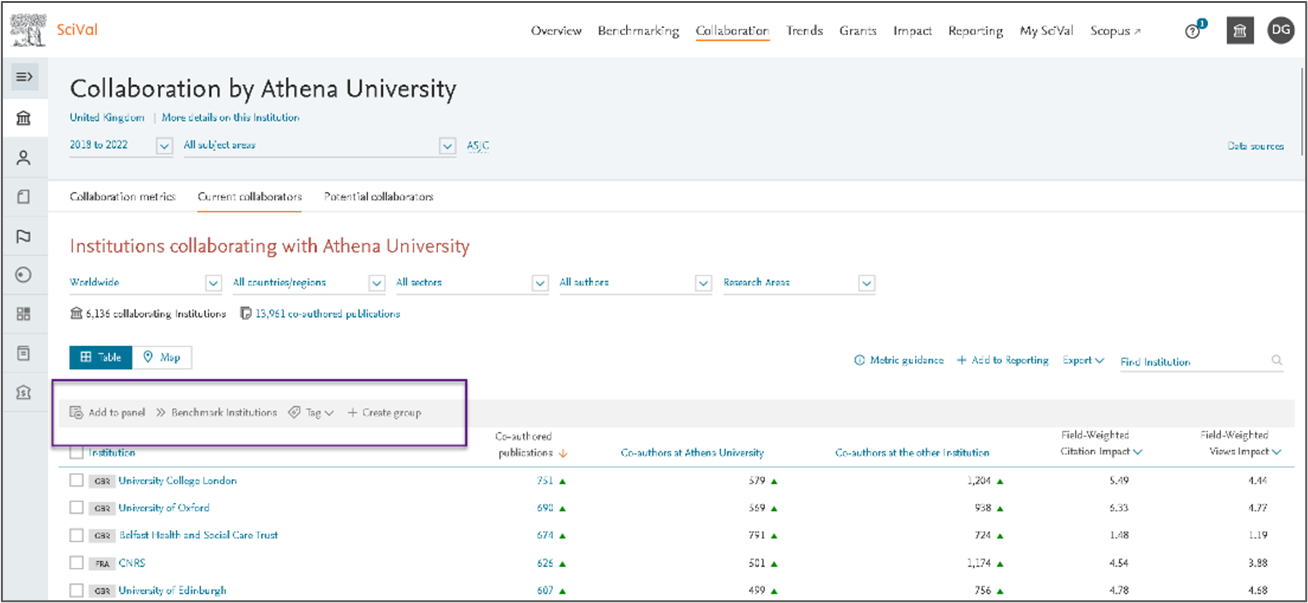
- Quick links to navigate between Collaboration analyses
We have added quick links at the bottom of the Collaboration metrics pages in the Overview and Collaboration modules, allowing you to easily link to the different functionalities to continue your analyses.
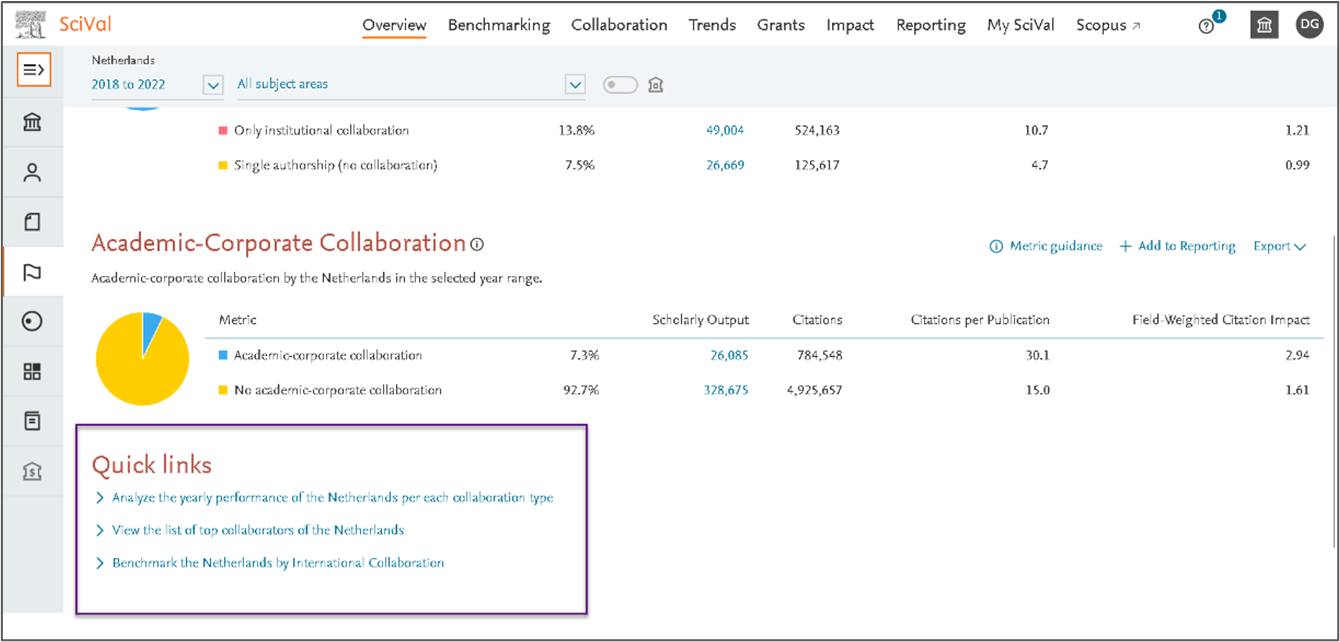
Impact module
- View a map of the geographic spread of Citing Policy Documents and Bodies
Visualize the impact your research is having on global policy documents, in a new map view. See the count of Citing Policy Documents or Citing Policy Bodies globally, or filtered by countries and regions in the Impact module.
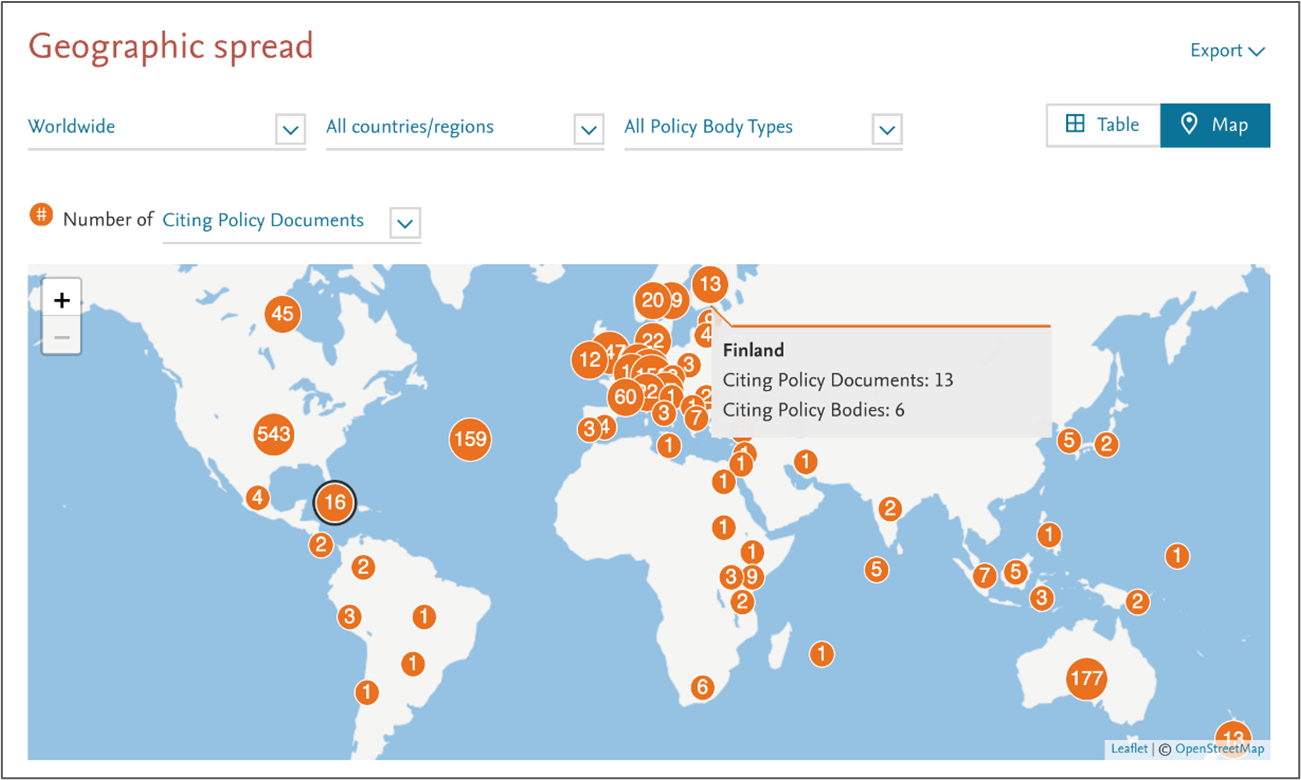
- Policy Cited Scholarly Output has been renamed to Scholarly Output cited by Policy
In response to customer feedback, we have adjusted a policy metric to make it easier to understand. This change has been made in the Impact and Benchmarking modules.
Grants module
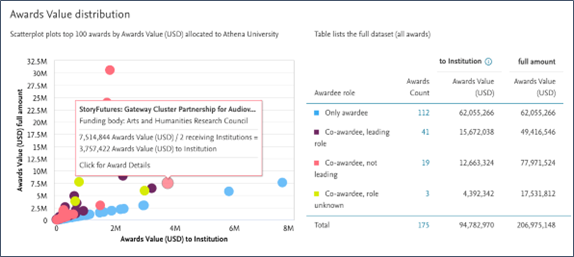
- Analyze co-awarded Awards Value distribution per Institution
The Awards Value distribution chart in the Awards tab of Institutional modals has been updated to include not only full Awards Value amount, but also co-awarded allocation per Institution. The exact allocation is used when the details are available and when they are not, the Awards Value is evenly distributed to each awarded Institution as an estimation.
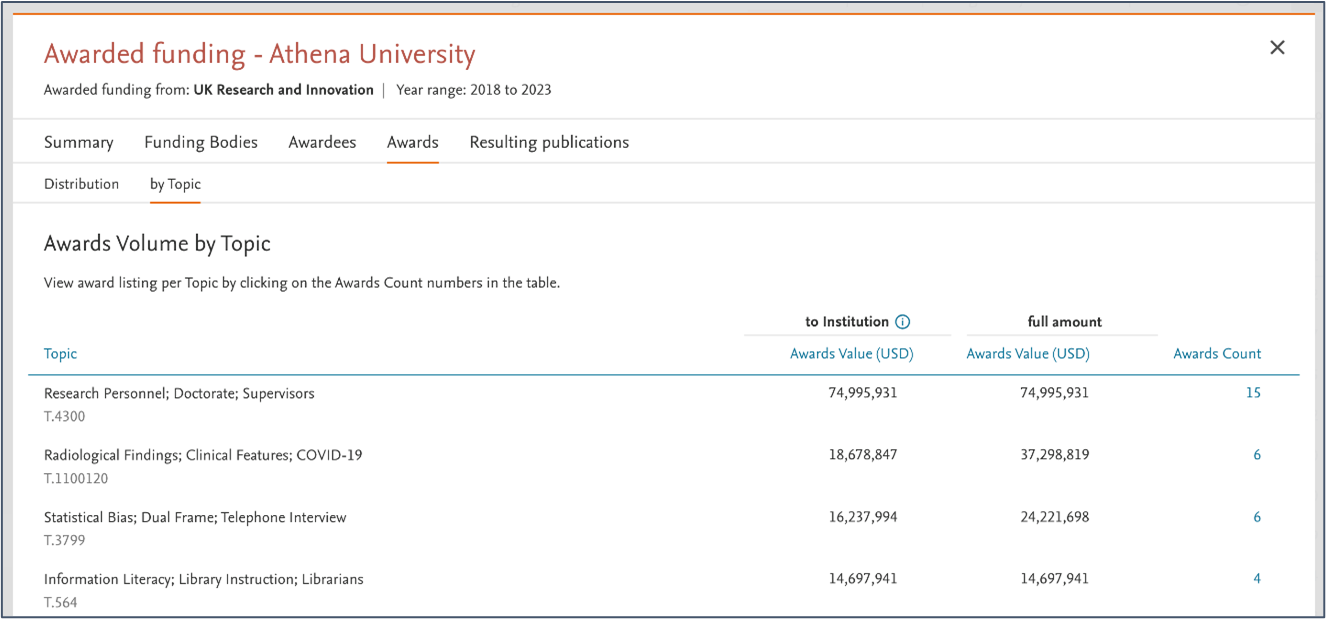
You can also find co-awarded allocation information under Awards by Topic distribution tab.
With the August release, we want to encourage you to consider how you can support the journey toward a “net zero” future. You can check the previous release notes from 2022 – 2023 for ideas on how to reduce your carbon footprint.
The Net Zero release brings you the ability to include Rankings information into your collaborator evaluations, approximation guidance for the new THE WUR 2024 rankings metrics, and an improved entity panel search workflow.
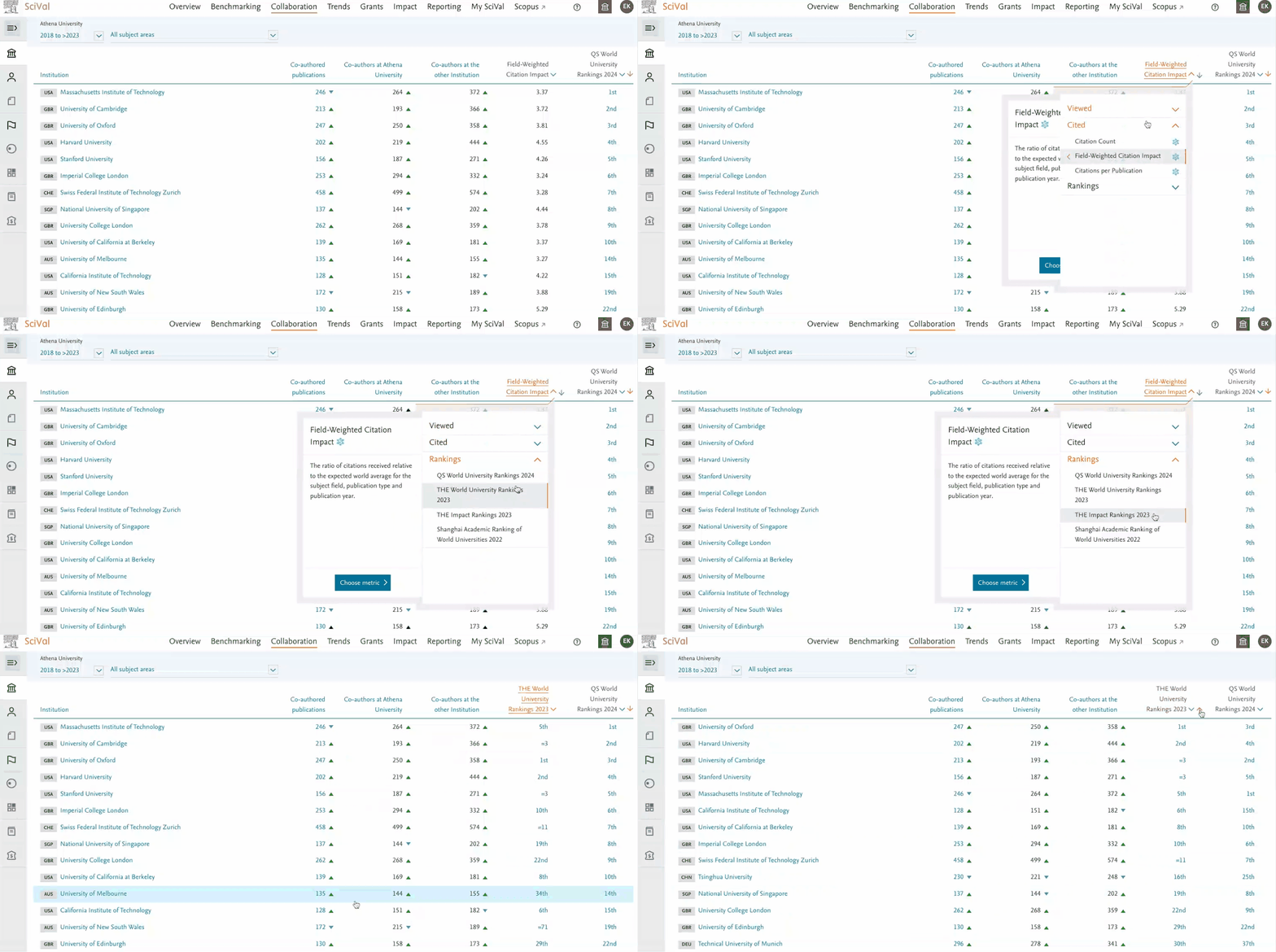
- Compare your collaborators by their overall rank in major university rankings in Collaboration module tables
Analyze your current and potential collaboration partners based on their overall rank in 4 Rankings supported in SciVal. You can now select among THE World University Rankings, THE Impact Rankings, QS Rankings and Shanghai Rankings in the metric selector for Institutions to populate the table with the rankings of interest.
- THE World University Rankings 2024 – approximation guidance for the upcoming new rankings metrics
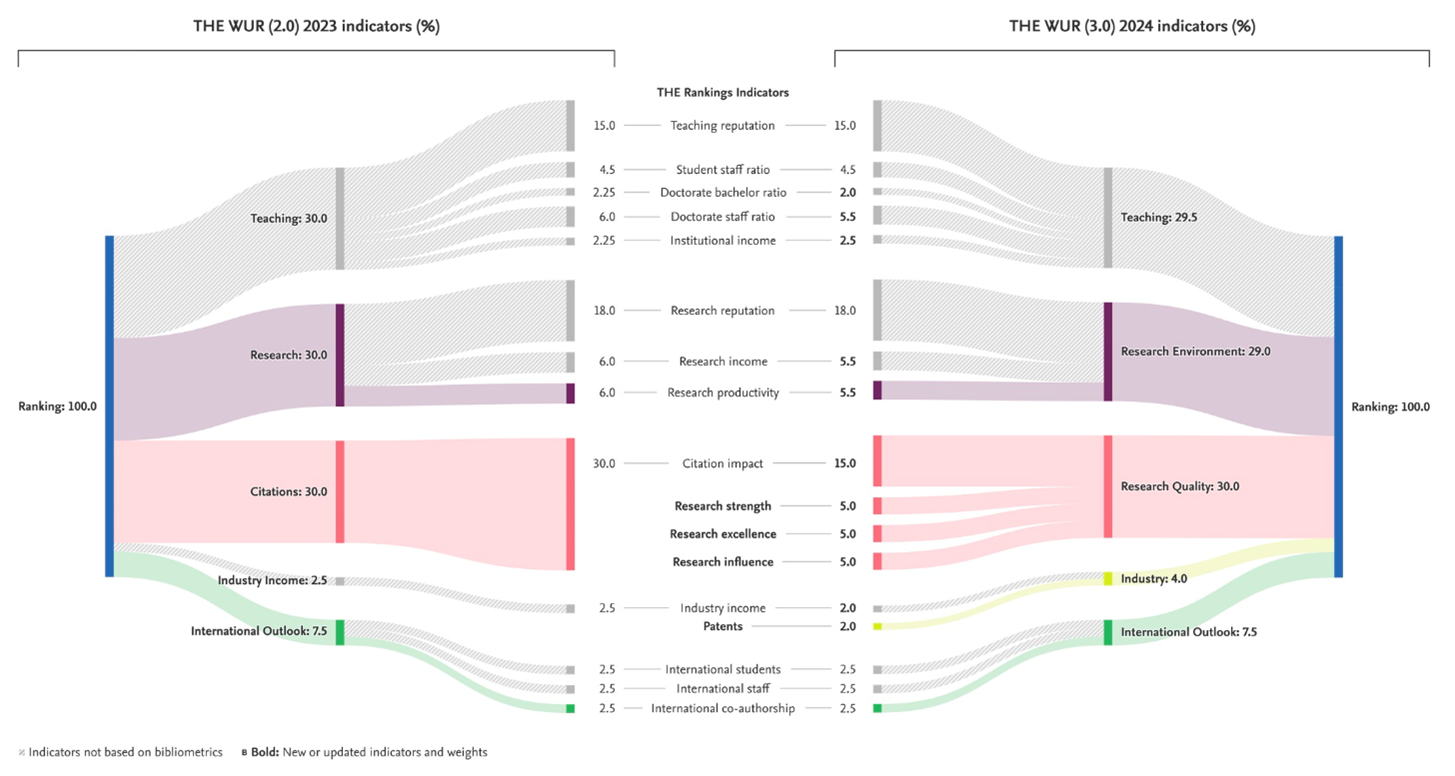
Times Higher Education (THE) updated the rankings methodology from 2023 to 2024. In preparation for THE WUR 2024 release in SciVal, expected in October, we are providing guidance around the changes related to the bibliometric indicators, and how to approximate the upcoming underlying bibliometrics.
Learn moreopens in new tab/window
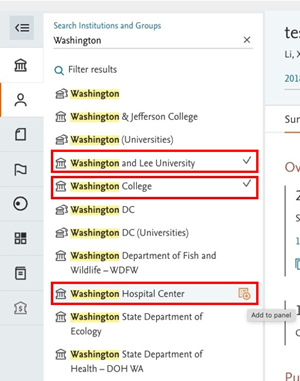
- Add multiple search results to the entity panel in one go with an improved workflow
You can now add multiple search results to your entity panel without the need to perform the search again. Simply hover over the entity and select the “Add to Panel” icon.
- 2023 SDGs now visible in SciVal
SciVal now contains the 2020, 2022 and 2023 SDGs as Research Areas, so you can see which of your entity’s publications have been mapped to each SDG. Learn more about the new 2023 mappingsopens in new tab/window.
Collaboration module
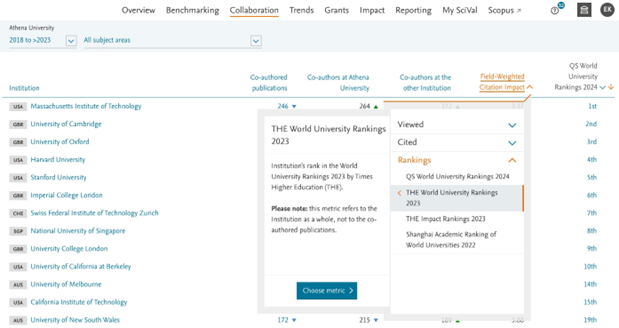
- Compare your collaborators by their overall rank in major university rankings in Collaboration module tables
Analyze your current and potential collaboration partners based on their overall rank in any of the 4 Rankings supported in SciVal: You can now select among THE World University Rankings, THE Impact Rankings, QS Rankings and Shanghai Rankings in the metric selector for Institutions to populate the table with the rankings of interest.
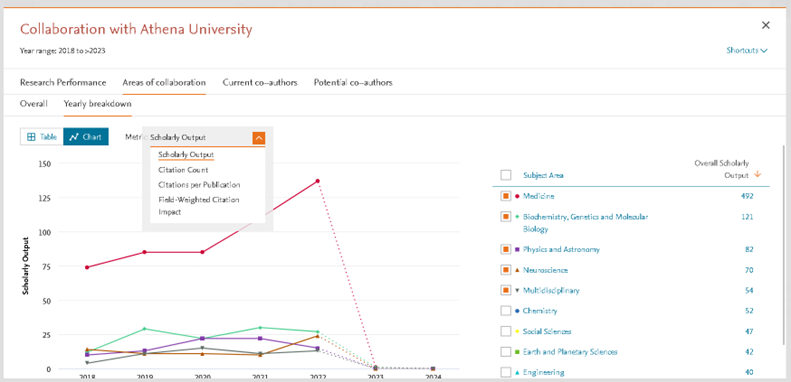
- Track how your Institution's collaborations have developed in specific fields with the new yearly breakdown by subject area
The new yearly breakdown by subject area allows you to see with more granularity how your collaborations have developed over time. Track in which fields your collaborations grew or declined over the years, and how this compares to the overall performance of the collaborating Institutions in the subject areas of interest. The chart view also allows you to drill down into the sub-categories of a selected subject area for more in-depth analysis.
The yearly breakdown can be found in the Collaboration module, underneath the “Areas of Collaboration” tab in the details modal.
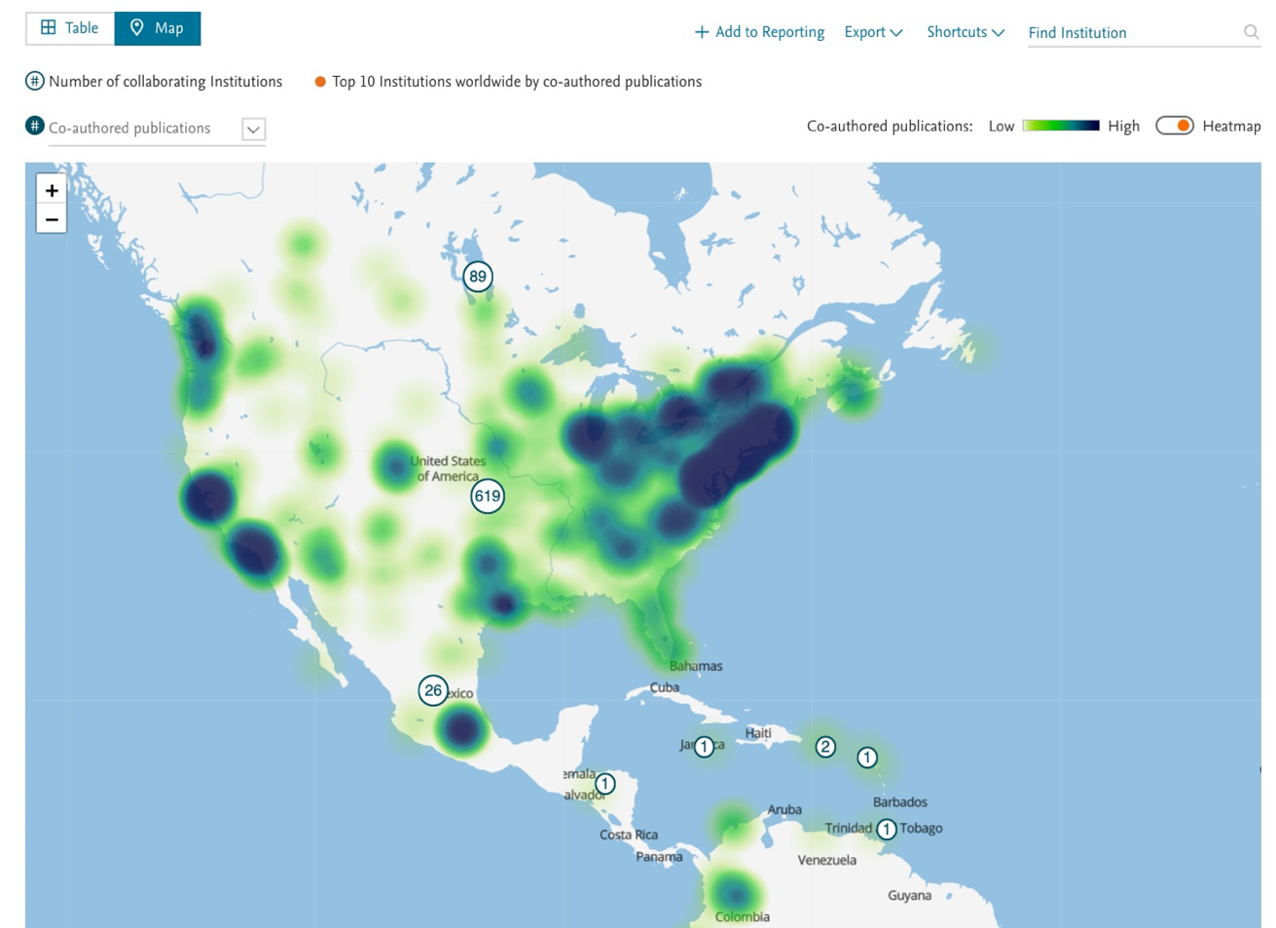
- Gain granular insights on the geographical location of your collaborators with the new heatmap
The heatmap for current Collaborators has been improved to be based on the location of the collaborating Institutions instead of the Country / Region level. This provides more specific and detailed insights into the collaborative links of an Institution of interest. The new heatmap is available in the 'Collaboration module - Map visualization' in the 'Current collaborators' tab.
Impact module
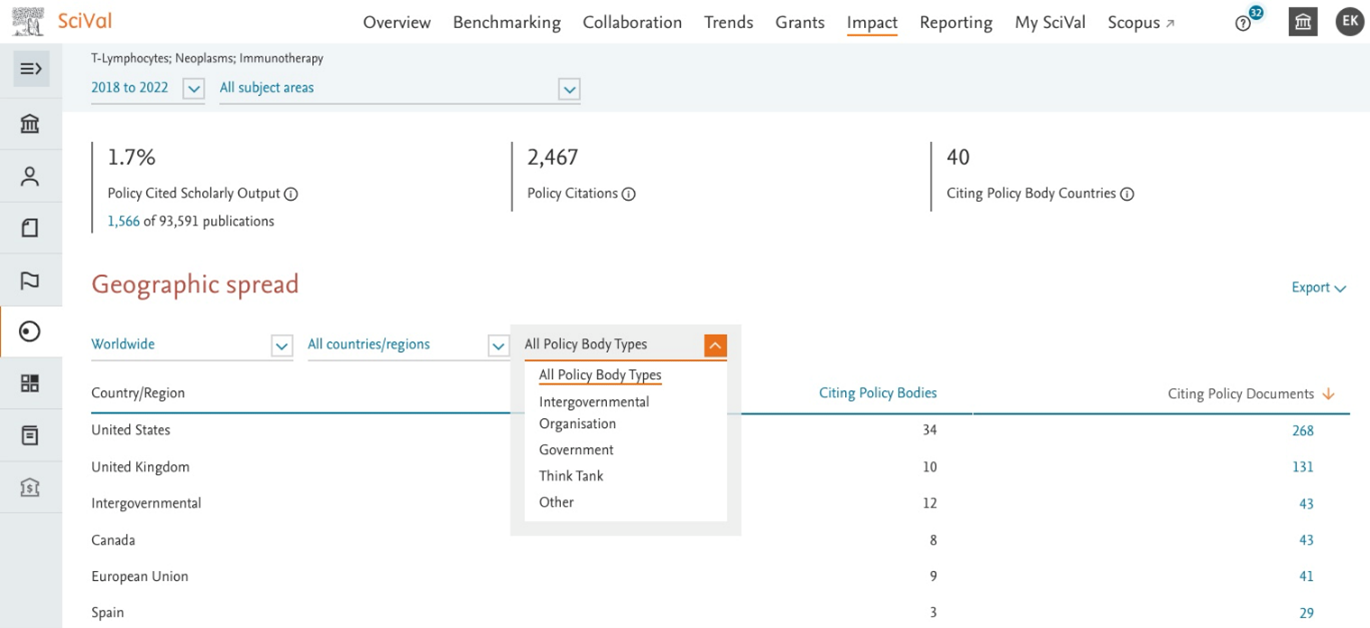
- Analyze the geographic spread of Policy bodies citing an entity's research
The “Geographic spread” section in the Impact module details the countries where the Citing policy bodies are located, providing insight into where in the world the entity's research is having impact in terms of being cited in policy documents. You can further filter on a specific country / region or type of Policy Body of interest.
The new section is available on the Summary pages for all entities supported in the Impact module.
Grants module
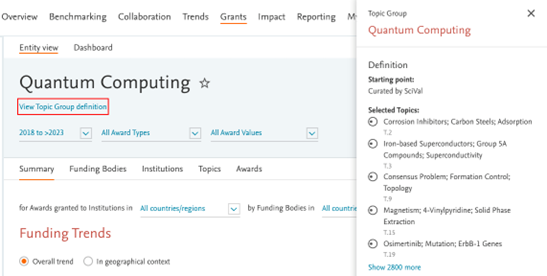
- View the Topic Group definition
The Topic Group definition is now available in the Grants module, so that you can easily check the list of Topics included in a Group.
Other release items
- Net Zero Research Area has been updated with new publications. The Net Zero dataset is a combination of publications from SDG 7 and energy related publications from SDG 13. It now leverages the latest Elsevier 2023 SDG mappingsopens in new tab/window and contains publications from 2011 to 2022.
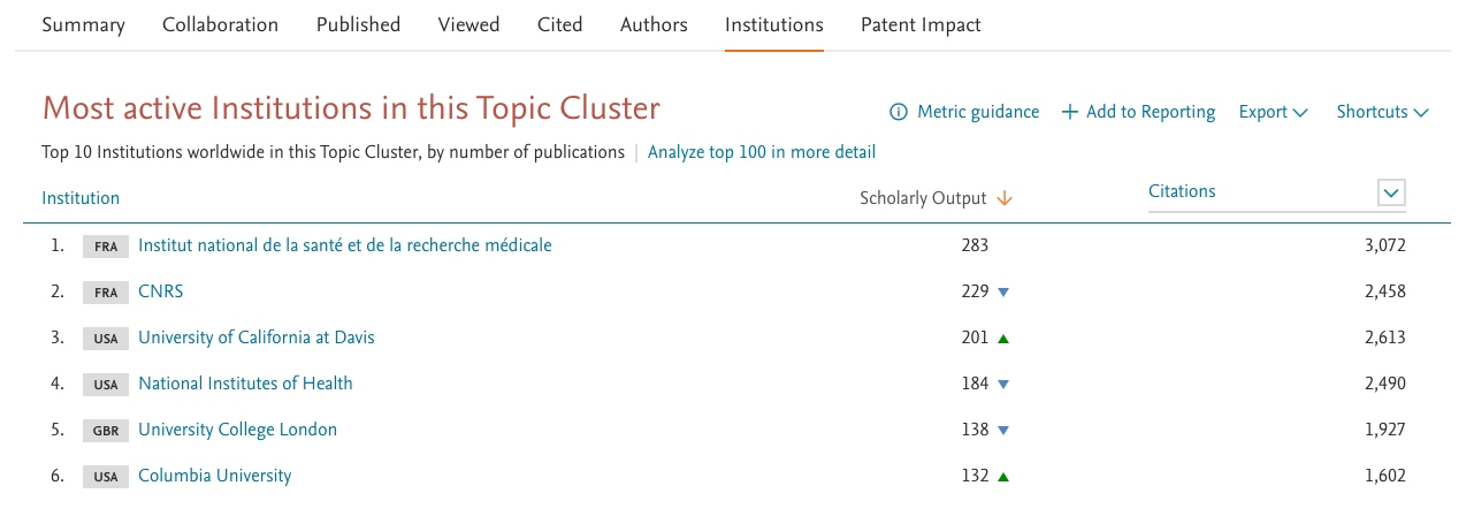
- To help alignment with other data sources you may be using, we moved away from using flag images to the international standard of Country/Region alpha-3 codes (ISO 3166). The codes will be displayed in places where flags were the only indication of the Country/Region, such as in Institutions tables.
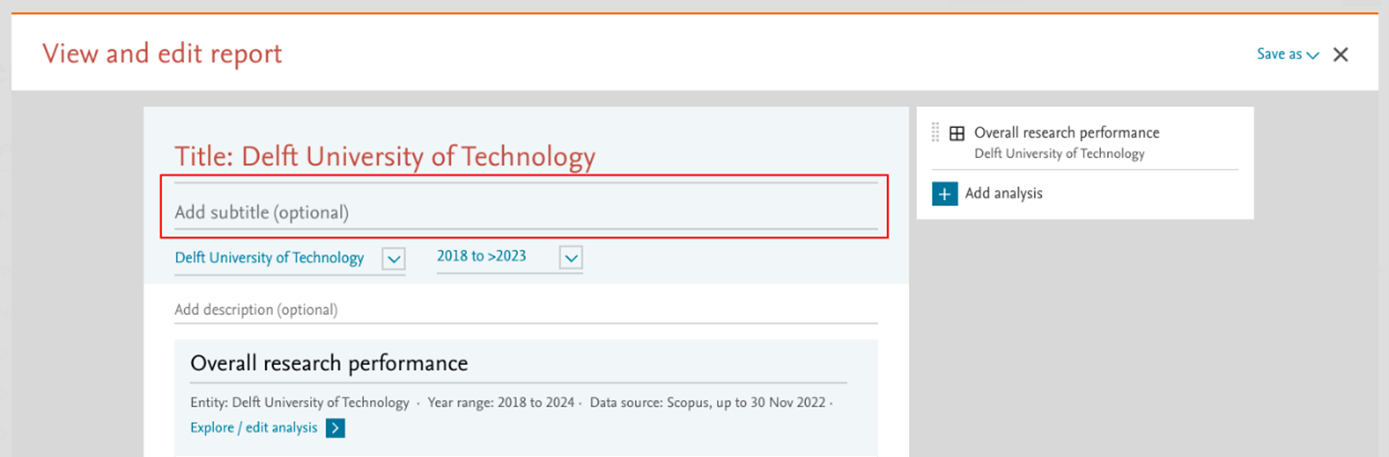
- A subtitle field is now available in reports so you can provide greater context to analyses.
The second phase of the Mangrove release adds the bibliometric data from the QS World University Rankings (WUR) 2024
- QS World University Rankings 2024 – Generate insights based on the actual bibliometric dataset considered in the QS WUR
Gain a deeper understanding of the bibliometric dataset underlying your institution’s ranking scores in the QS World University Rankings 2024 (announced June 27th, 2023). Analyze the drivers behind the Citations per Faculty (20% of Ranking) and International Research Network (5% of Ranking) to understand more fully your institution’s position. Use the metrics guidance to understand how each metric is calculated.
Please note that the data provided in SciVal, are the underlying data provided for rankings analysis and are not the scores that you'll find on the QS Rankings website (topuniversities.com). The SciVal data will help you understand how the final scores for you and your peers were derived.
The July release is dedicated to Mangrove forests for their ability to store excessive carbon dioxide, act as natural buffers against storms, hurricanes and coastal erosion and for supporting biodiversity through offering critical habitats to a diverse array of animals and plants.
The Mangrove release brings you the ability to include publication language into your analysis and to easily find metrics with the new search functionality in Benchmarking among other items.
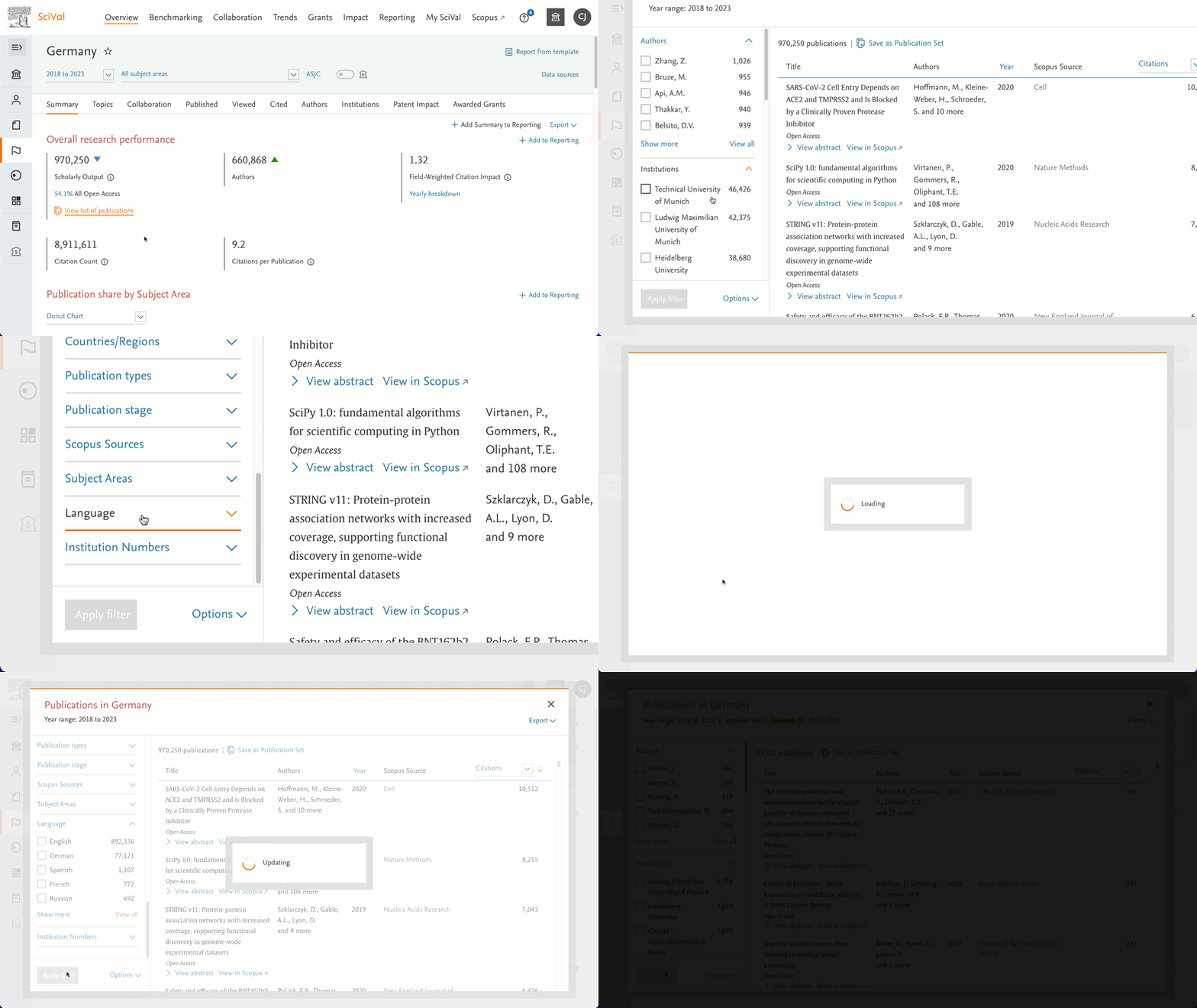
- Understand and analyze the language of publications of interest
With the new filter added to the publication modal, you can now incorporate publication language into your analysis to deepen your understanding of publications of interest. It is also possible to include the language field when exporting lists of publications.
Benchmarking module
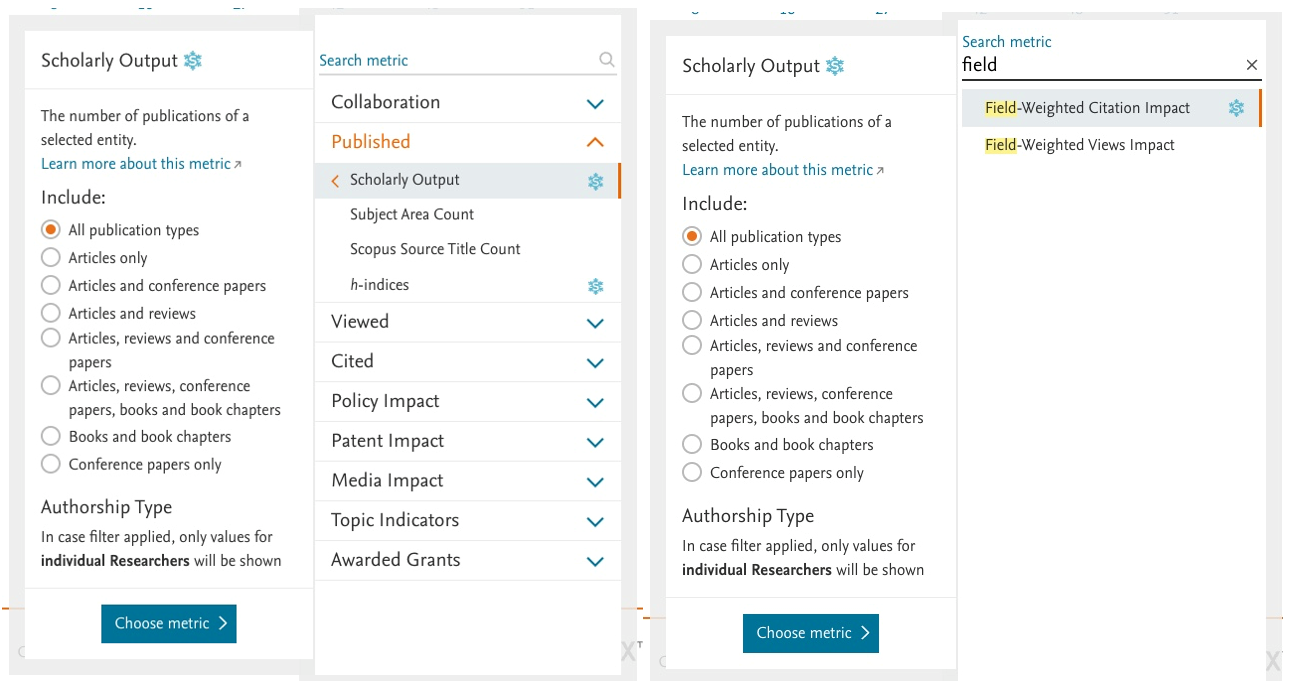
- Find metrics easily with the new search functionality in Benchmarking
The new search capability in the metric selector modal within the Benchmarking module allows you to quickly find and add the metrics required for your analyses.
Collaboration module
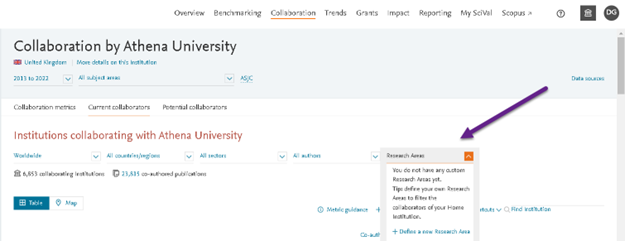
- Focus quickly on collaboration partners within your user-defined Research Area straight from the Collaboration module
The Research area filter lets you retrieve current and potential collaboration partners of your home institution in your specified field of interest. Previously located in the subject area filter section, we have now moved the filter to the main module section for increased visibility and easier access. Using the shortcut, you can also create a new research area straight from the filter to start your analysis.
Other release items
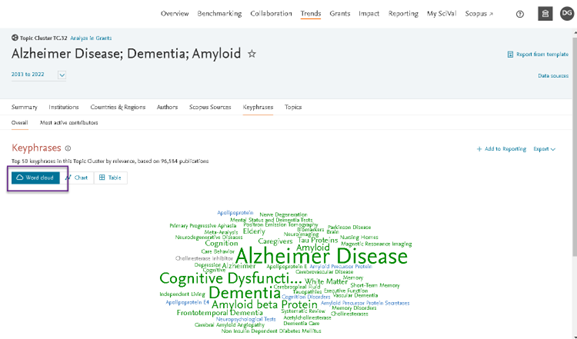
- We have added the Word cloud as a visualization option to the Keyphrases tab in the Trends module, making all Keyphrase analyses available in one place. The Word cloud additionally remains available on the Trends Summary page.
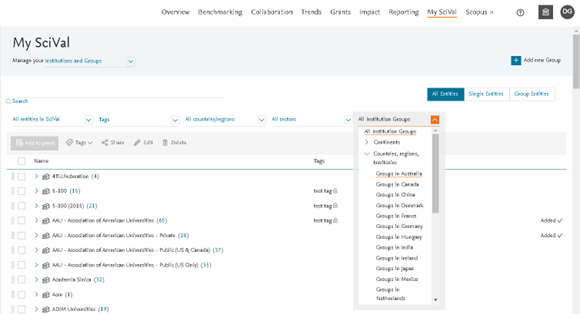
- The Institution Group and Country Group filters in My SciVal have been moved out of the “All entities in SciVal” into their own filter category.
With the June release, we want to encourage you to turn to LED lights (Light Emitting Diodes) for their energy efficiency, reduced carbon footprint and longer life span. Remember to check your local regulations on how to dispose of LEDs for recycling.
The LEDs release brings you the ability to analyze the bibliometric dataset used in the THE Impact Rankings 2023 in SciVal, along with some additional improvements to the Impact and Grants modules. Furthermore, the yearly rollover brings you updated year ranges and the latest CiteScore, SNIP and SJR values as well as recalculated Prominence percentile.
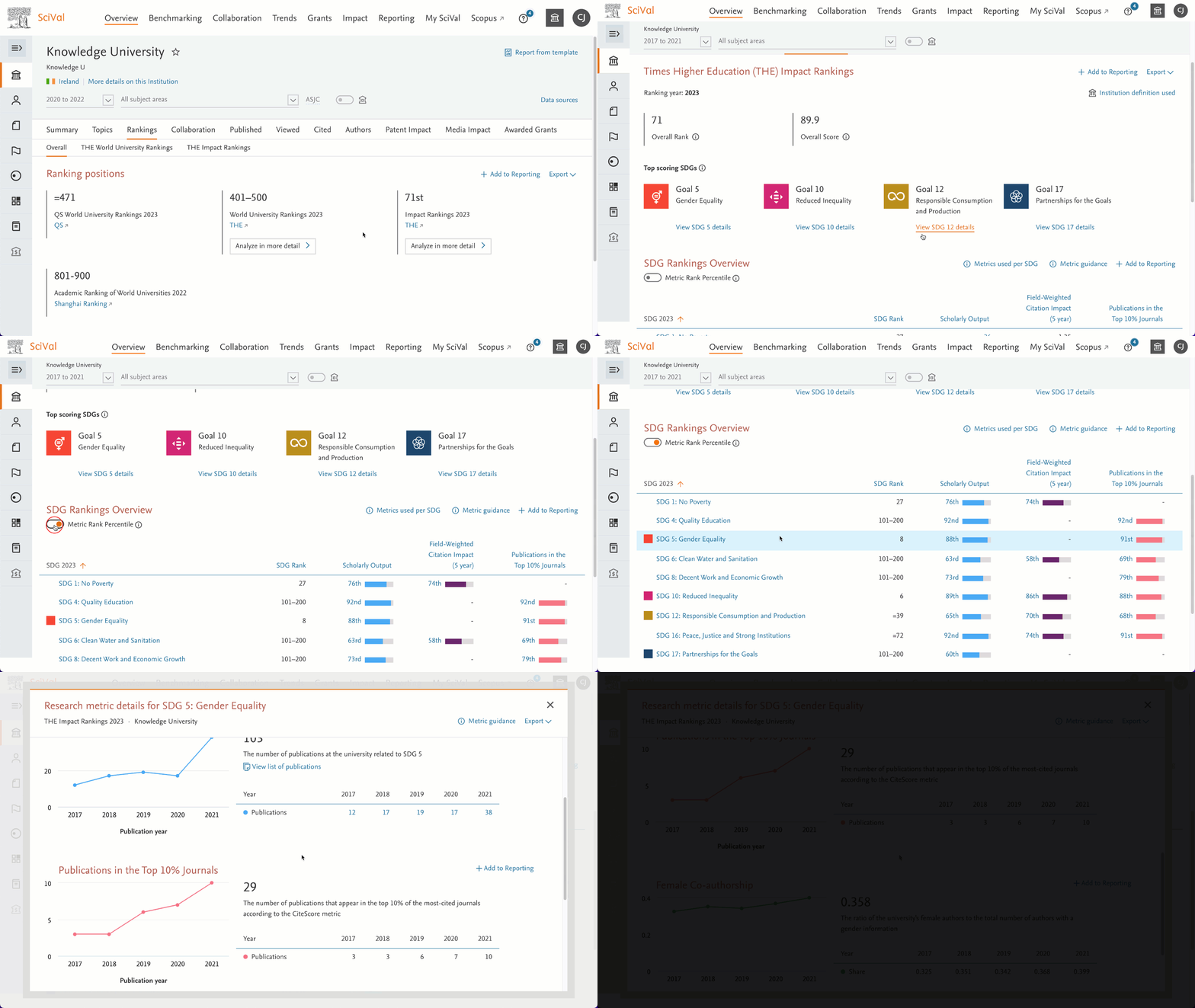
- THE Impact Rankings
Generate insights based on the actual research metrics used in the THE Impact Rankings 2023. SciVal provides an overview of the major research metrics used per SDG in the THE Impact Rankings, enabling you to visualize trends and complete in-depth analyses for each publication year. Learn more
- Yearly rollover
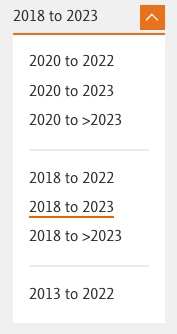
Each year in June, the Scopus content for the previous year (i.e. 2022) is considered over 95% complete. This is the point we make it a “complete year” in SciVal and we then move our pre-defined time ranges in the Overview, Collaboration, Trends and Grants modules, forward by one year. The new ranges are used to calculate the latest metric values and also make some changes to the Topics and Topic Clusters as below:- Recalculate the Prominence Percentiles for all Topics and Topic Clusters using the 2022 CiteScore metrics
- Reallocate papers published in 2020 from their current Topic to a more dominant Topic where applicable
Learn more about the yearly rolloveropens in new tab/window
Impact module
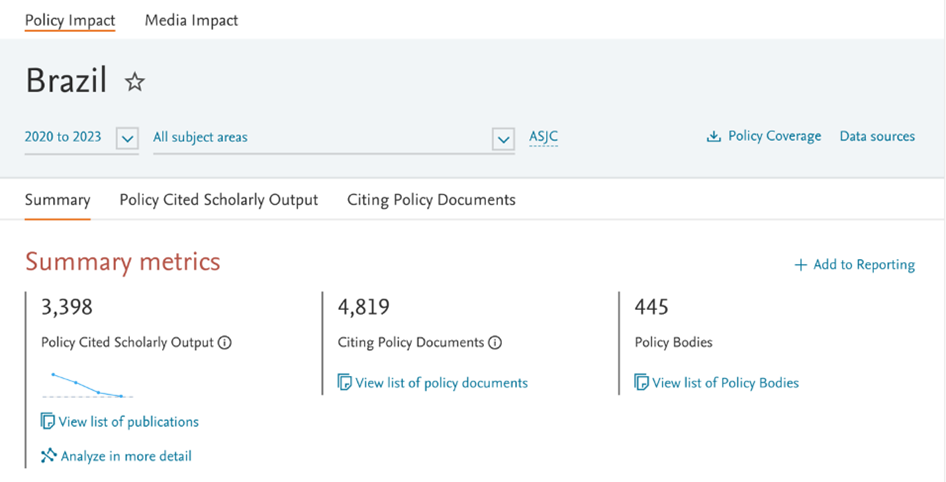
- View the list of citing policy bodies for an entity of interest
Get an overview of the policy bodies citing the Scholarly Output from your entity of interest, then filter and export the list for further analysis.
- Export additional policy citation data
Now available from the Policy Cited Scholarly Output tab, get detailed data about the policy documents citing your entity’s Scholarly Output as part of your publication export.
Grants module
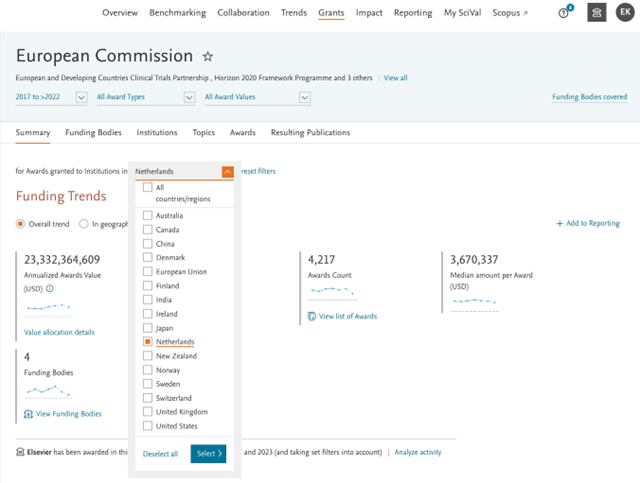
- Explore a Funding Bodies activity within a country or countries of interest
When exploring a Funding Body profile, the new Institutions country filter enables you to focus your analyses on relevant countries. For example, you can explore Awards granted by the European Commission to Institutions in the Netherlands.
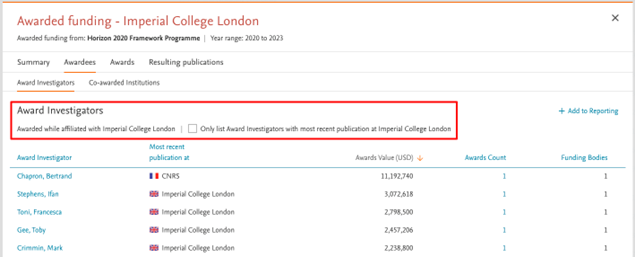
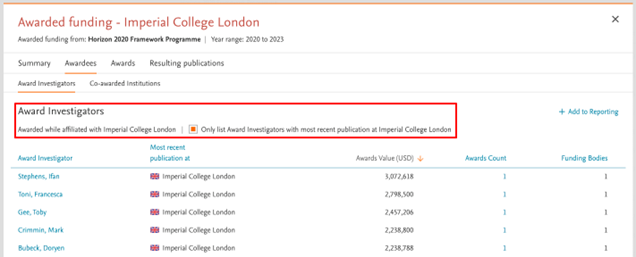
- Filter out Award Investigators not affiliated with the Institution
By default, when exploring Awardees within an Institution, you see details of all Investigators awarded while affiliated with this Institution. You can now see the current affiliation of the Awardees based on their most recent publication and choose to filter out the Awardees not affiliated with the Institution you are analyzing.
- Easily add Topics to your entity panel from any Topic listing in Grants
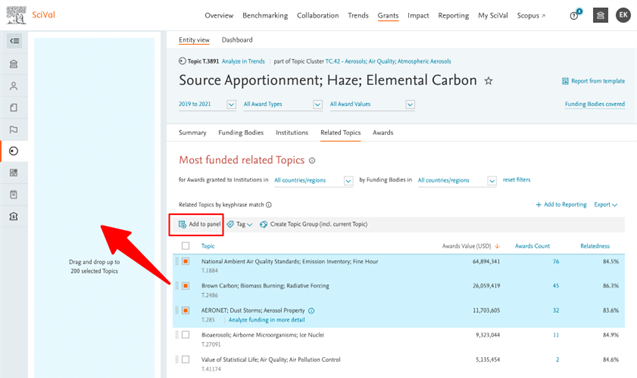
Drag and drop selected Topics and Topic Clusters from any listing in Grants to the entity panel, to further analyze across SciVal. You can also use the ‘Add to panel’ option on top of the listing.
With the May release we would like to highlight the importance of extending the life of products for combatting climate change. Keeping and using things for longer reduces the amount of raw materials, energy, and water needed to manufacture new goods and the amount of waste generated. Maintaining, repairing and reusing items doesn’t only lessen the impact on the environment, but also saves money.
The Keep release brings you the ability to track how your collaborations developed over time and exclude kilo authored papers from country and region analyses in collaboration among other items.
Collaboration module
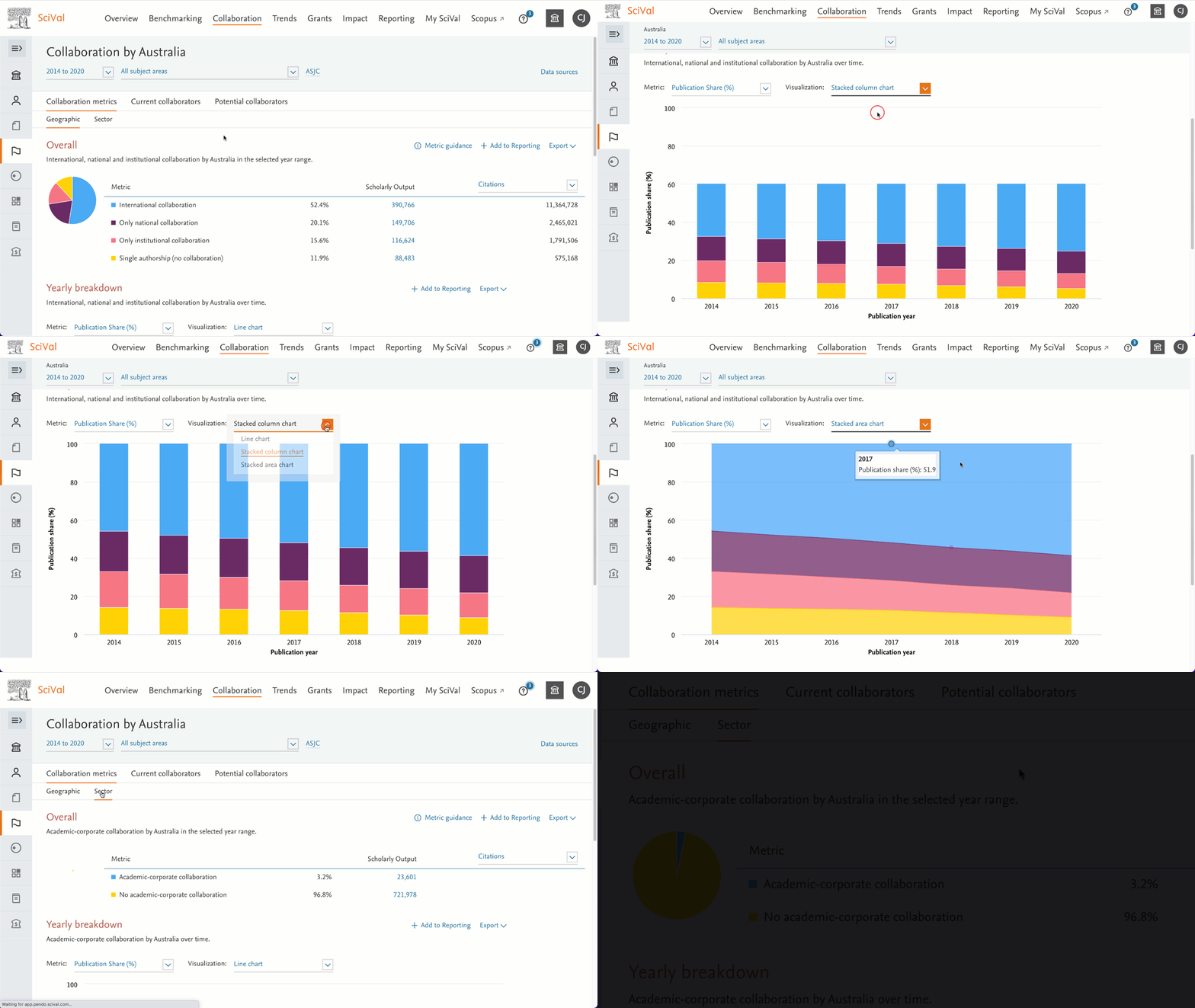
- Track how your collaborations by sector and geographic location developed over time on the new metrics pages in the Collaboration module
We have added a new tab - “Collaboration metrics” - for all entities supported in the Collaboration module. The pages within the tab provide you with metrics, at an aggregated level, around collaborations by sector and geographic location - as can be found in the Overview module, so you can now access all Collaboration information in one module.
Additionally, the yearly breakdowns for both metric categories let you analyze how your collaborations have developed over time. Select from a range of metrics, such as Publication Share (%) or Field-Weighted Citation Impact, and choose one of the different visualization options to assess how your collaborations such as International collaborations, or Academic-Corporate Collaborations, have grown or declined in volume and performance over the years.
- Filter out kilo authored papers at Country/Region level with the extended author filter
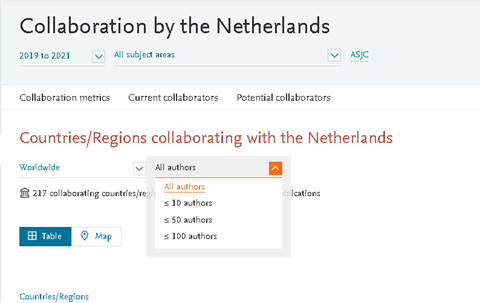
The author number filter is now available for Countries/Regions in the Collaboration module, allowing you to limit your collaboration analysis to publications with less than 10, 50 or 100 authors.
- Land back on the same tab within the details modal page when analyzing multiple entities in the Collaboration module
Your tab choice and configurations in the details modal are now remembered within your active session, bringing you back to the tab of interest when conducting analyses for multiple entities consecutively.
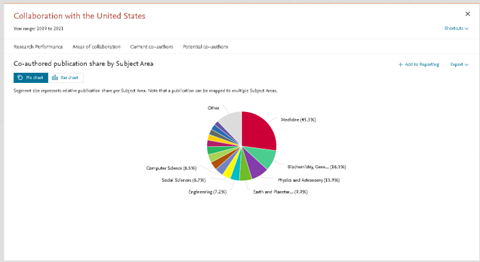
- Improvements to pie chart visualization in the “Areas of Collaboration” tab
We changed the way that percentages are calculated for the pie chart in the “Areas of Collaboration” tab within the details modal: the percentages now relate to the number of Scholarly Outputs collaborated on, as opposed to previously when a publication was counted multiple times if it was mapped to several subject areas. This update aligns the behavior of the visualization in the Collaboration module with the Overview module.
Impact module
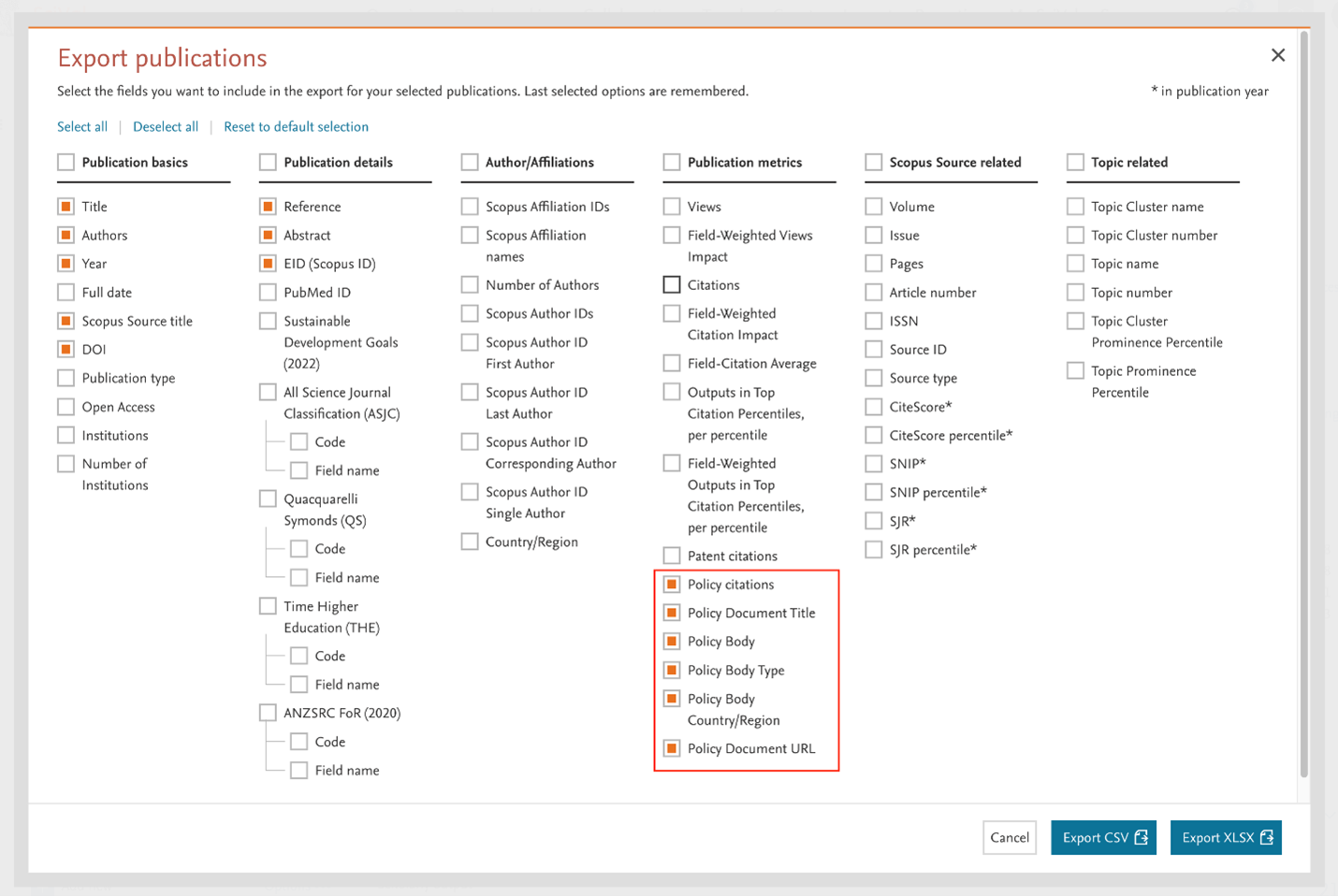
- See which policy documents are citing your Scholarly Outputs in the export
You can now export 6 different policy related fields as part of the expanded publication export in the Impact module.
Grants module
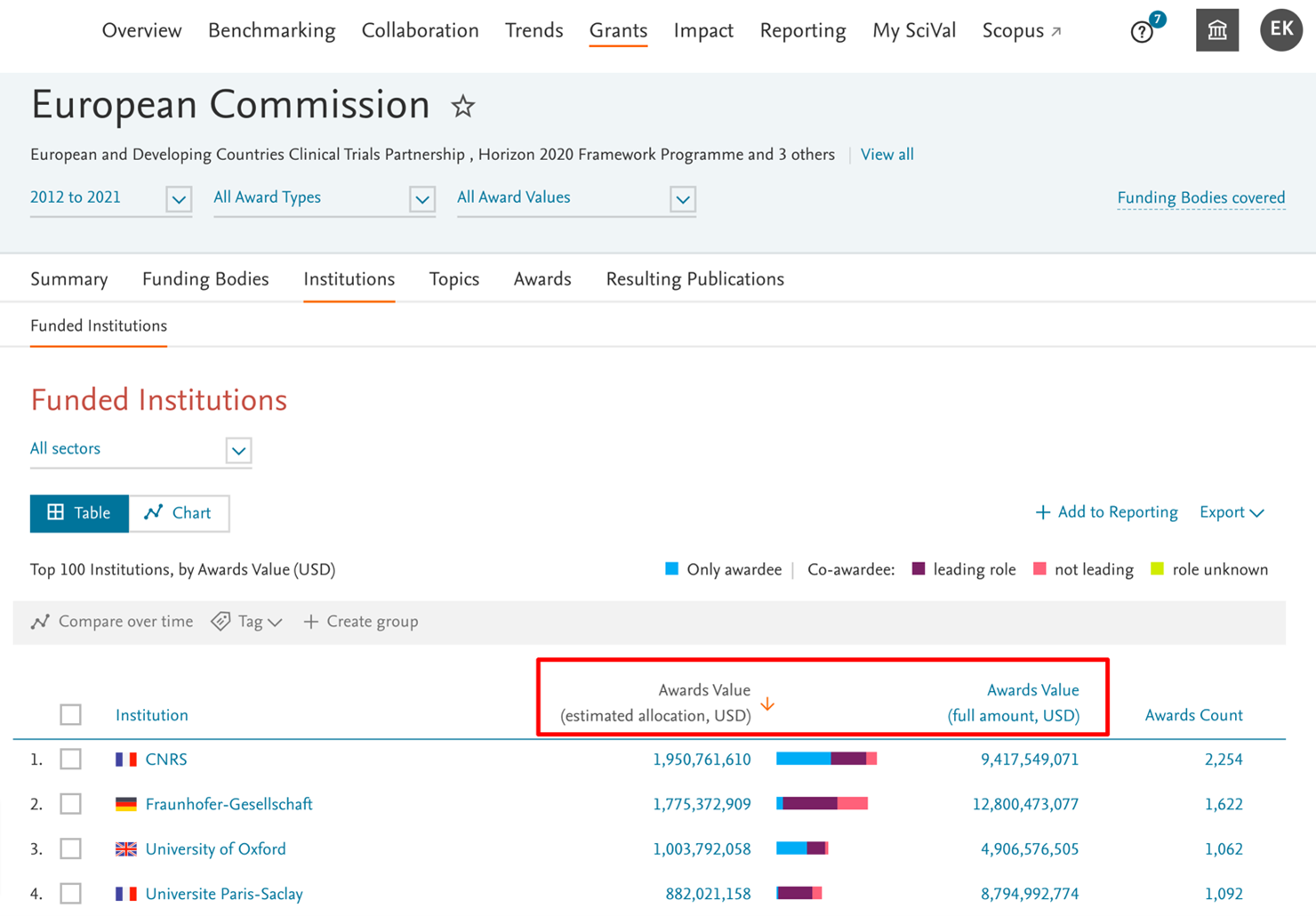
- Awards Value allocation to Institutions for co-awarded grants
When looking at Institutions in the Grants module, you will now find both the full amount and co-awarded allocation Awards Value metric. The exact allocation is used when the details of the awarded allocations per institution is available and when it is not, the Awards Value is evenly distributed to each awarded Institution as an estimation in this metric.
Example: if an award worth $3,000,000 is allocated to six Institutions, each Institution will show the exact allocation they received or where this information is not available each Institution will show an estimated Awards Value of $500,000.
Awards Value (full amount, USD) allocates the full award amount to each Institution.
We will continue improving our methodology, but the new estimated allocation value represents a funding landscape that is closer to reality.
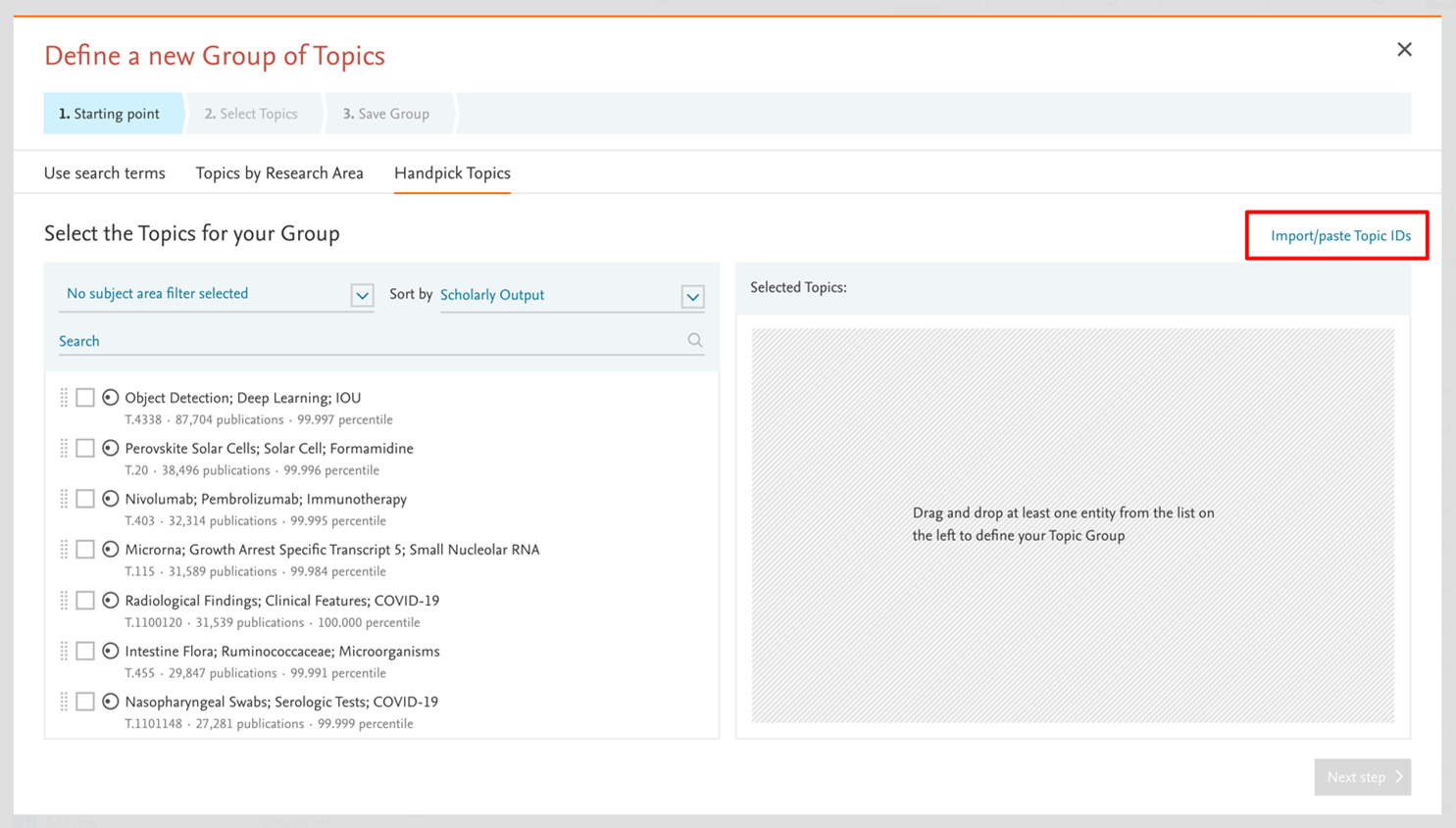
- Create Groups of Topics by importing Topic IDs
Import Topic IDs (Topic Numbers) from your previous analyses to analyze them as a Group in the Grants module. This is a new method to define a Group of Topics, in addition to already available options to use search terms, choose Topics from Research Areas and handpick Topics.
Other release items
- Field-Weighted Mass Media metric is now removed from the Overview and Benchmarking modules. The metric was rarely used and after collecting your feedback for several months, we took the decision to remove it to help streamline SciVal.
The March 2023 release is bringing your attention to the benefits of walking, jogging or running instead of driving. Physical activity has numerous health benefits, so you will not only be reducing your personal carbon footprint, but also taking care of your body. Let’s jog to a healthier and greener future!
The Jog release brings you the ability to view up to 200 filter results in the publications modal, a new filter option to identify Institutions from specific countries and sectors in My SciVal, and searchable country filters in Collaboration and Trends.
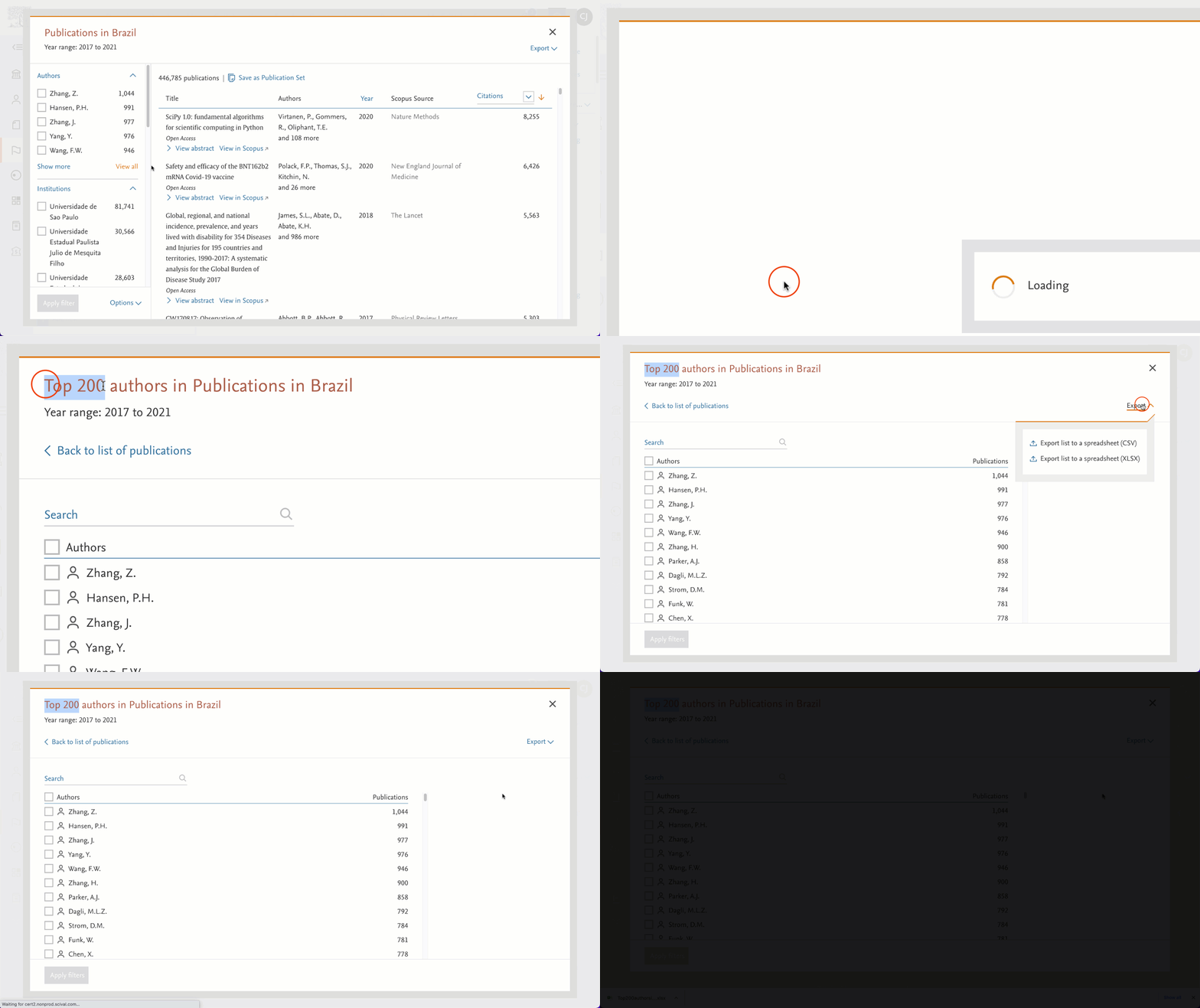
- View, export and use up to 200 results per filter group in the publications modal
We have doubled the number of filter results you can view, export and use in the 'View all’ section of the filter groups in a publications modal. You can now use these to further focus your publication results list to your area of interest, or you can export all 200 filters for further analysis offline.
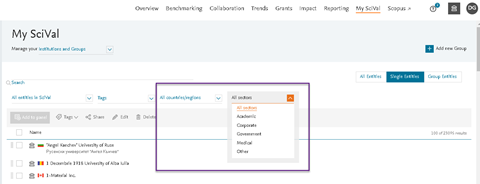
- New filters help you identify Institutions from countries and sectors of interest in My SciVal
Two new filter options for Institutions and Groups allow you to find Institutions from a specific country and / or sector in My SciVal and add them to your entity panel for further analysis.
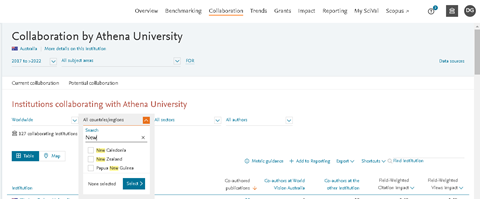
- The country filters in the Collaboration and Trends modules are now searchable
Simply type the name of the country you are looking for to quickly find the country of interest.
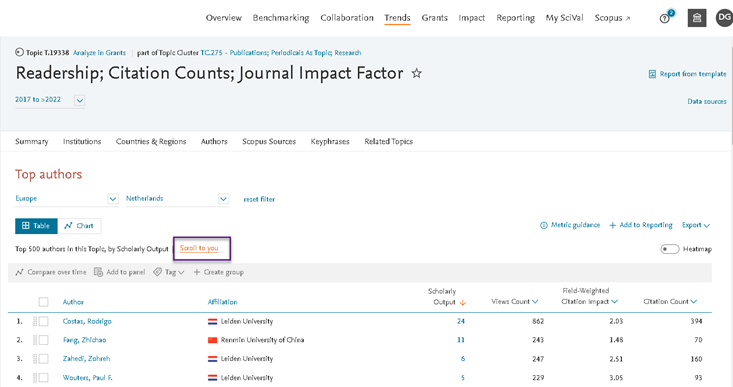
- Quickly find yourself in top author listings in Overview and Trends modules
Researchers who have connected their Scopus Author Profile to their SciVal profile will see the new “Scroll to you” link at the top of author listings if they are among the top authors for the entity and criteria selected.
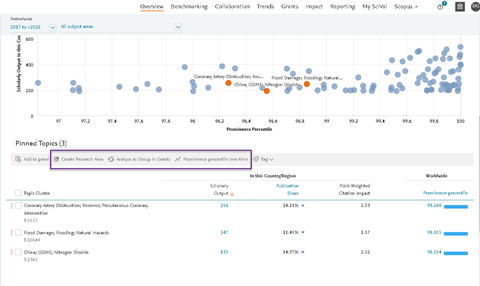
- Conduct further analyses on pinned Topics in the scatterplot with new options
We have added additional options to the action bar for pinned Topics, allowing you to create a Research Area based on your selection or populate the Benchmarking table to analyze the prominence percentile over time. Subscribers to the Grants module will also see the option to analyze the Topics as a Topic Group in the Grants module. The pinned Topics section can be found underneath the scatterplot in the Overview module Topics tab.
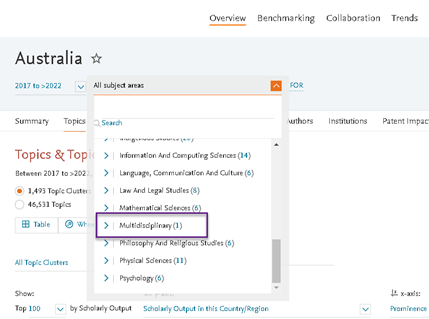
- Analyze multidisciplinary publications in the ANZSRC FoR classification
We have introduced an additional FoR category to capture content from Scopus Sources, such as journals, that are classified as multidisciplinary.
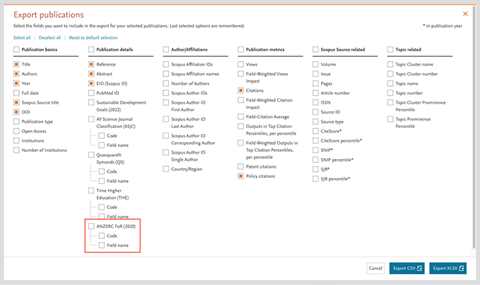
- Select the FoR classification as a publication export option
It is now possible to include the subject area names and codes for the ANZSRC FoR subject classification during the export of publication lists from the publications modal. The export fields capture both the parent level and the child level FoR categories.
Impact module
- Enhanced mapping of Policy Documents to Scholarly Outputs
This improved linking means you will see an increased number of Scholarly Outputs cited by Policy Documents. This will become available 2 weeks after the release.
Grants module
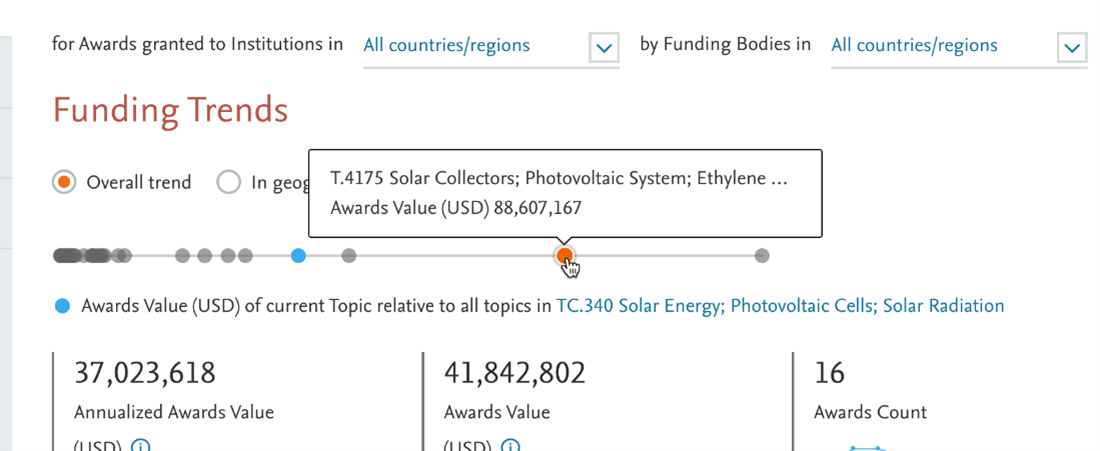
- More insights into Awards Value in a Topic with the Topic Awards Value chart
The new Topic Awards Value chart shows the Awards Value (USD) in the selected Topic relative to all other Topics in its respective Topic Cluster. This puts the Awards Value in context and helps you find and further analyze other Topics in the Cluster, for example, those with greater funding levels.
Other release items
- The Quantum Communications Research Area is now based on an advanced Scopus search query, resulting in updates with new publications on a weekly basis.
- The REF 2014 subject classification has been removed from SciVal. Instead, customers can use the REF Units of Assessment (UoA) Research Areas, to analyze the Scopus publications submitted by each institution to each UoA.
With the January 2023 release, we would like to encourage you to put some effort into insulating your house, so that it stays warm or cool in an efficient way. Besides saving on your energy bills, efficient energy consumption is a major contribution to battling climate change.
The Insulate release brings you the ability to create Publication Sets, Research Areas and Groups of Researchers of up to 200k publications and a new Institutions’ collaboration yearly breakdown.
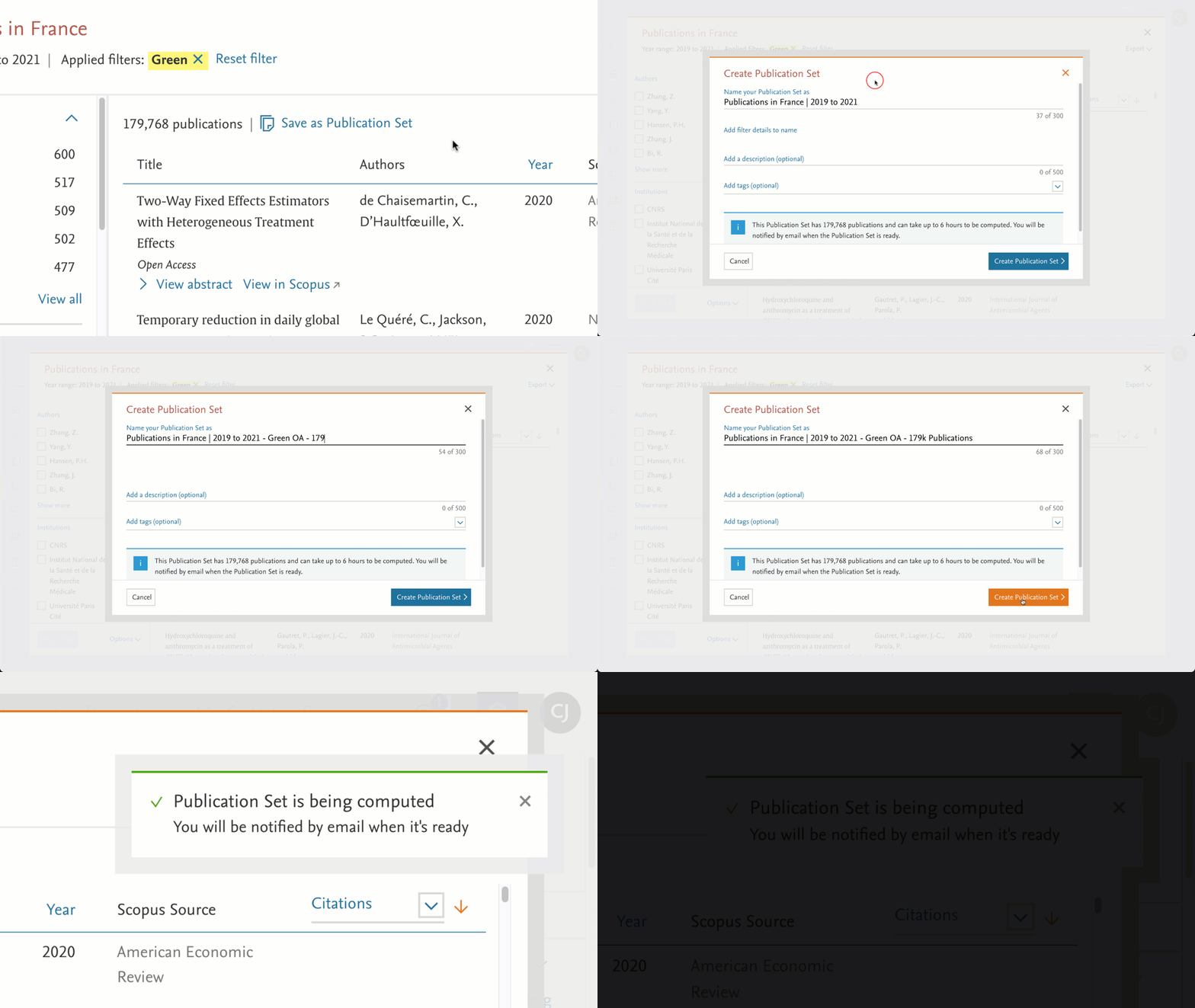
- Create larger entities for your analyses with the increased publication limit of 200k
The publication limit for user-defined entities has been doubled from 100k to 200k, allowing you to create larger Publication Sets, Research Areas and Groups of Researchers.
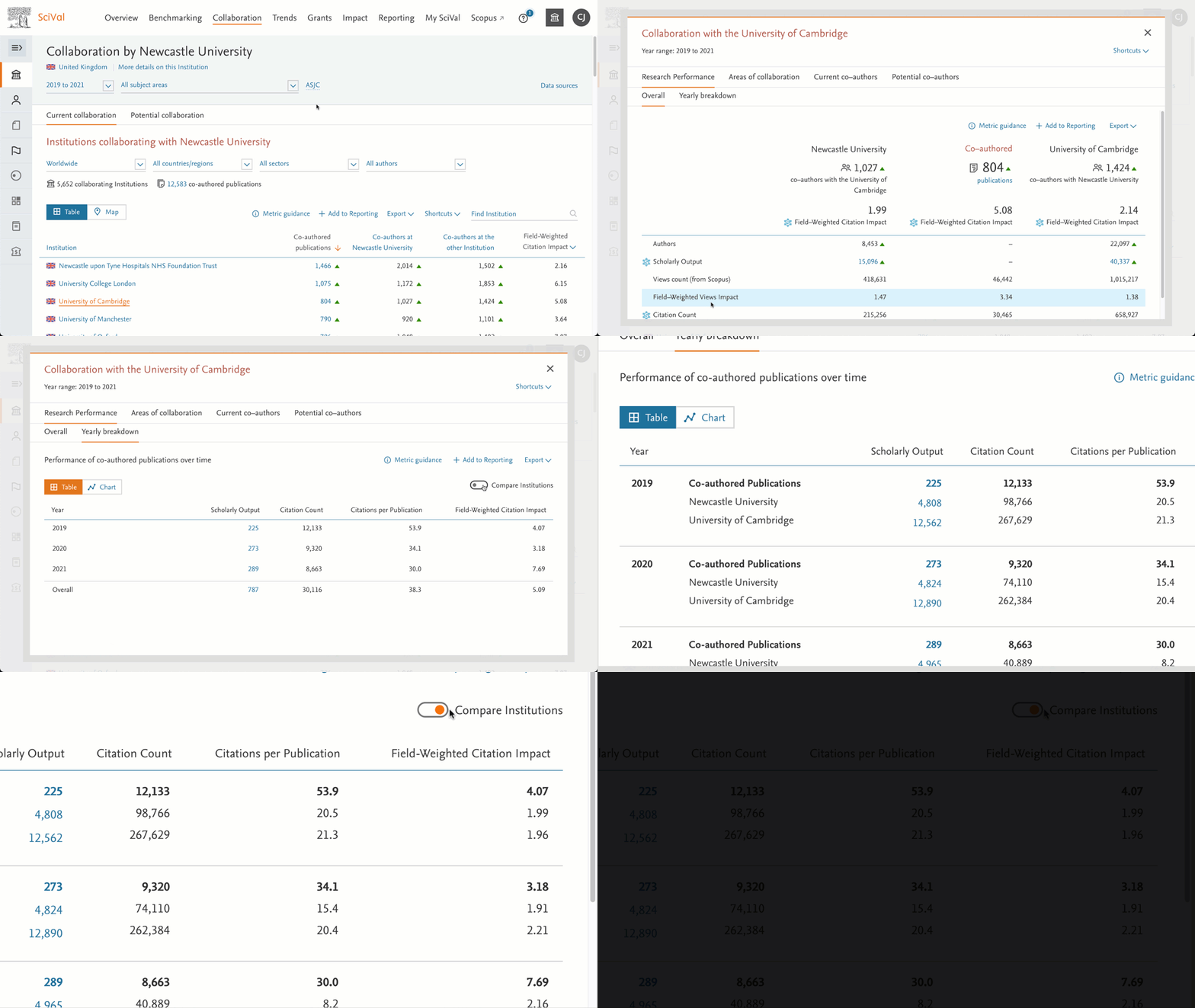
- Track how your Institution's collaborations develop over time with the new yearly breakdown
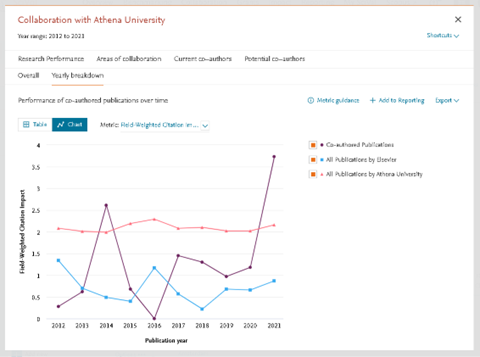
The new “Yearly breakdown” makes it easier to analyze how your collaborations have developed over time. Entering the details modal of collaboration with another Institution will provide you with a breakdown of metrics based on your co-authored publications by year, such as scholarly output, citation count, and FWCI. The “Compare Institutions” toggle further enables you to contextualize these metrics: how do our collaborative publications compare with the overall performance of all the Institutions publications? The yearly breakdown can be found in the details modal for Institutions in the Collaboration module, within the Research Performance tab.
Impact module
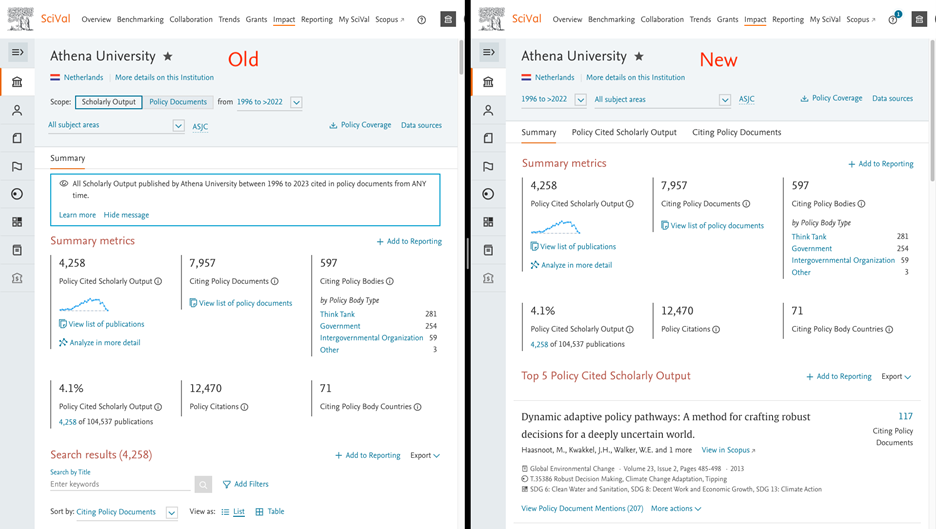
- New simplified Policy Impact layout
The new layout highlights the top 5 Policy Cited Scholarly Outputs and Citing Policy Documents and simplifies the interface. This layout will be used for additional data types that will be added in 2023.
Grants module
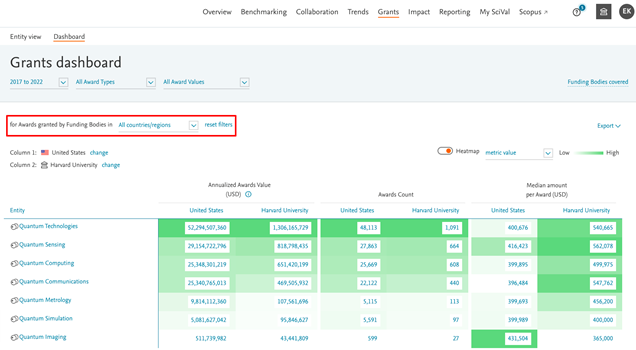
- Understand how research fields were funded by specific countries in the Grants dashboard
The new funding bodies country filter in the Grants dashboard enables you to understand how research fields were funded by specific countries.
SciVal APIs
- Publication Lookup API updates
- You can now retrieve the following via the Publication Lookup API:
- Topic and Topic Cluster of a publication.
- The latest 2022 SDG names, not 2020 SDG names.
 Current Release Notes
Release Notes 2021-2022
Release Notes 2019-2020
Release Notes 2017-2018
Did we answer your question?
Related answers
Recently viewed answers
Functionality disabled due to your cookie preferences