
View by category
How are Topics and Topic Clusters assigned to ASJC categories?
Last updated on November 15, 2024
Also available in
 Back to Topics FAQs
Each publication within SciVal is assigned to at least one ASJC category. The assignment comes from the journal in which the article is published. We look at all of the publications within the Topic or Topic Cluster and count the number of papers per ASJC category. The Topic or Topic Cluster is then assigned to its dominant ASJC categories.
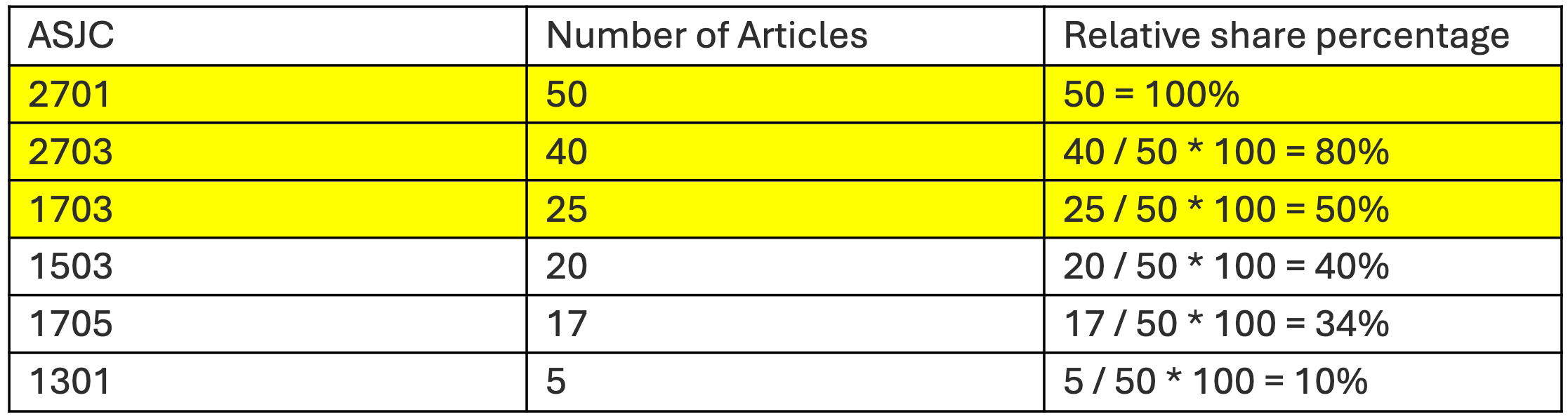
The dominant ASJCs are based on an implemented threshold which looks at the relative share of articles. The cut off threshold is 50%. The same methodology is used for both Topics and Topic Clusters.
Example: If Topic / Topic Cluster A (of any size) has ASJC articles as follows, only the highlighted ASJCs (2701, 2703 and 1703) would be retained.
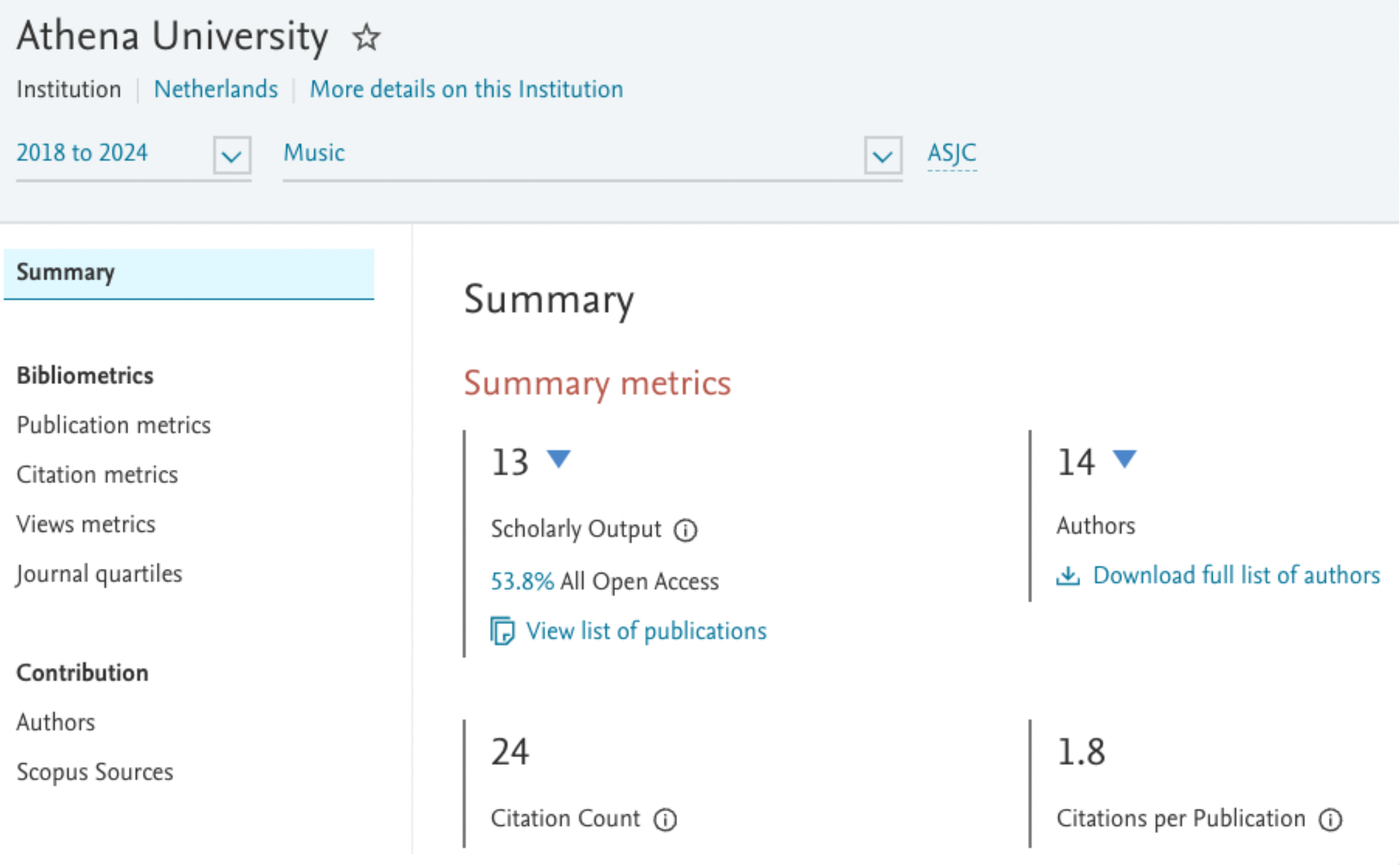
When a subject filter is used on Topics page, it is applied to the Topics/Topic Clusters and not to the publications within the Topics. As a result, the filter does not affect the metrics (Scholarly Output, Publication Share, FWCI and Prominence percentile), but instead displays the Topics/Topic Clusters which are returned based on the 50% threshold.
For example, this institution has only produced 13 publications when you select the subject area Music.
Keeping the same subject area and opening the Topics page, there are 15 Topics with a total of 49 publications.
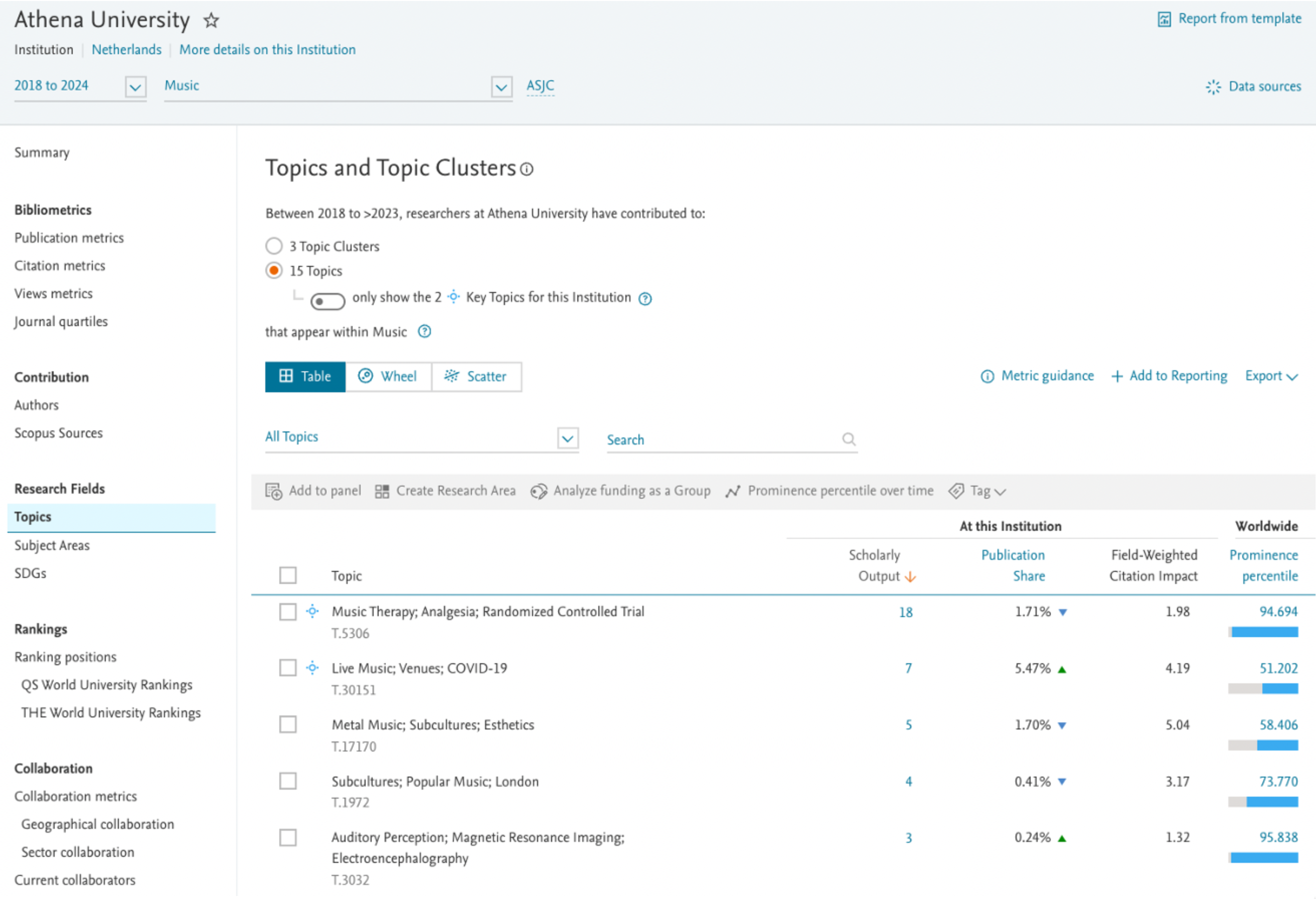
Why are there more than 13 publications, even though the same subject area is selected?
This is because these 49 publications belong to Topics where one of their dominant ASJCs is Music. SciVal no longer looks at the ASJCs associated with each publication (which come from their respective journals), but instead uses the ASJCs associated to the Topic. In this case, all of the publications in Topic T.5306 (Music Therapy; Analgesia; Randomized Controlled Trial), are associated with the ASJC Music, because that is one of the ASJCs associated to the Topic.
Did we answer your question?
Related answers
Recently viewed answers
Functionality disabled due to your cookie preferences