
Journal Author Guide to Alt Text for Images
Last updated on March 18, 2026
Introduction
Alt text (alternative text) is a textual description of the visual content and function of an image. It conveys the key elements to readers who use assistive technology such as read-aloud screen readers, meaning that everyone can equitably access and understand visual content. It also enhances content discoverability because alt text is indexed by search engines.
Alt text is a legal requirement. Elsevier cannot publish content without it.
The alt text is generated by suppliers that specialise in image descriptions using AI to generate the description, with human overview for complex images to ensure responsible use of AI. Authors are required to review the descriptions during proofing and to make changes where required.
In Elsevier’s PDF format journal articles, image descriptions are visually hidden and accessed by assistive technology. From April 2026, HTML article long descriptions are displayed on the page beneath the image.
To see how assistive technology such as screen-reader software reads the alt text for an image, see this example on ScienceDirectopens in new tab/window.
Depending on the complexity of the image, the description may be split into two parts: short alt text and a long description.
Terminology
Short alt text: A concise description of the image in up to 200 characters. All Elsevier images that communicate information have short alt text.
Long description: Many of the scientific images published in Elsevier content are too complex to describe meaningfully in 200 characters. In these cases, the short alt text introduces the image and a long description provides a complete description. A long description is a literal translation of the image, conveying all elements that are important to understand its intent and meaning. It may include multiple paragraphs.
Figure caption: Visible text that puts the image in the context of the rest of the text. It may briefly describe the image and/or its purpose but is generally not as visually rich as alt text. Each image has a figure caption alongside the alt text.
Together these text elements work together to give a complete description of the visual.
Key information about alt text
- Alt text should not repeat the caption or content from the surrounding text, unless necessary for clarity.
- The long description does not replace the figure caption, and the caption cannot replace the long description.
- Labels or other text within the image will be spelled out in the alt text.
- Alt text does not include assumptions or interpretations.
- However, it does highlight abnormalities, trends and other important lessons.
- Acronyms that may be read out accidentally as a single word by assistive technology include a space between each character, such as S A R S C o V 2.
- Decorative images that do not contain informative content do not require alt text.
Checklist for proofing alt text
Before proofing the alt text in your article, see the alt text example below, which shows how the visual, long description differs to the figure caption
Imagine that you are visually describing the image over the phone to somebody who needs to understand it. Check the description is:
- Accurate;
- Complete;
- Relevant to the purpose of including the image;
- Communicating key data and trends;
- Clear and concise.
What you will see in the proofing tool
Each image in the proofing tool will feature either short alt text or both short alt text and a long description. In the example below, these appear above the image. You will be asked to review the description(s) for each image and make any corrections, if required.
A Checklist for proofing alt text is above to guide your review.
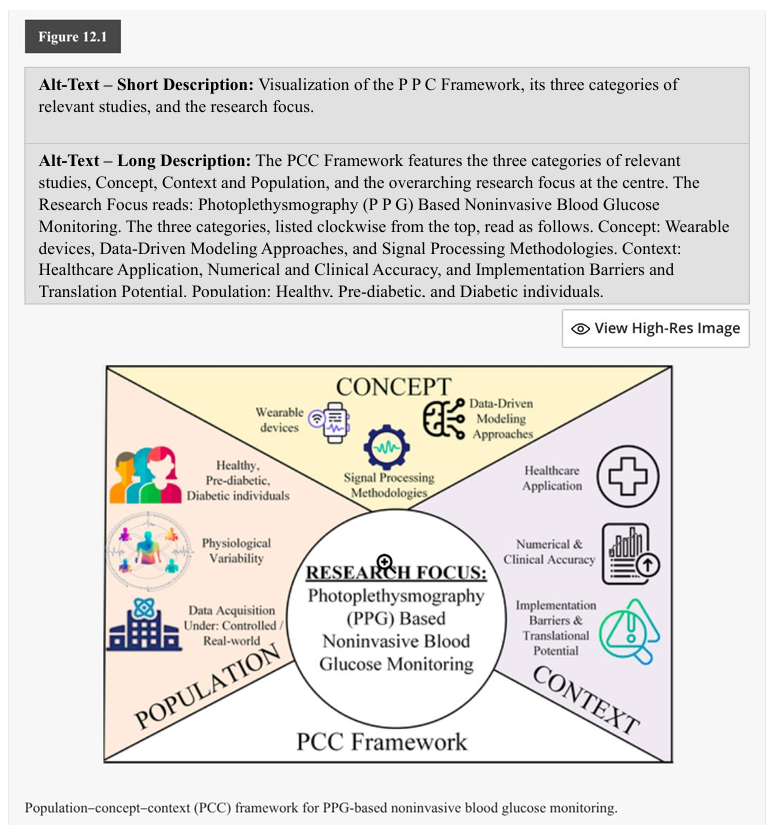
Alt text example
The following example demonstrates how the short and long alt text work together with the figure caption and the surrounding text that cross-references the image to provide a full visual description:
- The caption introduces the figure;
- The surrounding text provides a reference point;
- The short alt text introduces the figure to people using assistive technology;
- The long description gives a detailed visual description.
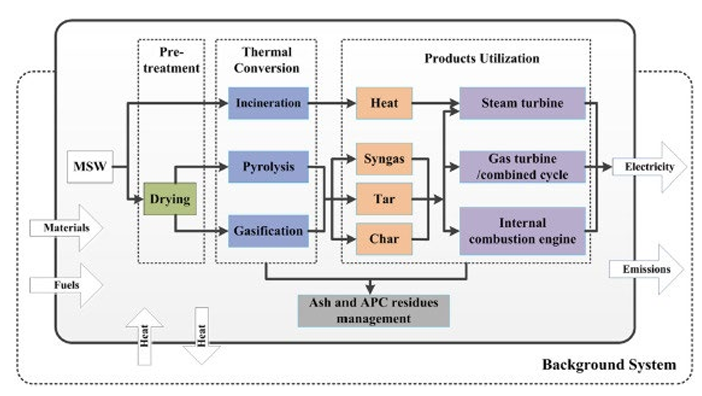
Figure caption: Figure 5.3. Example of a LCA for incineration, pyrolysis and gasification.
Cross-referencing body text: LCA study applications are linked to the definition of the objective and scope, which is one of the stages of the study, as indicated previously. Many studies use the LCA to compare between different technologies for the use of waste energy, or between the use of energy and other forms of waste management, while in some cases the LCA was applied to advance specific processes in the treatment units, in order to optimize energy use (Fig. 5.3).
Short alt text: Alt text begins. A flowchart illustrating the thermal conversion of municipal solid waste into energy and byproducts through incineration, pyrolysis, and gasification. Alt text provided by Elsevier.
Long description: Alt text begins. The flowchart illustrates the conversion of municipal solid waste (MSW) into energy and byproducts using thermal conversion methods, structured into three main sections: Pre-treatment, Thermal Conversion, and Products Utilization. In the Pre-treatment stage, municipal solid waste undergoes drying to prepare it for further processing. The Thermal Conversion section presents three distinct pathways: incineration, pyrolysis, and gasification. Incineration primarily produces heat, while pyrolysis and gasification yield syngas, tar, and char. In the Products Utilization section, heat from incineration drives a steam turbine for electricity generation, syngas from pyrolysis and gasification is used in gas turbines or combined cycle systems, and tar and char are utilized in internal combustion engines. Additionally, the chart addresses the management of ash and air pollution control residues, byproducts from the thermal processes. Arrows trace the movement of materials, energy, and emissions through the system, and a dotted border outlines the background system, highlighting the integrated nature of the entire process. Alt text provided by Elsevier.