
View by category
What is a self-citation and how can they be excluded in SciVal?
Last updated on November 15, 2024
Also available in
Self-citations are those by which an entity refers to its previous work in new publications. Self-citations are typically thought of in the context if an individual academic, but institutional self-citations and country self-citations are all also possible. There is nothing inherently wrong with the act of self-citing.
It is normal and expected behavior to build on work previously conducted and published and to alert the reader to important and relevant information that will aid their understanding. It is however, open to abuse and there are rare cases of unethical self-citation practices.
In SciVal it is possible exclude self-citations from many Citation Impact metrics, so you can make a judgement about whether self-citation rates are within normal boundaries. SciVal distinguishes between self-citations at the Researcher, Institution, Country, Publication Set and Topic / Topic Cluster level and applies the appropriate exclusion depending on the type of entity being viewed, without the user needing to specify this.
In practice this means that the excluded self-citations will depend upon the entity you’re looking at. For example, when looking at Athena University, we look at the citations received by the papers published by Athena University to see if the are also published by Athena University. If they are, then it is classified as a self-citation. If no Athena University Researchers are present in the citing publication, it is considered a regular citation (no self-citation).
In other words, SciVal takes the following steps when excluding self-citations:
- Looks at the date range that you have selected to define the publications to have self-citations removed (e.g. 2010 – 2015)
- Identifies the entity, which is then used to locate self-citations (e.g. Athena University)
- Looks at all publications from the entity to see if any publications have cited those in the date range (e.g. have any articles written by Athena University between 1996 – 2020 cited Athena University articles written between 2010 – 2015.) If so, it is a self-citation.
- Any identified self-citations are removed
Entity | It is counted as a self-Citation when… |
|---|---|
Researcher | … the Researcher cites his/her own publications
|
Group of Researchers | …the Group of Researchers cite their own publications. e.g.
|
Institution | …the Institution cites its own publications. All papers co-authored by any researchers from the Institution are considered as self-citations. |
Group of Institutions | …the Group of Institutions cite any publications from any institution in the group.
|
Country | …the Country cites its own publications
|
Groups of Countries | …the Group of Countries cite any publications from any of the countries in the group
|
Publication Set | … the Publication Set cites its own publications
|
Topic / Topic Cluster | … the Topic or Topic Cluster cite their own publications
|
Research Area | Not possible to remove self-citations
|
World | Not possible to remove self-citations
|
How do I remove self-citations?
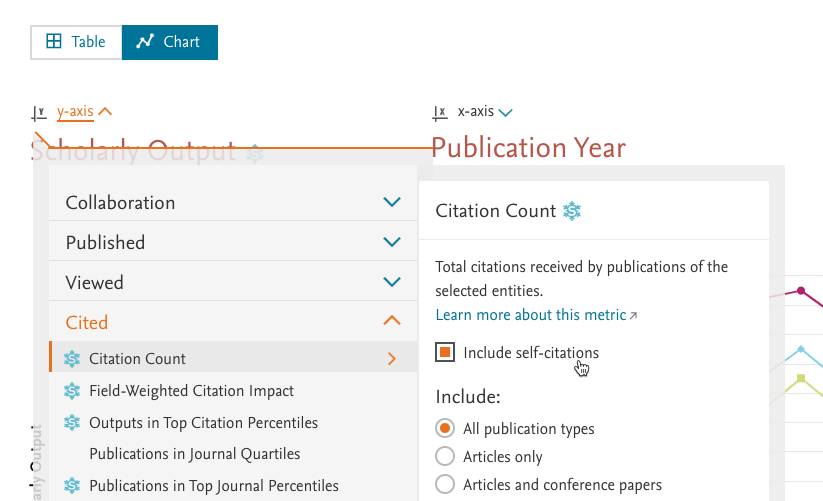
To do this, deselect the “include self-citations” box on the metric of interest. This option is available for a number of metrics in the Benchmarking module, for example Citation Count, Field-Weighted Citation Impact, Citations per Publication, etc.
I split my entity into a number of Publication Sets. Why do the total self-citations of the individual Publication Sets differ to the original entity, when I analyze it per year in Benchmarking?
This is because the total number of publications with which to accrue self-citations is lower with the multiple Publication Sets, then with the complete entity.
For example, you do the following:
- Analyze the citation count, excluding self-citations, for Athena University in Benchmarking using 2 methods:
- You do this per year for 5 years using the Benchmarking date range selector. For example, the year 2010 only, 2011 only, 2012 only, 2013 only and 2014 and make a note of the number of self-citations per year
- You create 5 Publication Sets for the same 5 years using the publications from Athena University and make a note of the number of self-citations per Publication Set
- There are fewer self-citations when you total the 5 Publication Sets (method B), then if you total the results using the Benchmark year selector (method A)
This is because with method A you look at ALL of Athena University’s publications for potential self-citations. As a result, a publication from 2010 can receive a self-citation from a publication in 2010, but also from a publication from 2011 – 2020.
With method B, you’re looking at each Publication Set on its own. As a result, a publication from 2010 can only receive self-citations from other publication in the same Publication Set. Each Publication Set was created using one year’s worth of publications, so the 2010 Publication Set is limited to publications from 2010 only, which means there are fewer years of possible self-citations.
How is the FWCI calculated when self-citations are removed?
When self-citations are removed, they are done so at the publication level, based upon the entity (see the table above). When self-citations are removed, a publication will have the same or fewer citations then when self-citations are included (they will never have more citations). In general, the citation count will be lower.
When self-citations are removed, the FWCI is calculated as normal - simply put, total received citations divided by the field-citation average. As the citation count is generally lower, the FWCI will also be smaller per publication.
Please note: when you export the FWCI as part of the publication list, the FWCI is always the metric including self-citations.
Did we answer your question?
Related answers
Recently viewed answers
Functionality disabled due to your cookie preferences