
View by category
The Sustainable Development Goals (SDGs) challenge the global community to build a world where no one is left behind.
The United Nations SDGs, adopted in 2015 as part of the 2030 agenda for sustainable development, set 17 goals and the associated 169 targets as areas considered of critical importance for humanity. Learn more on the RELX SDG Resource Centeropens in new tab/window.
In SciVal there are 3 sets of SDGs:
- one set created using the search queries for the 2020 THE Impact Rankings - these are static and no longer receiving new publications
- one set using the queries and machine learning component used in the 2022 THE Impact Rankings - these are static and no longer receiving new publications
- one set using the queries and machine learning component used in the 2025 THE Impact Rankings
We have worked with a set of university partners to improve the mappings, with their input used to create and improve the 2022 and 2023 search queries.
We have created 16 predefined Research Areas for 2020, 2022 and 2025 in SciVal to help you get a better understanding of the type of work done by the various countries, institutions and researchers in each SDG. We used each search query to generate pre-defined Research Areas in SciVal which begin to describe and help gain an understanding of the work that research institutions are doing on each SDG.
To locate an SDG in SciVal:
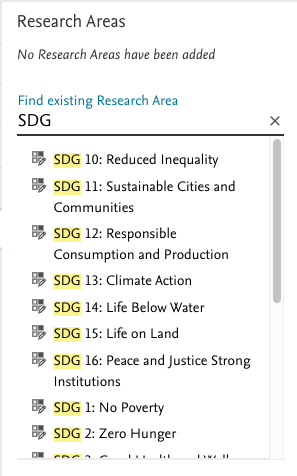
- Go to Research Areas on the left panel.
- Type "SDG" in 'Find existing Research Areas'.
- Click on the one you want to use.
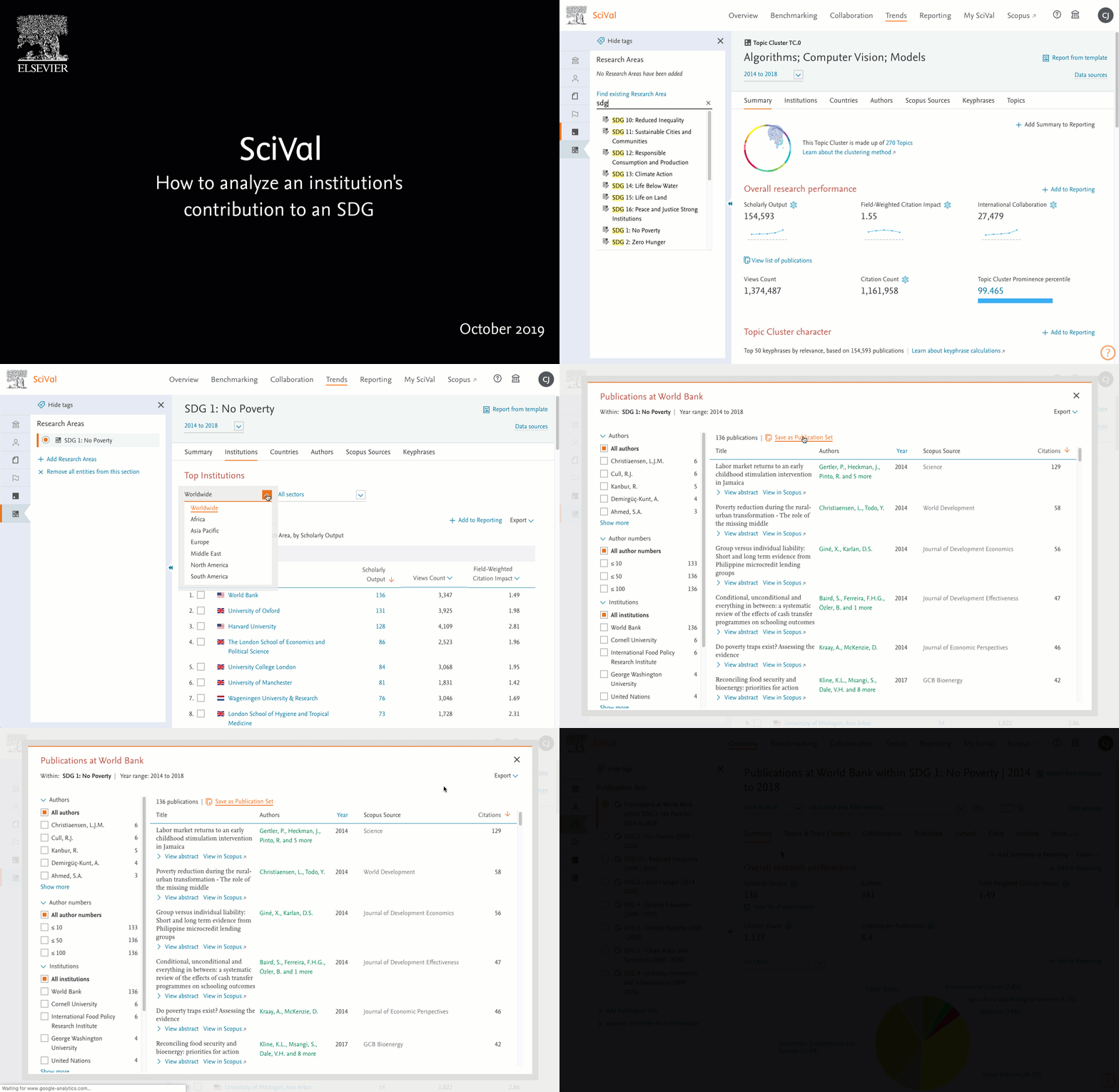
In Overview you can see the top 10 contributing institutions by Scholarly Output and in Trends you can see the top 100, but also filter by region. If you would like to analyze the contribution of an institution to an SDG, follow these steps to create a Publication Set:
- Put the SDG in Trends.
- Find the institution in which you’re interested.
- Use the region filters to help locate the institution.
- Click on the Scholarly Output number to see the underlying publications.
- Create a Publication Set.
- Use the 'Save as Publication Set' option.
- You can now look deeper at the institution’s contribution to the SDG in the Overview, Benchmarking and Trends modules, based upon the SDG search query.
For 2025, the SDGs use the exact same search query and ML algorithm as the Elsevier 2023 SDG mappings, with only minor modifications coming from changes to the search engine handling the SDG queries. Because of this, while the vast majority of publications retain their original mapping, the number of publications in each SDG has slightly changed.
The Elsevier 2025 SDG mappings are the latest versions of the mapping and are used in the 2025 THE Impact Rankings.
Full details on the search queries and methodology can be downloaded from Digital Commons Data.
For 2022, all SDGs used the exact same search query and ML algorithm as the Elsevier 2021 SDG mapping, except SDG 3. Working in conjunction with our university partners, we agreed that Covid related search terms should be added to SDG 3 - Good health and well-being. We made no changes to the ML algorithm.
The newly added Covid query adds a little more than 190,000 publications to SDG 3, out of about 300,000 publications containing Covid related terms. We focused on public health, clinical medicine, and biomedical research, avoiding publications related to the impact of the pandemic on research spheres outside health research (e.g., economic, political, etc.).
Full details on the search queries and methodology can be downloaded from Digital Commons Data.
In 2020, inspired by the earlier queries, Elsevier, through Science-Metrix, developed a new approach to mapping publications to the SDGs. Taking customer feedback into account, they significantly increased the number of search terms used to define each SDG. Those queries were then complemented by a machine learning model. Two concepts are important to introduce here: recall and precision. Recall is the percentage of publications from the specialist journals that are captured by the selected search terms. Precision is the percentage of relevant papers in a random sample of publications in the seed data set. The machine learning model helped increase the recall of publications by approximately 10%.
As a result of this new approach, the “Elsevier 2021 SDG mapping” on average captures twice as many articles as the 2020 version, while keeping precision above 80%. The mapping also has a better overlap with SDG queries from other independent projects. Times Higher Education are using the Elsevier 2021 SDG mapping as part of their 2021 Impact Rankings. Full details on the search queries, methodology and machine learning component can be downloaded from Digital Commons Data.
The initial work was part of a request from Times Higher Education (THE) who asked for help in defining SDG search queries for use in their University Impact Rankings by SDGsopens in new tab/window. This original query then formed the starting point for several rounds of review and refinement, which included looking at the publications returned by the search queries in Scopus. Full details of the methodology and results for each SDG search query are freely available on Mendeleyopens in new tab/window and the team will continue to welcome feedback from the community around the queries so they can be refined further moving forward.
Since SDG 17 is very difficult to quantify, we could not find a satisfactory search query to define it. As a result, we decided not to include it with this release. In the future, we will of course look into whether there is a good way to identify where partnerships have happened and how to quantify that. Learn more about SDG 17 on the UN site.opens in new tab/window
Yes, part of their ranking is made up of data taken from Scopus at the beginning of the year, which uses the latest Elsevier SDG mapping algorithm.
The Times Higher Education University Impact Rankings are the only global performance tables that assess universities against the United Nations’ Sustainable Development Goals. Learn more about the THE University Impact Rankings.opens in new tab/window
Did we answer your question?
Related answers
Recently viewed answers
Functionality disabled due to your cookie preferences