
View by category
THE Impact Rankings / Sustainability Impact Ratings
Last updated on November 15, 2024
Also available in
The Impact Rankings (known as the Sustainability Impact Ratings from 2026 onwards), are the first global attempt to measure university progress specifically around the Sustainable Development Goals (SDGs). The hope is that they are used as a catalyst for action, a mechanism for holding our universities to account, and an opportunity for universities to highlight the great work they are already doing.
The rankings are open to any university that teaches at either undergraduate or postgraduate level. Although research activities form part of the methodology, there is no minimum research requirement for participation. THE also reserves the right to exclude universities that they believe have falsified data, or who are no longer in good standing.
The methodology is built up from individual Sustainable Development Goals. Universities receive a score and a rank for their activities in each of the SDGs for which they submit data. Participation in the overall ranking requires universities to submit data to at least four SDGs, one of which must be SDG 17*: Partnerships for the Goals. If a university submits data, but doesn’t fulfil the requirement to be part of the overall ranking they will still be ranked in the SDGs for which they have provided data.
SciVal’s rankings analyses provide transparency around the bibliometrics used in the THE Impact Rankings.
*SDG 17 is the deduplicated count of all publications from SDGs 1-16
THE Impact Ranking enhancements in the Overview module
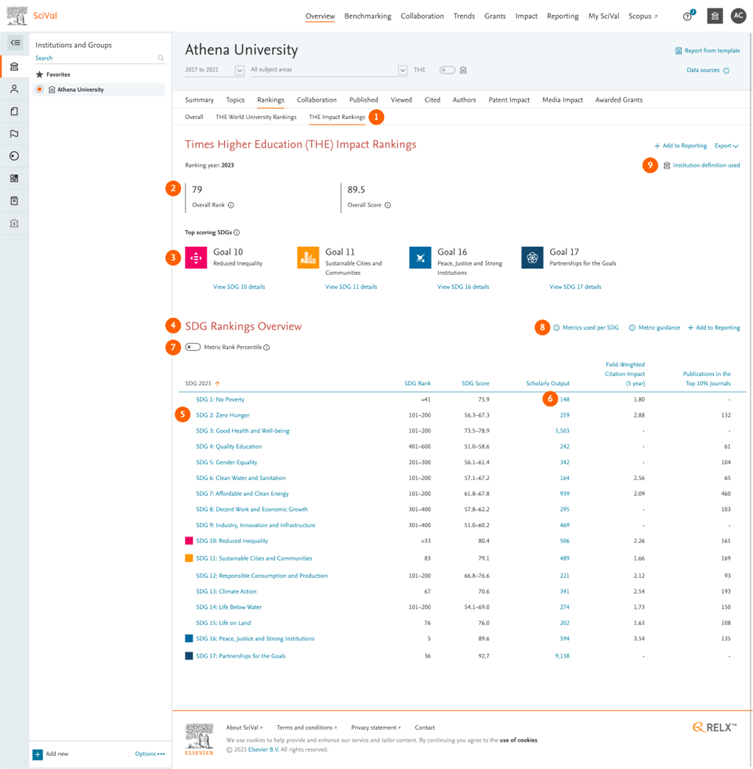
- “THE Impact Rankings” tab in 'Rankings' section helps SciVal customers:
- Generate insights based on the bibliometric used in the THE Impact Rankings per SDGs, removing the need to export and generate the dataset manually.
- Analyze, understand, and generate insights based on the actual research metricsopens in new tab/window such as Scholarly Outputopens in new tab/window, FWCI 5Yopens in new tab/window, Publications in the Top 10% Journals, and others, accounting for 27% of the single SDG score, rather than proxies developed in-house.
- Analyze the trends in the bibliometric drivers to enrich your understanding and inform plans accordingly.
- Summary of metrics
THE’s Overall Ranks and Overall Score are only available for universities that have four Top Scoring SDGsopens in new tab/window. - Top Scoring SDGs
The three SDGs, plus SDG 17* selected by THE where the institution performs the highest. This list considers all indicators per single SDG, including non-metric evidence. - SDG Rankings Overview
Includes the possibility to analyze the most common research metricsopens in new tab/window across the SDGs considered by THE. - More details on single SDG
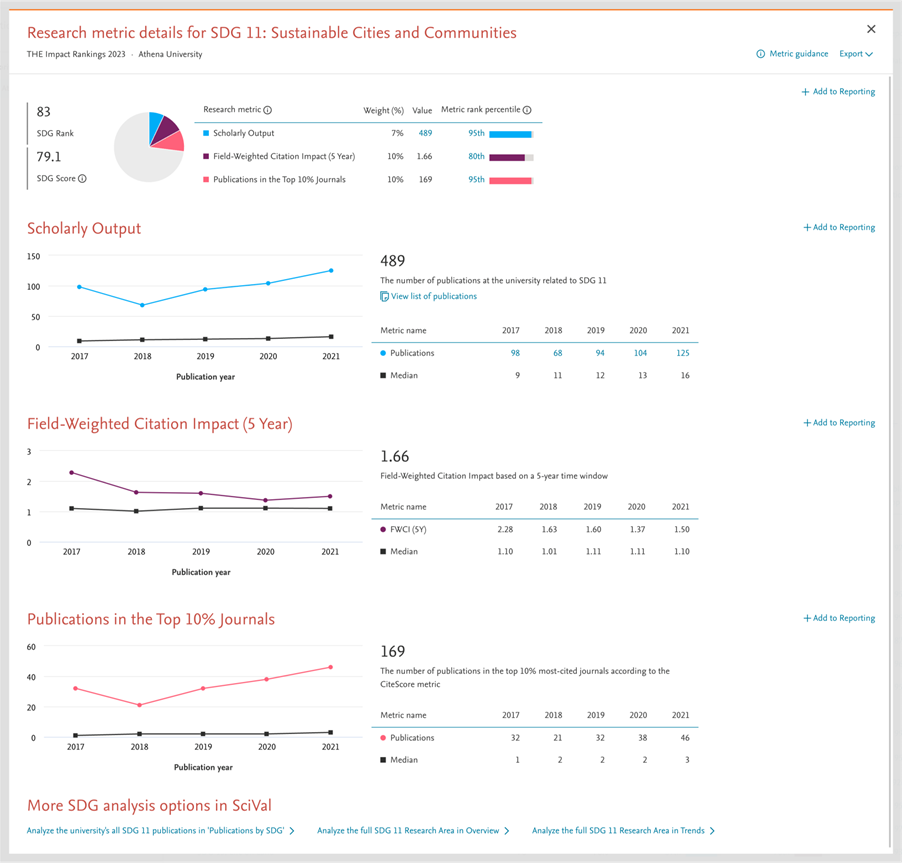
- Clicking on an “SDG name” opens a modal that shows the full detail of all the research metricsopens in new tab/window related to the SDG.
- View the single SDG Rank and score as well as the summary of composing metrics and their weight.
- Analyze each of the research metrics by looking at the yearly breakdown and get a sense of their relative performance by looking at the yearly median and overall Metric Rank Percentileopens in new tab/window.
- List of Scholarly Output used in the SDG
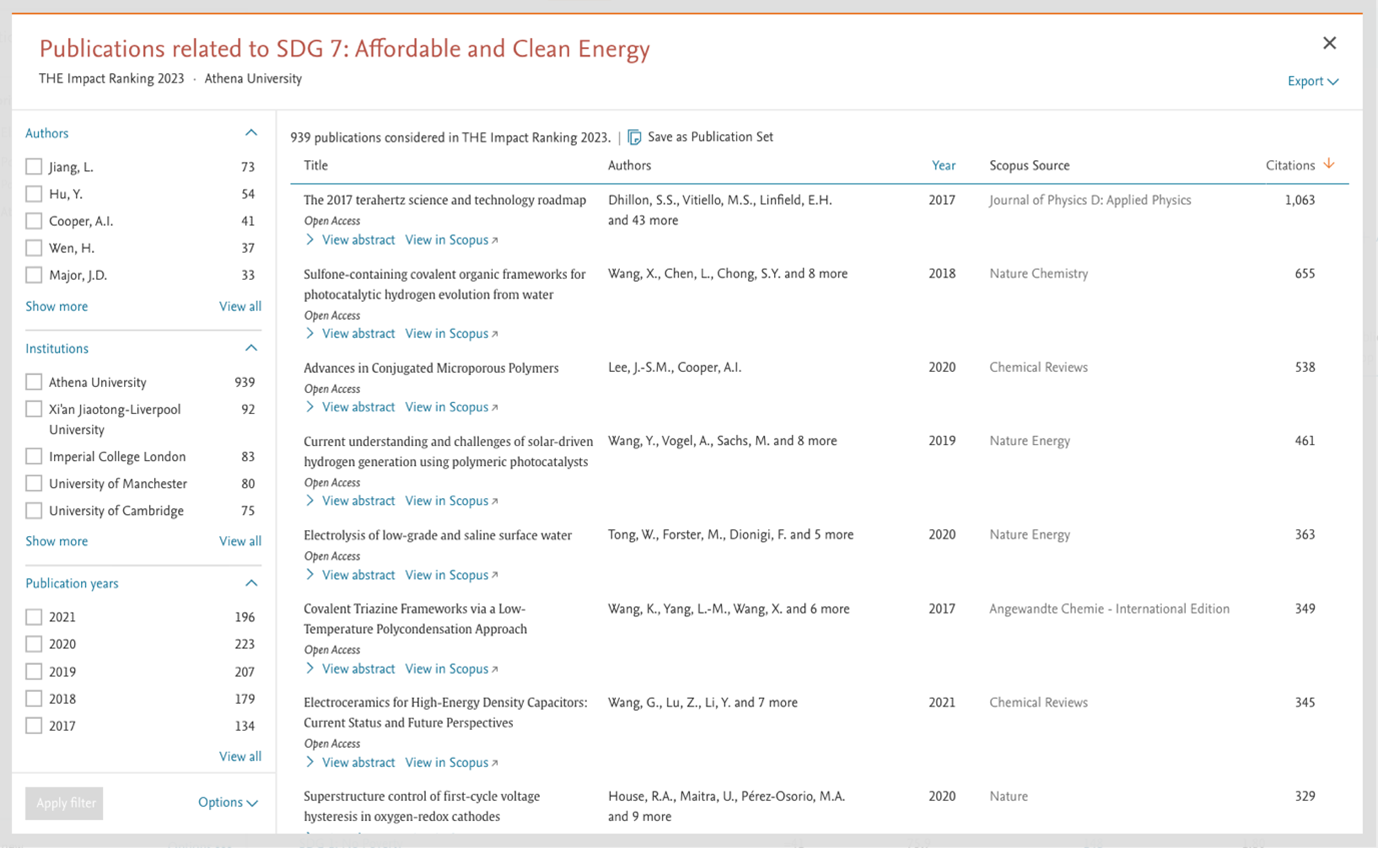
- Clicking on a Scholarly Output number link, launches a modal showing the underlying publications.
- For further analysis, you can export the publications into a spreadsheet or save the list as a Publication Set.
- Relative performance
Use the Metric Rank Percentileopens in new tab/window switch to understand the relative metric performance compared to the entire population. - Research metrics per SDG
Opens a modal that shows an overview of the metrics used in each SDG.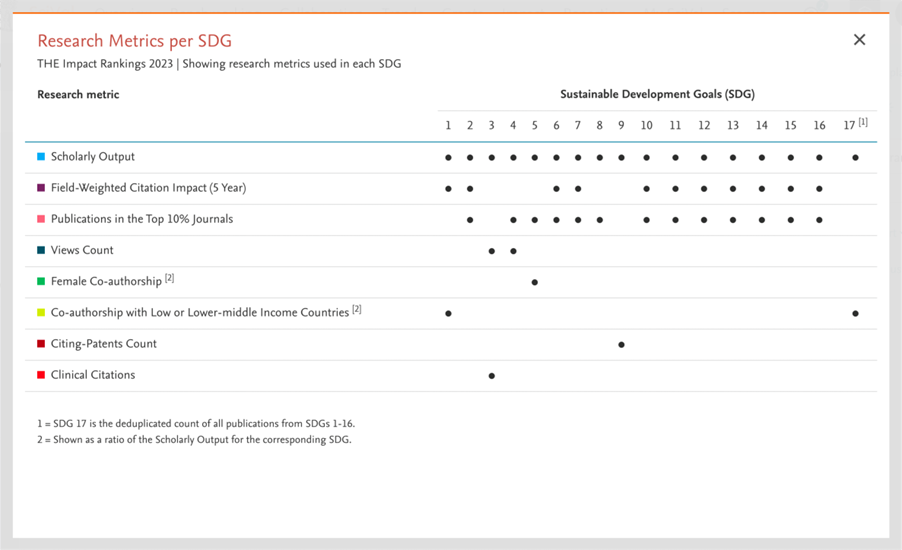
- Institution definition used
Opens a modal that shows the Institutions used in the count of the Scholarly Output by the different ranking agencies.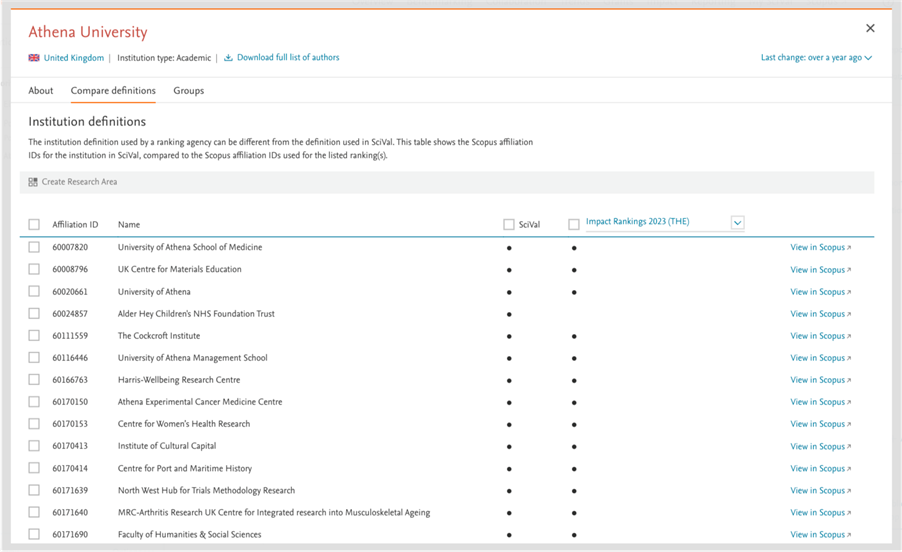
Did we answer your question?
Related answers
Recently viewed answers
Functionality disabled due to your cookie preferences