
View by category
The majority of publications are created with the input from multiple co-authors. Traditional citation metrics give each co-author the same citation impact, even though the actual contribution of each researcher will not have been even. For example, a publication with 10 co-authors receives 5 citations and each co-author therefore receives 5 citations.
In many disciplines an author’s contribution to a research output is approximated through the authorship position of a researcher. In SciVal you can now use authorship and look at the following authorship positions or types:
- First author: The first author mentioned in the publication
- Last author: The last author mentioned in the publication
- Corresponding author: An author is marked as the corresponding author in the publication. Since June 2020, newly released documents in Scopus can contain more than one corresponding author. All documents published and indexed in Scopus before that date can only have one corresponding author.
- Co-author: For documents with more than one author, co-authors are any author that is not a first, last or corresponding author
- Single author: An author is the only author of a publication
SciVal allows the analysis of authorship both in the Overview and Benchmarking modules.
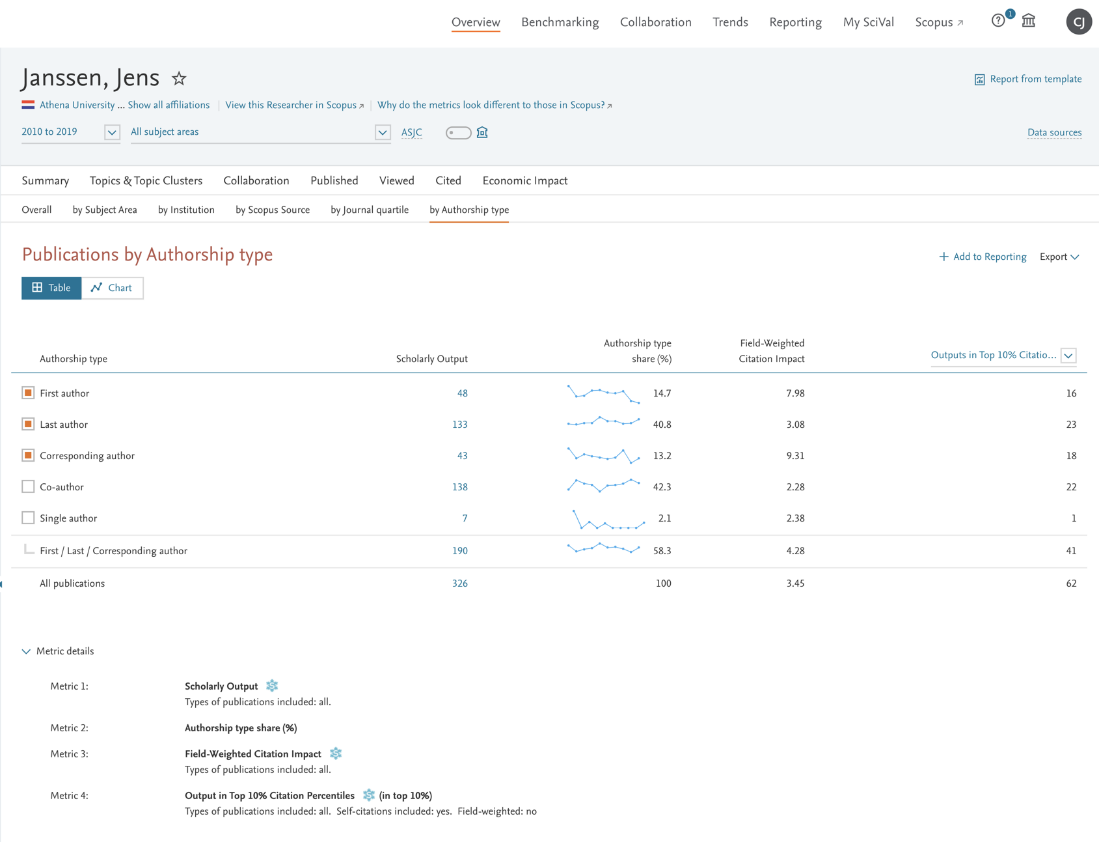
In Overview, the functionality can be found in the Published tab when analyzing a Researcher. In the tab you will find a sub-selection called Authorship type where you will find a table listing the various authorship types in combination with a select set of metrics.
In addition, there is a chart view in Overview that enables you to directly compare various author roles across the set of metrics.
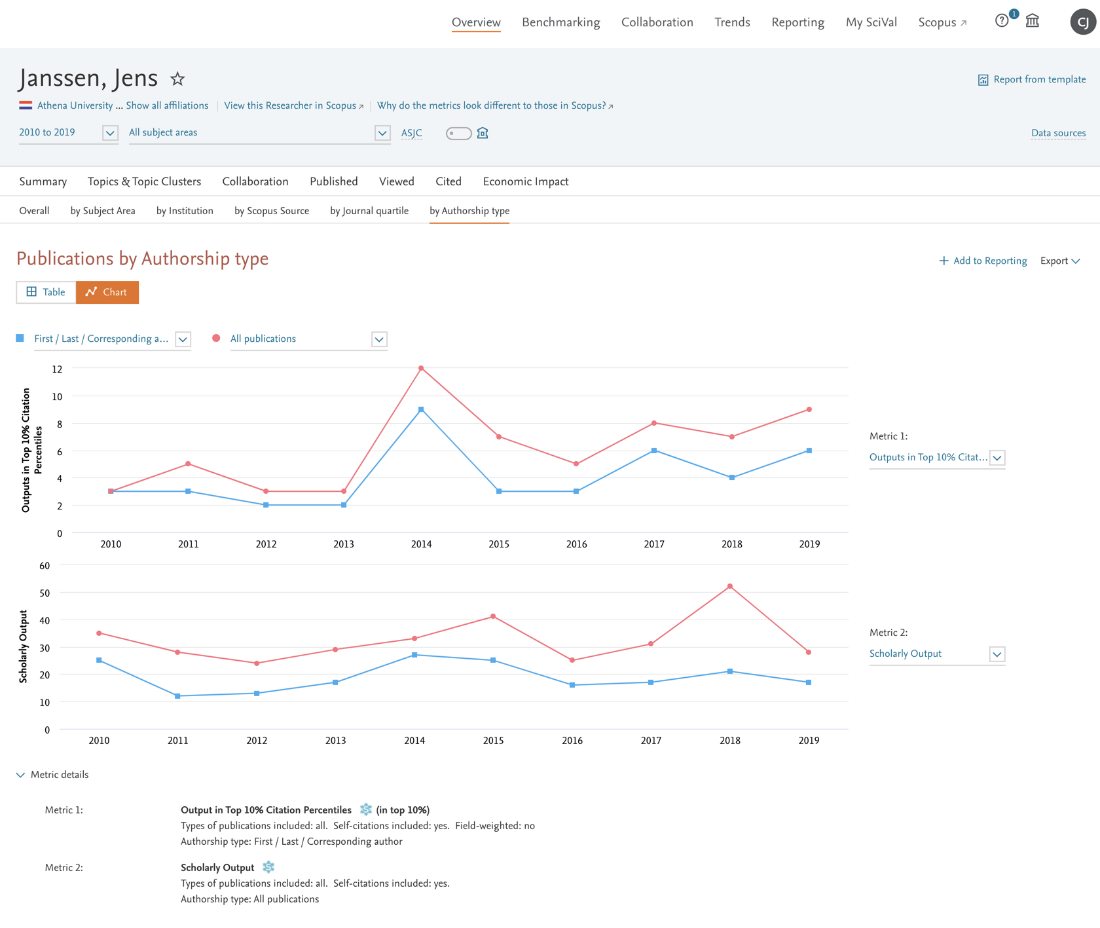
The following metrics are currently supported in combination with the various authorship types:
- Scholarly Outputs
- Citation Count
- Citations per Publication
- Field-Weighted Citation Impact
- Outputs in Top 10% Citation Percentiles (field-weighted and non-field-weighted)
- Outputs in Top 25% Citation Percentiles (field-weighted and non-field-weighted)
For these metrics the authorship types are also included for analysis in the Benchmarking module. In addition, in Overview the percentage share of the total output for which the currently selected authorship type is applicable is also available.
Authorship types can be selected individually or in combination with other types. In the latter case, the resulting document count will automatically be deduplicated. This means that when an author is listed both as the first and corresponding author on the same document, the document will only be counted once in the resulting analysis.
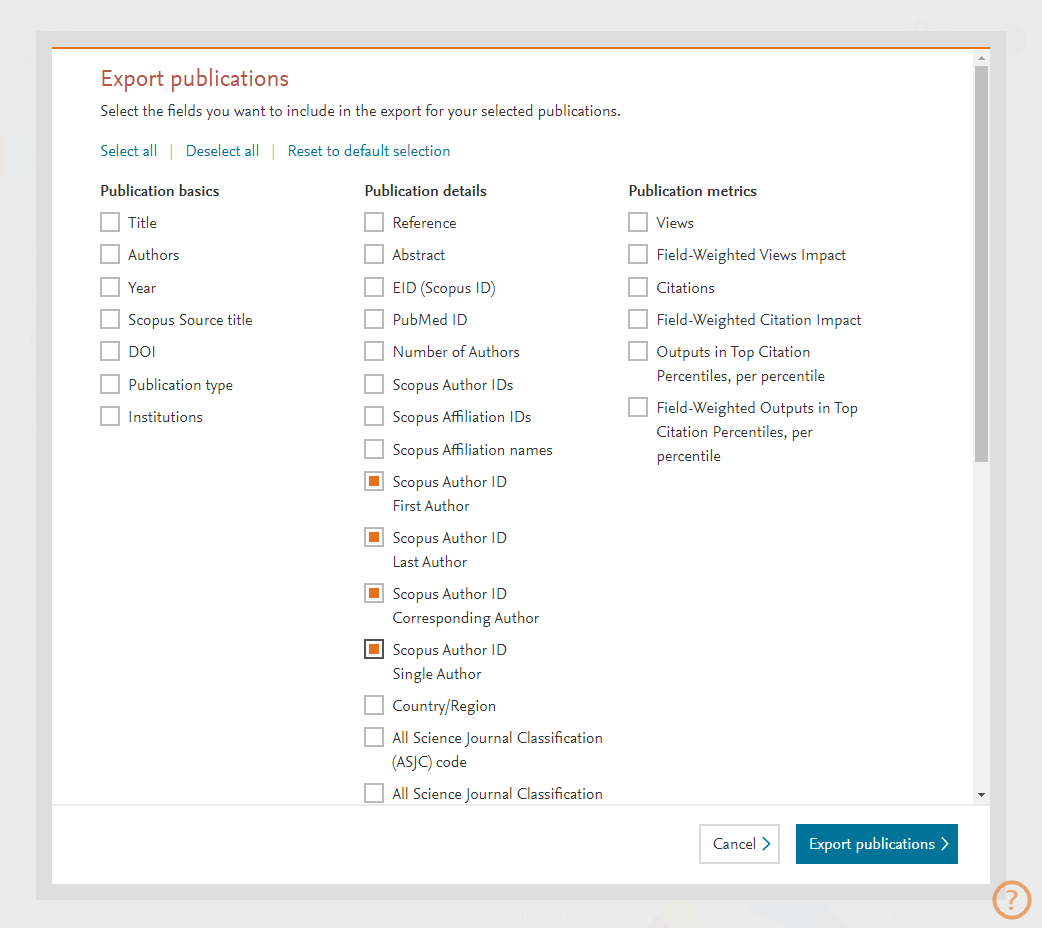
Furthermore, single, first, last and corresponding authorship types are included as an export option for any publication link export, enabling you to perform this analysis on any entity of interest. As co-authors can easily be determined by subtracting the author IDs from the full author list, they are not listed as a separate export option.
At the time of development of this capability, around 2 million records in Scopus listed a single author, and so we decided to place these documents in a separate category. A single author cannot be a first or last author at the same time, but they can be the corresponding author. Whether or not that is the case often depends on the content type.
When using this functionality, be mindful of the following limitations:
- Around 2% of all Scopus records present in SciVal do not contain any author data.
- Not all documents list a corresponding author. Analyses suggest this is the case for around 20% of all Scopus records present in SciVal.
- In disciplines such as physics and mathematics, authors are often listed alphabetically in the publications and corresponding metadata. We recommend analyzing these disciplines separately and to focus on the corresponding author, if one is indicated, rather than the first or last author.
Did we answer your question?
Related answers
Recently viewed answers
Functionality disabled due to your cookie preferences