
View by category
Citations indicators considered in THE Rankings
Last updated on November 15, 2024
Also available in
 Back to all metrics
The Citations indicators – THE Citations Score, Global Citations Score, Country Normalized Citations Score, Global FWCI and Country Normalized FWCI – are based on 5-year Field-Weighted Citation Impact (FWCI) data calculated using the snapshot of Scopus data provided around May each year.
The final THE Citations Score in the ranking is the average of the Global Citations Score and Country Normalized Citations Score.
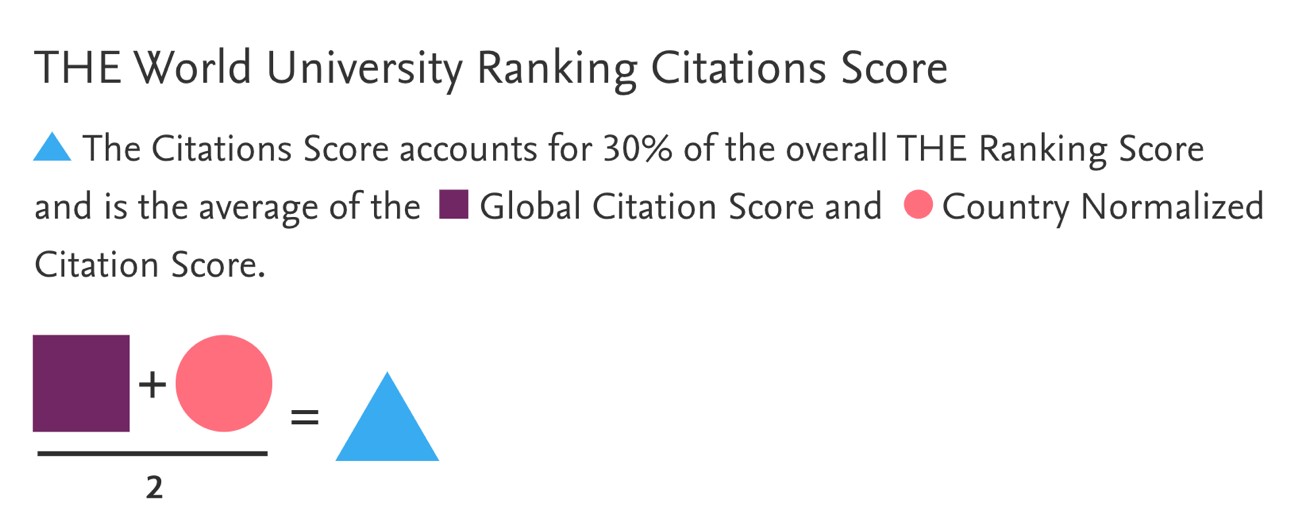
Global Citations Score
Is based on the normalized z-score of an eligible university’s Global FWCI, where the FWCI of a university’s publications is analyzed in terms of the number of standard deviations from the mean, (the dataset used for the normalization includes eligible publications from all universities ranked in the THE World University Rankings only). The Z-score is then transformed into the Global Citations Score that ranges from 0-100. For more on Z-score, see https://en.wikipedia.org/wiki/Standard_score.
Country Normalized Citations Score
Is based on the normalized Z-score of an eligible university’s Country Normalized FWCI. The Country Normalized FWCI of a university’s publications is analyzed in terms of the number of standard deviations from the mean, (the dataset used for the normalization includes eligible publications from all universities ranked in the THE World University Rankings, from each country). The z-score is then transformed into the Country Normalized Citations Score that ranges from 0-100.
The Country Normalized FWCI adjusts each university’s FWCI based on how they are placed relative to other universities in the same country. It is calculated by dividing the university’s FWCI by the square root of the country’s FWCI.
The indicators incorporate a fractional counting approach for kilo-authored publications, according to which all universities with authors on such a publication receive at least 5% of the ‘value’ of the publication.
Please note, the FWCIs used in THE Rankings are based on a 5-year time window and are different from the FWCIs available in other parts of SciVal, which are based on a 4-year time window.
- Benchmark entities regardless of differences in their size, disciplinary profile, age, and publication-type composition.
- Comparing an institution against normalised global and country values.
- Looking at the full output of the institution, as not all outputs are used by the THE rankings.
- Comparing the THE FWCI metrics against the standard FWCI elsewhere in SciVal as they are based on different time periods. THE uses a 5 year time window and the the standard FWCI a 4 year time window.
- Citations per Publication opens in new tab/windowand Field-Weighted Citation Impactopens in new tab/window, which bring complementary perspectives into view on total visibility, and also account for differences in the size of entities being compared. Field-Weighted Citation Impact also accounts for differences in publication and citation behavior between disciplines.
- Field-Weighted Citation Impactopens in new tab/window, Outputs in Top Citation Percentilesopens in new tab/window, and Publications in Top Journal Percentiles opens in new tab/windowavoid the “dip” in recent years due to little time having passed to receive citations since publication
Did we answer your question?
Related answers
Recently viewed answers
Functionality disabled due to your cookie preferences