
View by category
The redistribution table allows you to analyze the redistribution of publications from the Previous generation Topics to the New generation Topics. And the other way around.
The analysis can be done on Topic and Topic Cluster level.
When analyzing the redistribution of publications of a specific entity (can be done via the Analyze option on the Topics pageopens in new tab/window)
- the active year range and the set Subject Area filter are taken into account
- "Scholarly Output" and "Scholarly Output rank" metrics pertain to the contribution of the entity to that Topic or Topic Cluster
When analyzing the overall redistribution via the Excel sheets that can be found in the Download pulldown in My SciValopens in new tab/window
- the year range is fixed to 1 Jan 2018 - 15 April 2024
- "Scholarly Output" and "Scholarly Output rank" metrics pertain to the entire Topic or Topic Cluster
Using two examples, we hope to explain the table and its metrics. Both examples are analyzing the overall Topic / Topic Cluster redistribution. So not the redistribution of the publications by a specific entity.
Example 1: Previous generation Topic as starting point
- Answers:
to which New generation Topics are the publications of each Previous generation Topic redistributed? - Main sort:
by Scholarly Output of the Previous generation Topics
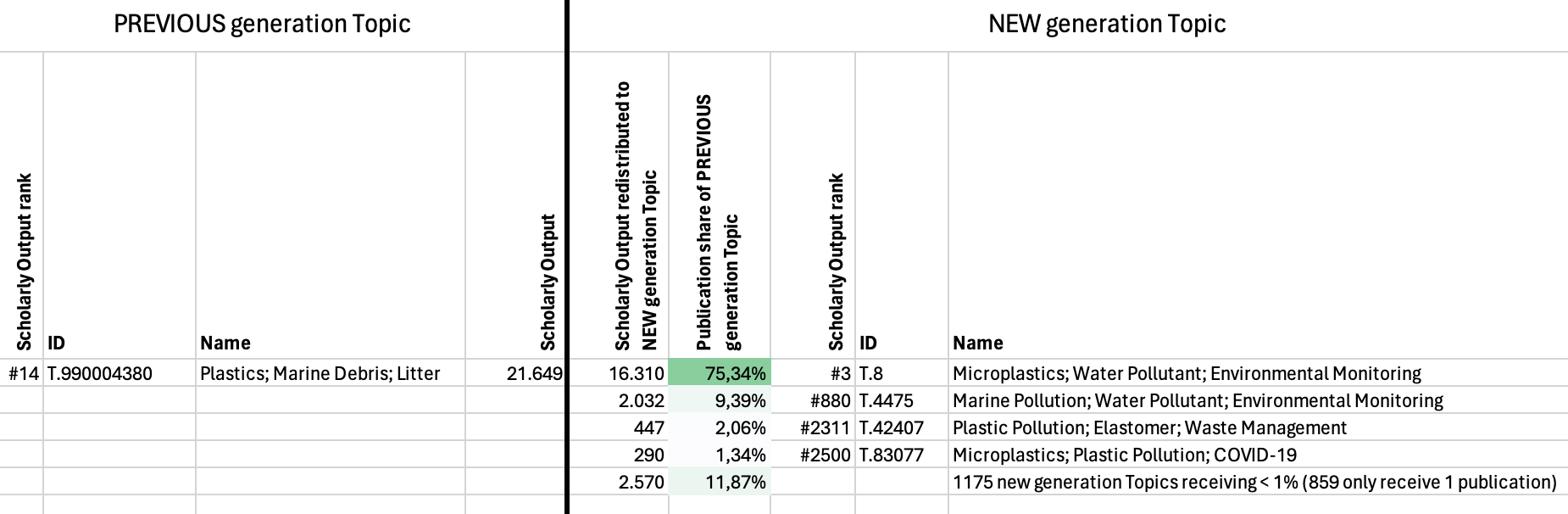
- What does this part of the table tell me?
- Previous generation Topic "T.990004380 Plastics; Marine Debris; Litter" does have a Scholarly Output of 21,649 publications.
- In the listing of all Previous generation Topics, sorted by Scholarly Output, the Topic can be found at position #14. Topics with equal Scholarly Output are considered to be at the same position. This position is called the "Scholarly Output rank".
- 16,310 publications of the Previous generation Topic are now assigned to New generation Topic "T.8 Microplastics; Water Pollutant; Enviornmental Monitoring"
- This Topic can be found at position #8 of the list of New generation Topics, sorted by Scholarly Output
- 16,310 of 21,649 is 75.34%. This value can be found in the column called "Publication share of PREVIOUS generation Topic"
- In total, 4 New generation Topics receive >1% of the Previous generation Topic
- 2,570 publications (11,87%) are redistributed in amounts of <1% to 1175 New generation Topics.
Example 2: New generation Topic Cluster as starting point
- Answers:
from which Previous generation Topic Clusters are publications redistributed to each New generation Topic Cluster? - Main sort:
by Scholarly Output of the New generation Topic Clusters
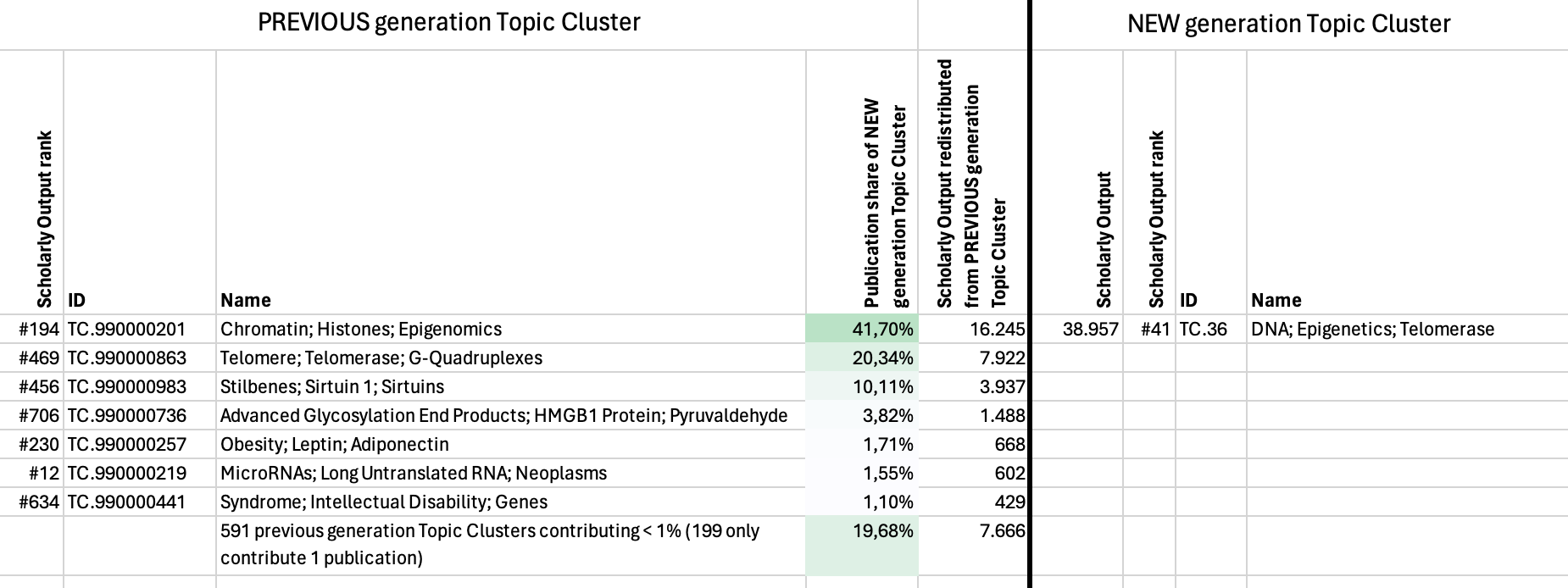
- What does this part of the table tell me?
- New generation Topic Cluster "TC.36 DNA; Epigenetics; Telomerase" does have a Scholarly Output of 38,957 publications.
- In the listing of all New generation Topic Clusters, sorted by Scholarly Output, the Topic Cluster can be found at position #41. Topic Clusters with equal Scholarly Output are considered to be at the same position. This position is called the "Scholarly Output rank".
- 16,245 publications of the New generation Topic Cluster were previously assigned to Previous generation Topic Cluster "TC.990000201 MChromatin; Histones; Epigenomics"
- That Topic Cluster can be found at position #48 of the list of Previous generation Topic Clusters, sorted by Scholarly Output
- 16,245 of 38,957 is 41.70%. This value can be found in the column called "Publication share of NEW generation Topic"
- In total, 7 Previous generation Topic Clusters contribute >1% to the New generation Topic Cluster
- 7,666 publications (19,68%) are redistributed in amounts of <1% from 591 Previous generation Topic Clusters to "TC.36 DNA; Epigenetics; Telomerase".
Did we answer your question?
Related answers
Recently viewed answers
Functionality disabled due to your cookie preferences