
View by category
What does the launch of new generation SciVal Topics mean for the previous generation Topics?
Last updated on May 23, 2024
Also available in
 Back to Topics FAQs
The new generation SciVal Topics provide greater relevance and precise insights as they consist of more cohesive sets of publications. Learn moreopens in new tab/window
With the launch of the new generation SciVal Topics and Topic Clusters the previous generation Topics and Topic Clusters are no longer available.
Below, you'll find where in SciVal this change will have an impact. Plus more information about the functionality we have created that should help you transition.
The transition functionality will be available for about 6 months after the new generation Topics launch. It will be decommissioned with the first SciVal release of 2025, on February 4th. As communicated earlier, at the end of the transition period:
- Favorites section of the entity selection panel will be cleared of previous generation Topics and Topic Clusters.
- Non-converted Research Areas based on previous generation Topics and Topic Clusters will be deleted.
- Non-converted Reporting Analyses for previous generation Topics and Topic Clusters will be deleted, also from the Reports containing them.
The re-distribution files referred to in section 6 below will remain available, also in My SciVal.
Relevant for the information in the panels below:
- everything we describe for Topics on this page, also applies to Topic Clusters
- everywhere where old Topics or Topic Clusters are referenced in the transition functionality, their IDs are changed to follow 990000000 format; for example old Topic T.12 becomes T.990000012, old Topic Cluster TC.123 becomes TC.990000123.
Topic and Topic Cluster listings - often sorted by Scholarly Output - are as of May 21st populated with the new generation Topics and Topic Clusters.
The re-distribution of publications between old and new generation Topics can be analyzed by doing a Redistribution Export via the banner at the top on the Topics page.
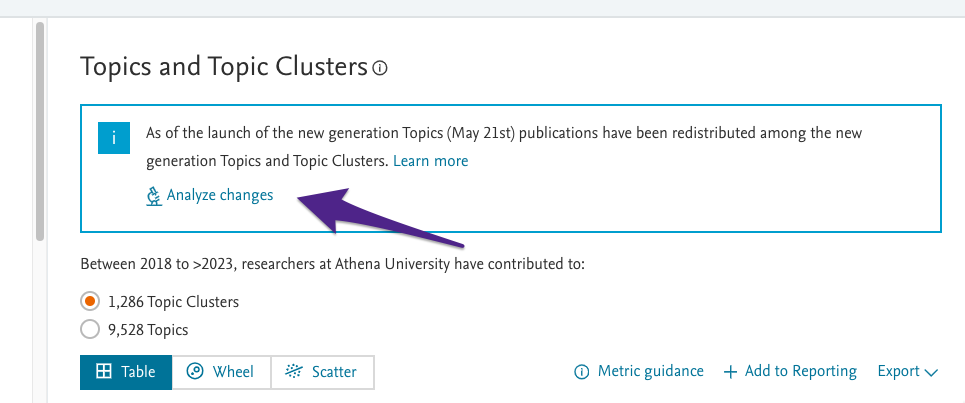
By uploading the Redistribution Export file on this Support Hub page, you will be able to analyze the exact distribution in both ways:
- To which new generation Topics did the publications of a particular old generation Topic go?
- From which previous generation Topics did a particular new generation Topic receive its publications?
Previous generation Topics and Topic Clusters only appear in the entity selection panel if you added them to favorites. They are not available for analyses, but you can save them as Publication Sets for reference or substitute with alternative new generation Topics / Topic Clusters using our matching suggestions.
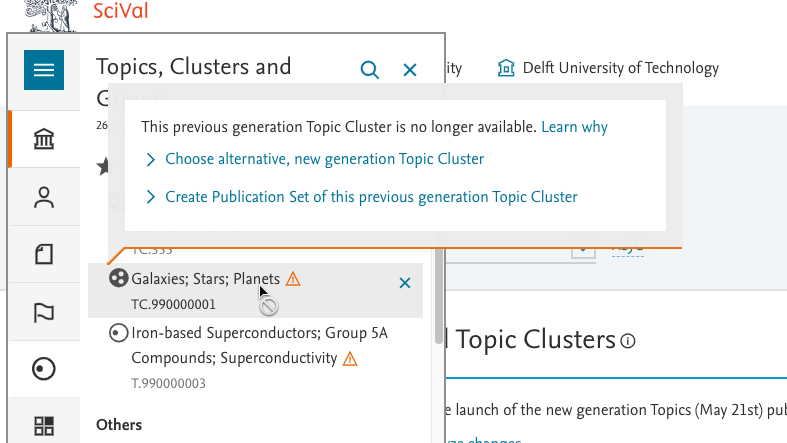
The details of the matching suggestions in the conversion flow can be found in the How are the matching suggestions generated? section on this page.
You can use only one Topic / Topic Cluster as an alternative. If you cannot choose a single Topic / Topic Cluster alternative, you can export the matching suggestions for further analyses.
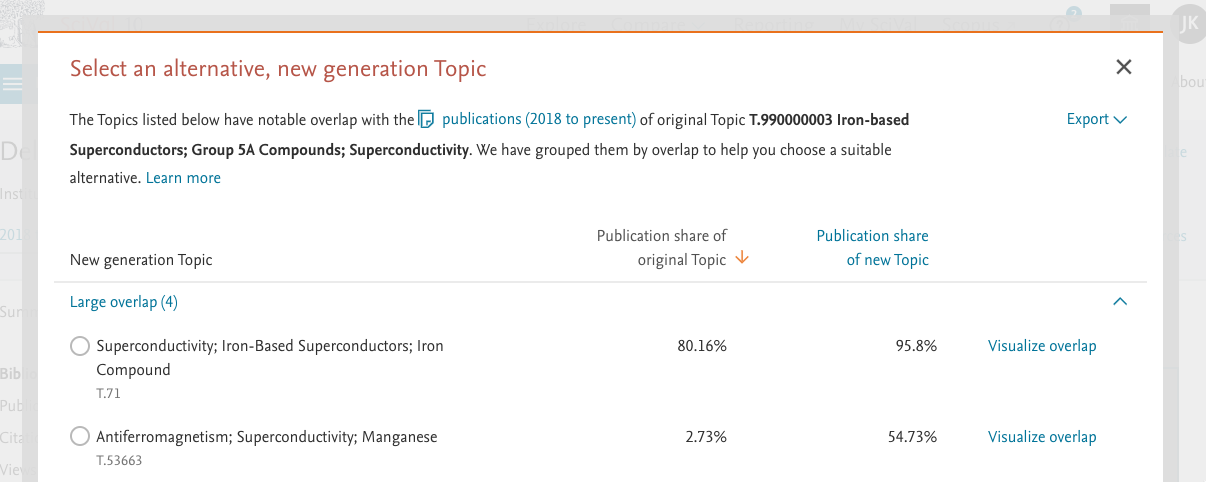
Please note, once you finish updating the Topic / Topic Cluster with the new generation Topic / Topic Cluster, the reference to the old entity will not be available anymore. Save it as a Publication Set upfront if needed.
At the end of the transition period, Favorites section of the entity selection panel will be cleared of previous generation Topics and Topic Clusters.
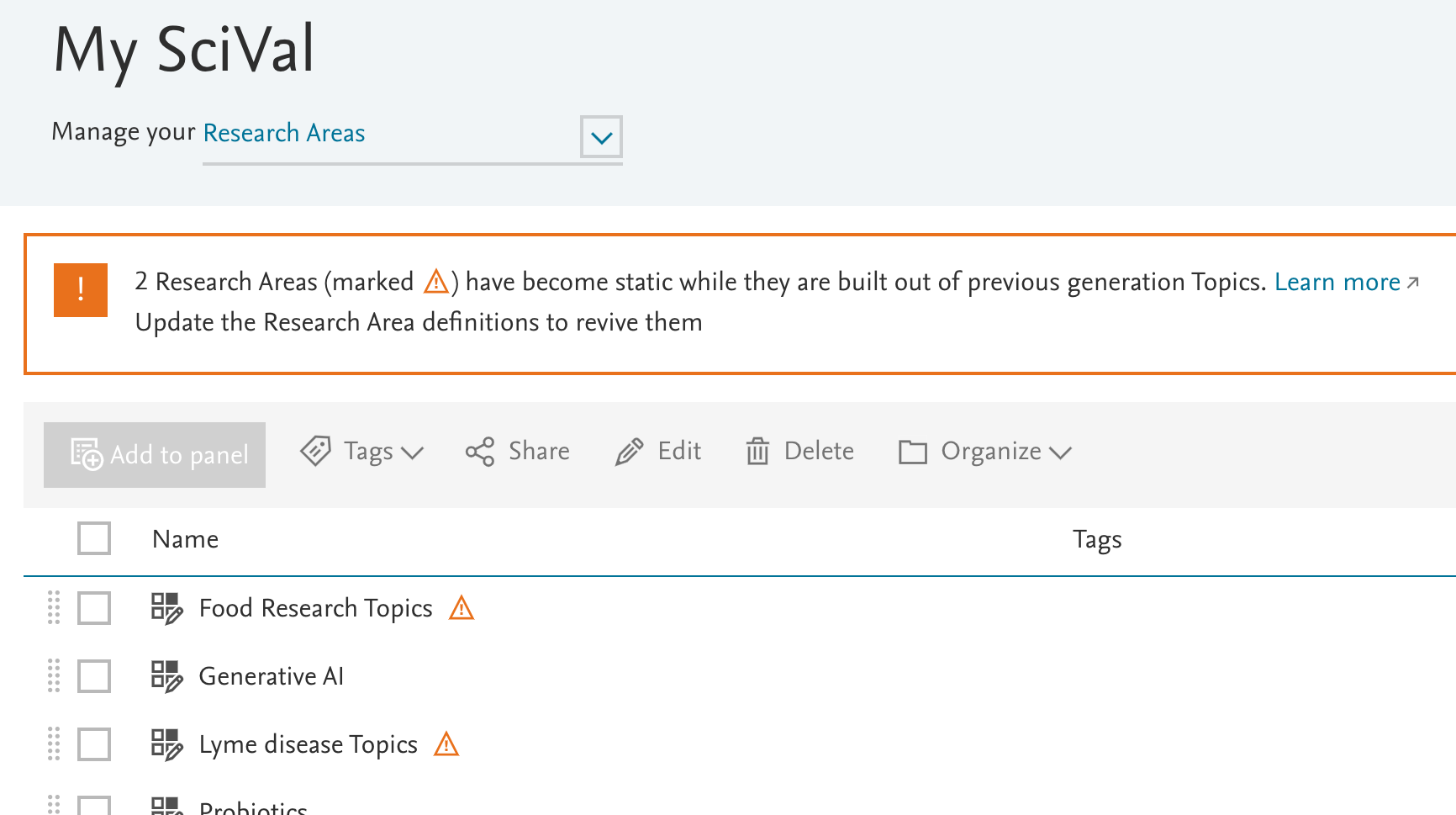
As of the the launch of the new generation Topics, user-defined Research Areas based on previous generation Topics and Topic Clusters are available as static.
This means that they are not updated with new publications, but you can still analyze them during the transition period or save them as a Publication Set for reference. It's also possible to look at the Topic / Topic Cluster listings in Explore for these Research Areas.
These static Research Areas are clearly indicated in My SciVal.
And in the Research Area page header in Explore.
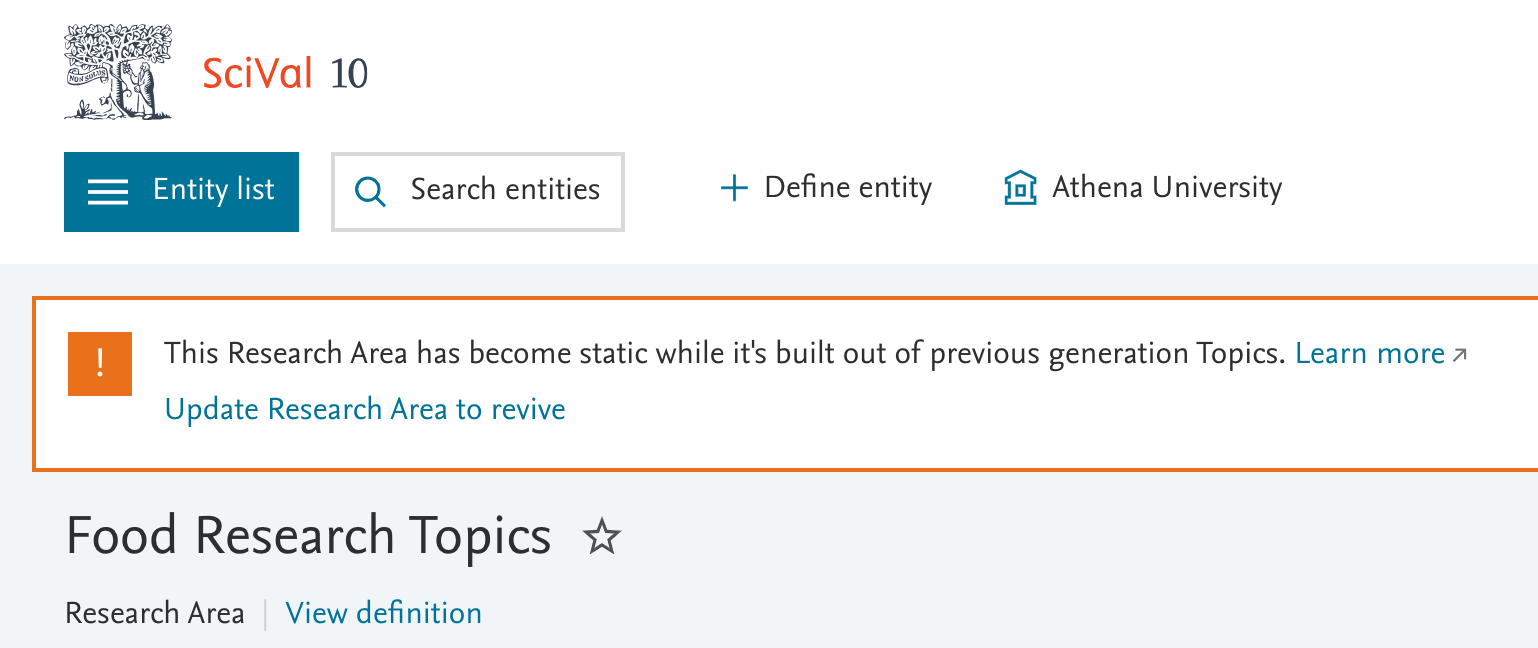
To revive a static Research Area, you need to update its definition with new Topics / Topic Clusters. You can do this by using the conversion flow available in the Research Area header and in the Research Area listing in My SciVal.
The conversion flow suggests alternative new generation Topics / Topic Clusters based on overlap. Learn more
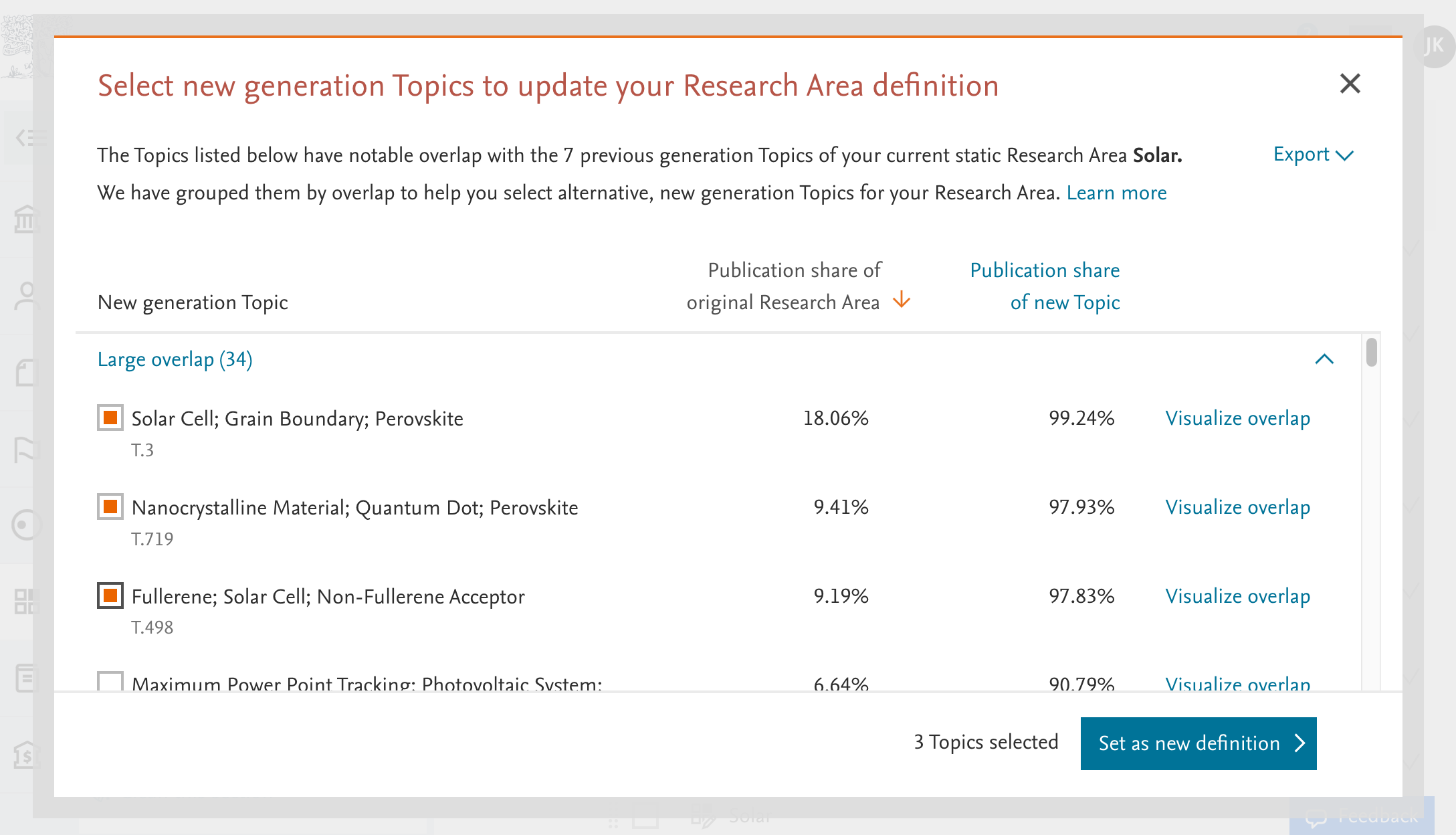
Please note, once you finish updating the Research Area definition with the new generation Topics / Topic Clusters, the old definition will not be available anymore. Save it as a Publication Set upfront if you would like to keep it for reference.
At the end of the transition period, non-converted Research Areas will be deleted.
Reporting Analyses for previous generation Topics or Topic Clusters are unavailable. These Analyses are clearly indicated in Reporting as well as Reports containing them.
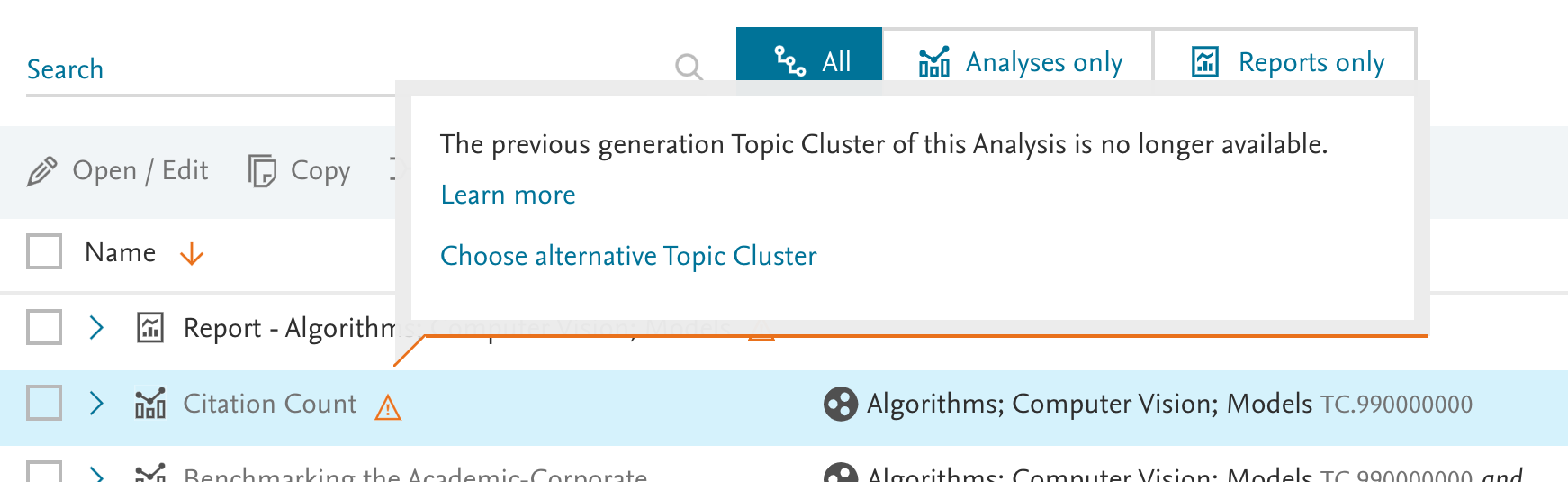
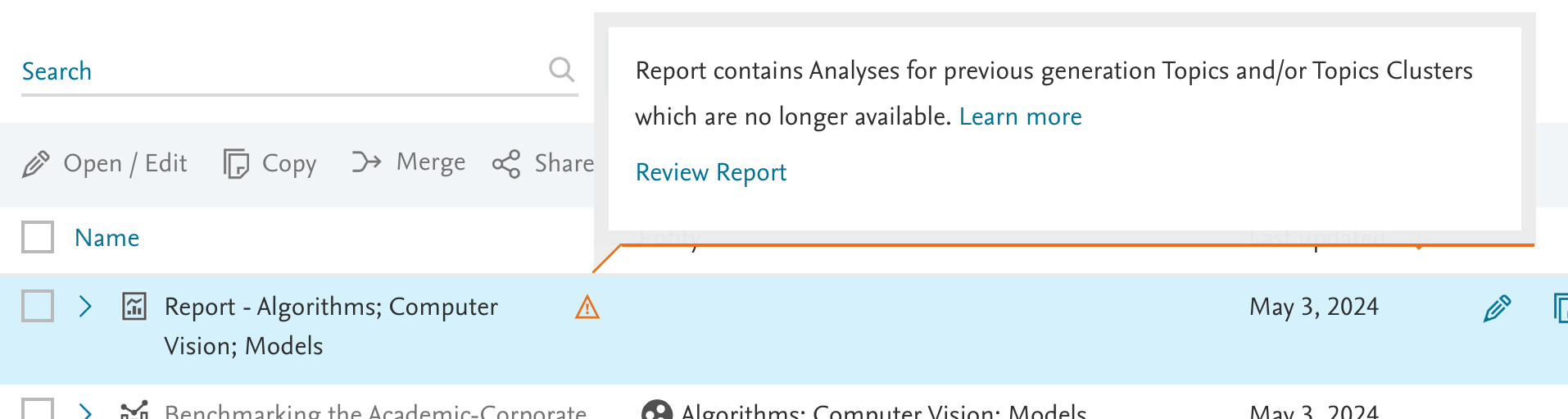
You can review the Reports and Analyses to substitute with alternative new generation Topics / Topic Clusters using our matching suggestions.
The details of the matching suggestions in the conversion flow can be found in “How are the matching suggestions generated?”
You can use “Populate all Reporting Analyses for this original Topic / Topic Cluster with the selected alternative” option at the bottom of the conversion flow screen. If you check the box, all your Reporting Analyses for the original Topic / Topic Cluster will be populated with the chosen alternative new generation Topic / Topic Cluster.

For single entity Reporting Analyses you can use only one Topic / Topic Cluster as an alternative. If you cannot choose a single Topic / Topic Cluster alternative, you can export the matching suggestions for further analyses.
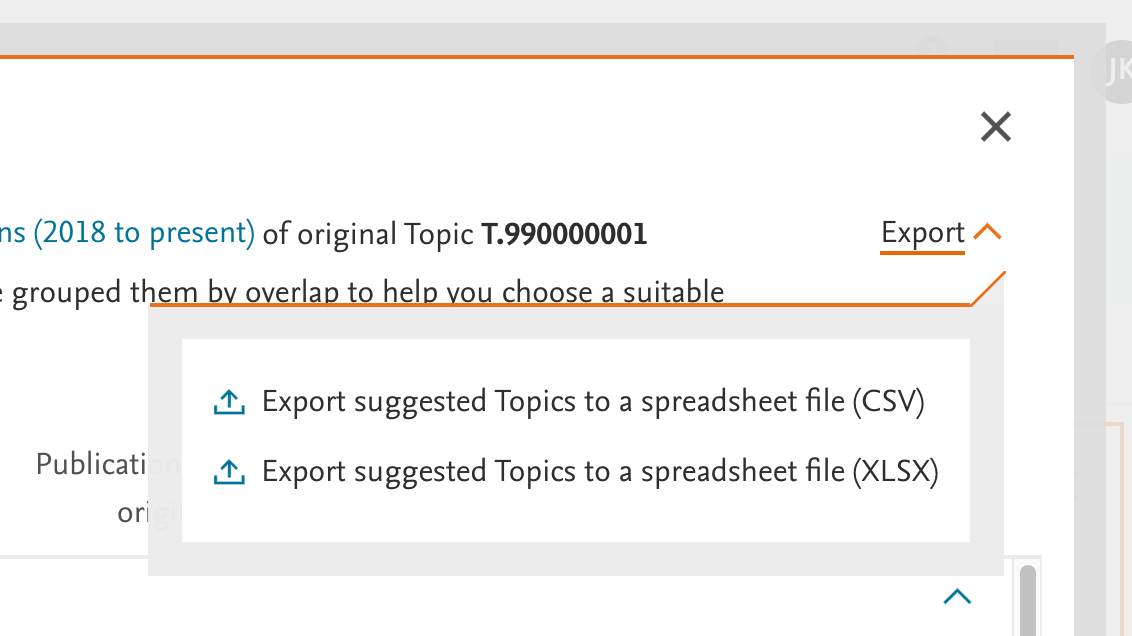
For Benchmarking Reporting Analyses you can choose multiple alternative new generation Topics / Topic Clusters.
At the end of the transition period, non-converted Reporting Analyses will be deleted, also from the Reports containing them.
The matching suggestions are based on the overlap in between the publications in the original entity and the publications of the suggested new generation Topic / Topic Cluster.
The table contains 2 overlap percentages
- Publication share of original entity:
This is the percentage of publications from the original entity that can be found in the suggested new generation Topic / Topic Cluster. - Publication share of new Topic / Topic Cluster:
The portion of the suggested new generation Topic/Topic Cluster that the publications from the original entity do represent, expressed as a percentage
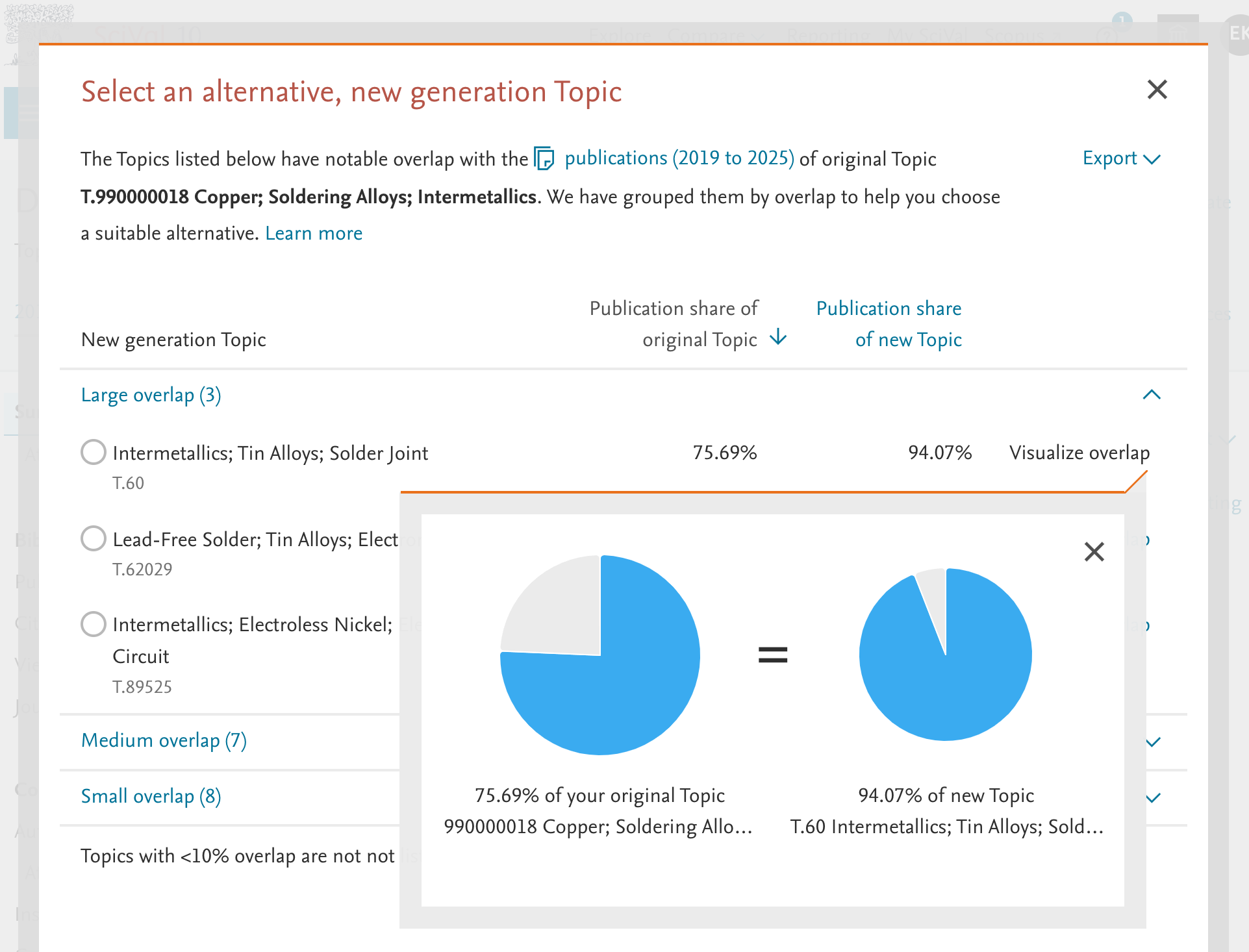
To calculate the overlap, we use publications of the original entity starting from 2018 up until publications that were available on May 21st 2024 when the new generation SciVal Topics were launched, and previous generation Topics became unavailable.
Original entity can be
- Research Area based on previous generation Topic(s) and / or Topic Cluster(s):
the total publications from all Topics and / or Topic Clusters of the Research Area fitting the time range are used for the overlap calculation. The filters applied in the original Research Area definitions are not considered, but will be pre-selected further in the flow, so that you can keep them. For Research Areas based on a combination of previous generation Topics and Topic Clusters, only Topics will be suggested for conversion. - Previous generation Topic or Topic Cluster and Reporting Analyses for previous generation Topic or Topic Cluster:
the publications of the single original Topic or Topic Cluster fitting the time range are used for the overlap calculation. - Benchmarking Reporting Analyses for several previous generation Topics and / or Topic Clusters:
the total publications from all Topics and / or Topic Clusters of the Reporting Analyses fitting the time range are used for the overlap calculation. For Benchmarking Analyses based on a combination of previous generation Topics and Topic Clusters, only Topics will be suggested for conversion.
Example:
- The original entity is a Research Area based on 5 previous generation Topics which have 1000 publications in total from 2018 - May 21st 2024
- 300 of these publications can be found in the new generation Topic T.100000
- T.100000 consists of 400 publications in total
- Publication share of original entity – Research Area = 300/1000 = 30%
- Publication share of new Topic = 300/400 = 75%
We use the following thresholds for Topics / Topic Clusters categories in the matching suggestions:
| Publication share of original entity | Publication share of new Topic / Topic Cluster |
|---|---|---|
Large overlap | >30% | >50% |
Medium overlap | >20% and <=30% | >30% and <=50% |
Small overlap | >10% and <=20% | >10% and <=30% |
Since the minimum threshold used is >10%, the “Publication share of original entity” column in the transition flow will not amount to 100%.
For the majority of Topics there is no direct one-on-one mapping from the old to the new Topics. Large or small portions of old generation Topics’ publications form a large or a small portions of new generation Topics' publications.
When comparing the new set of Topics with the old set, there is a strong overlap still, especially for the cores of Topics (groups of publications strongly connected).
You can analyze the publications redistribution from previous generation Topics and Topic Clusters to new generation Topics and Topic Cluster, and new generation composition from previous generation by downloading the redistribution files:
Did we answer your question?
Related answers
Recently viewed answers
Functionality disabled due to your cookie preferences