
View by category
What publications are considered in the QS World University Rankings (WUR) year?
Last updated on April 23, 2026
Also available in
Ranking year 2026: Some data points for the 2026 ranking edition have been revised and detailed below.
The publications considered in the QS World University Rankings (WUR) has consistent pattern as explained with example below:
Calculation for QS World University Rankings 2026 (Ranking year = 2026)
Publications window considered is 5 years: 2019 to 2023
Rule: For each ranking year, publications indexed in Scopus ® from (Ranking Year - 7) to (Ranking Year - 3) are considered.
Citations counted until 2024
Rule: Citations to these publications are counted until (Ranking Year - 2).
Use data snapshot: 2019 to 2023
Rule: Use data snapshot: (Ranking Year - 7) to mid-(Ranking Year - 3).
Sustainability metrics and indicator 2026
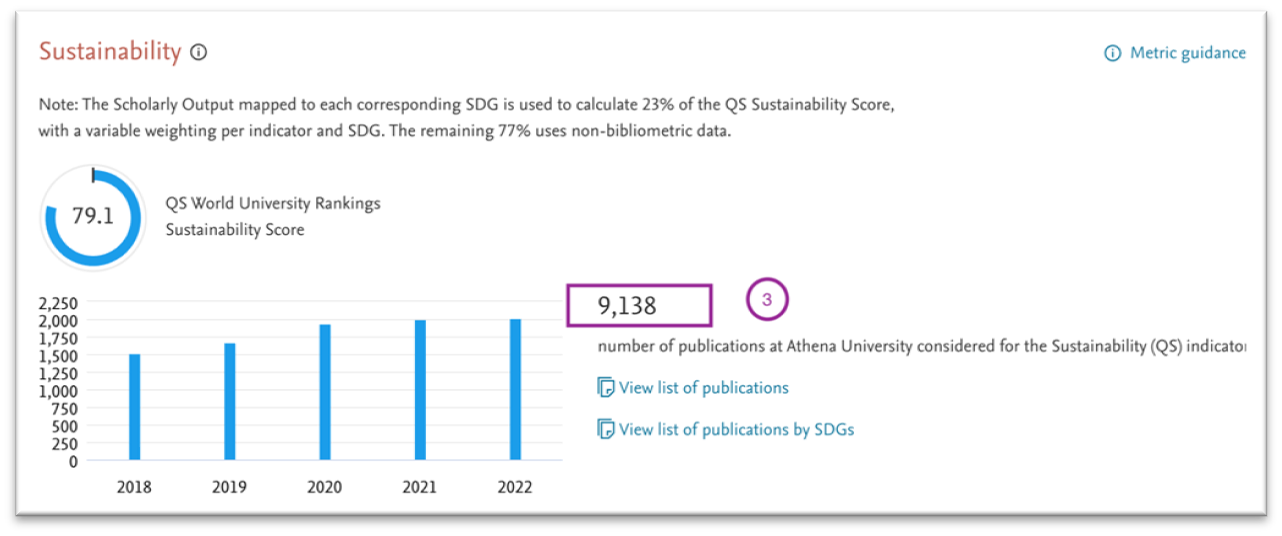
Use data snapshot: 2018 to mid-2022
Rule: Use data snapshot: (Ranking Year - 8) to mid-(Ranking Year - 4).
- Document types considered for Ranking year 2026 & 2025:
- Article, Review, Conference Paper, Book, Book Chapter, Article in Press, Business Article, Data Paper and Report.
- Note: Document types considered for Ranking year 2024 include Article, Review, Conference Paper, Book, Book Chapter, Article in Press and Business Article.
- Some papers are excluded based on affiliation cap.
Some previous year examples:
Ranking year | Publications | Citations until | Data snapshot |
|---|---|---|---|
2026 | 2019–2023 | 2024 | 2019–2023 |
2025 | 2018–2022 | 2023 | 2018–2022 |
2024 | 2017–2021 | 2022 | 2017–2021 |
Sustainability metrics 2026 | – | – | 2018 to mid‑2022 |
Sustainability metrics 2025 | – | – | 2017 to mid‑2021 |
The citation count is for 6 years for papers published over a five-year period.
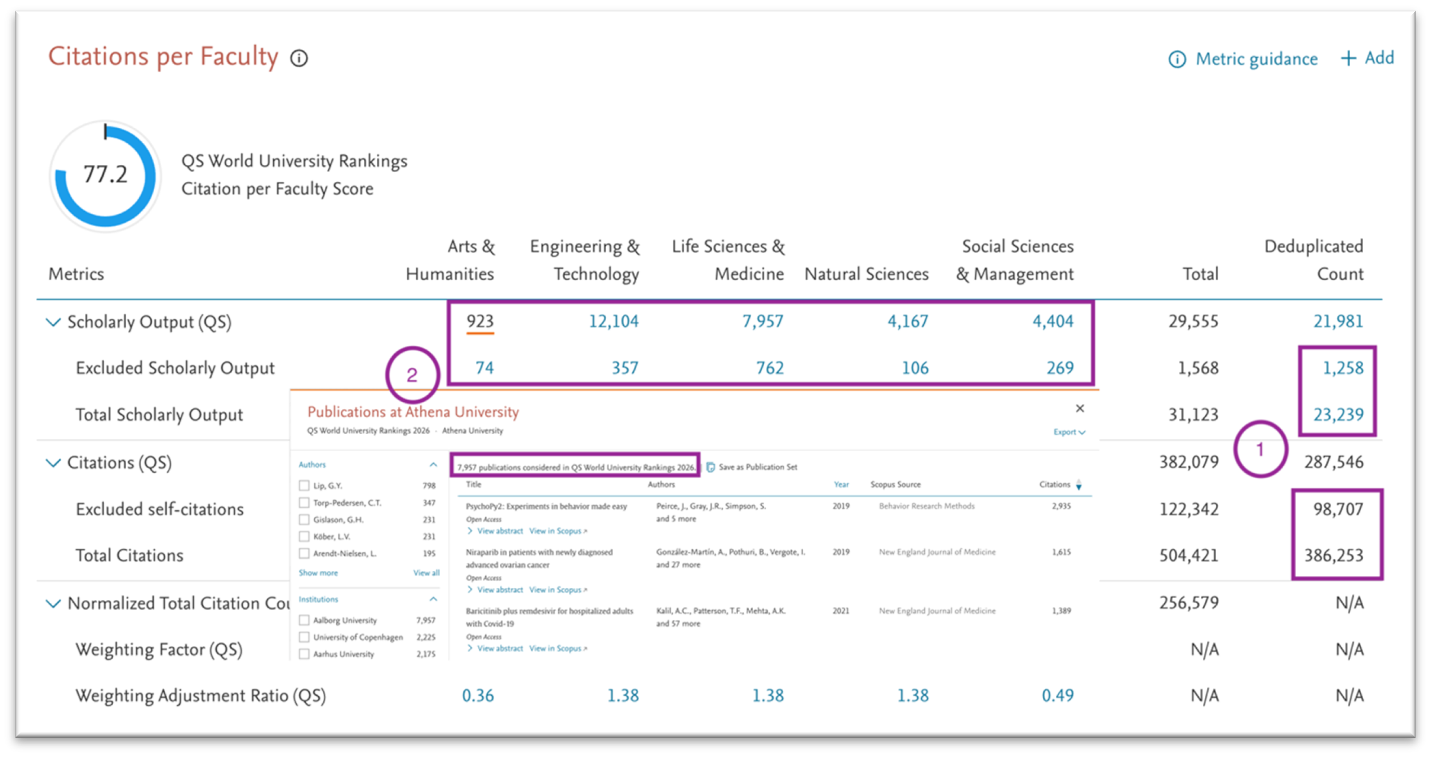
- Starting with the 2026 QS World University Rankings (WUR), in the Citations per Faculty section, deduplicated counts will now represent truly unique publications. Previously, a paper was counted multiple times when the paper exceeded an affiliation cap in 1 faculty area, but not in the other(s). For example, Paper X is considered below the affiliation cap in Arts & Humanities, but above the affiliation cap in Social Science & Management. In the earlier rankings this paper gets counted as 2 records. For the 2026 rankings, this paper is counted as 1 record. This means that in general, you’ll notice a small decrease in the counts. (Refer:Processing of citations and papers). This will affect the values for deduplicated counts in Excluded Scholarly Output, Total Scholarly Output, Excluded Self-Citations, and Total Citations.
- Additionally, we have improved the linking of the number of underlying publications for Scholarly Output and Excluded Scholarly Output across all faculty areas. While there are no changes in the values, you will find a larger number of publications available in SciVal that were considered in the rankings.
- There is also a minor variation in the number of publications considered for the Sustainability indicator. The updated dataset now includes a more precise count of publications per SDG.
These changes do not impact or alter the scores or overall ranking of an institution.
Did we answer your question?
Related answers
Recently viewed answers
Functionality disabled due to your cookie preferences