
View by category
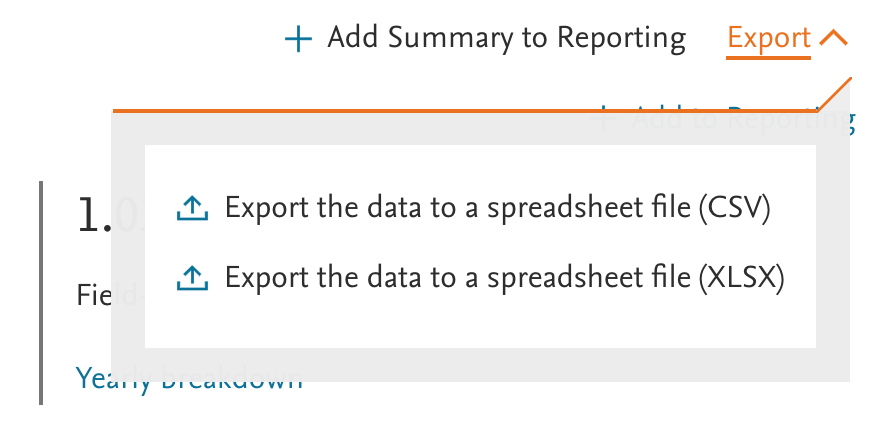
In many places in SciVal you can export data as a spreadsheet, either as a CSV or XLSX.
Click on 'Export' and choose the format you would like.
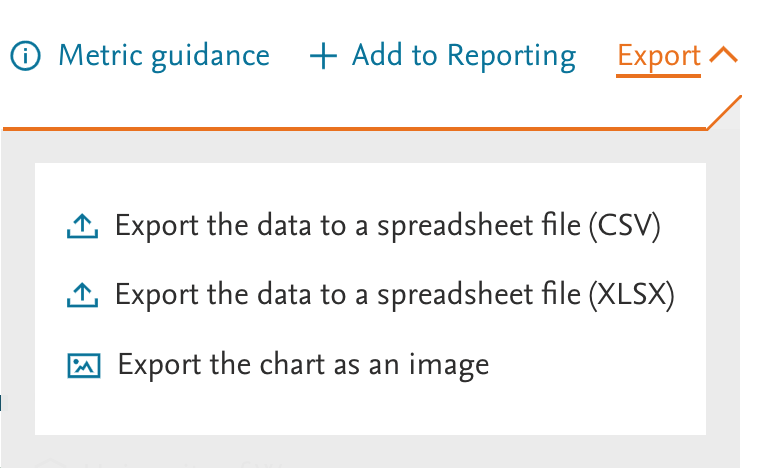
In the Benchmarking module, there is also the option to Export the chart as an image.
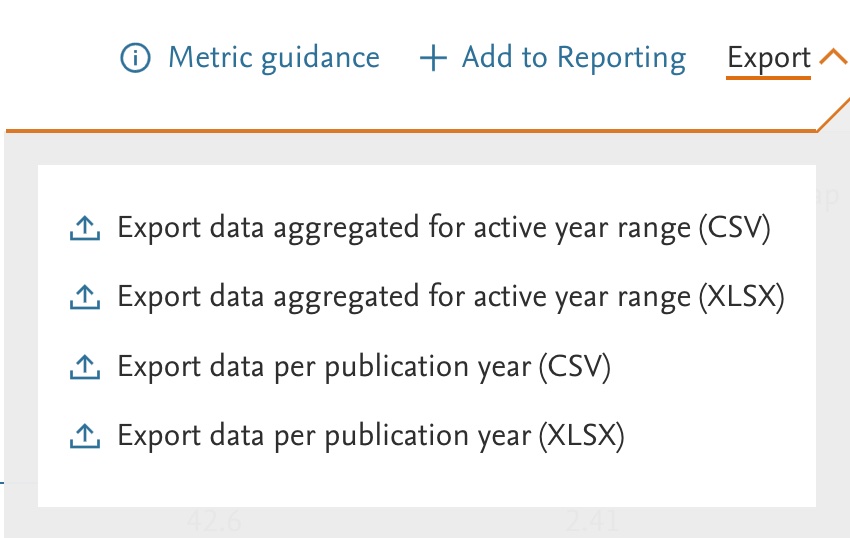
In Benchmarking, if multiple metrics are selected, there is also the option to export the data per publication year.
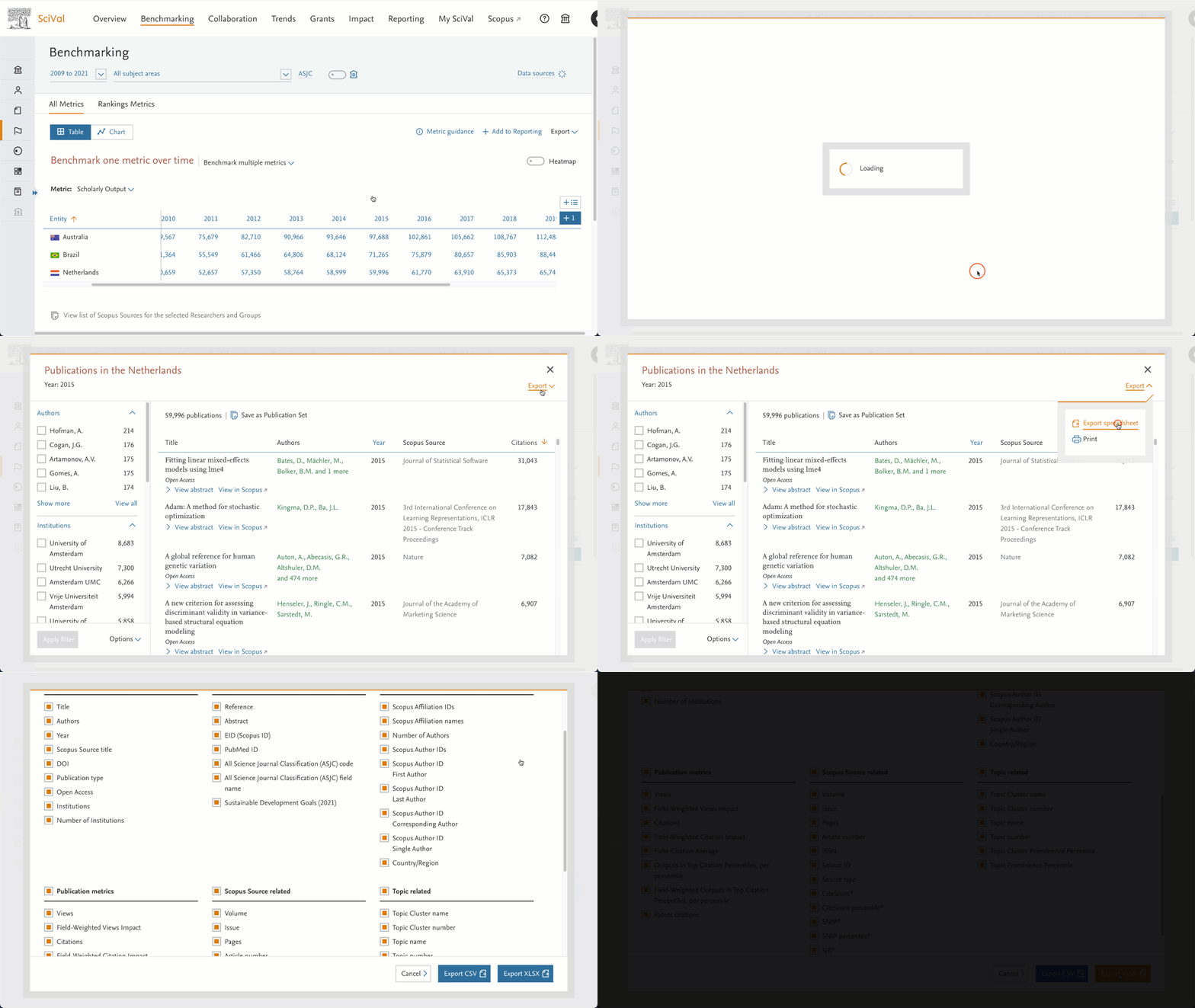
- Any time you see a Scholarly Output count in blue, this is a clickable link that shows details about the underlying publications.
- You can export the details of up to 100,000 publications as a single spreadsheet.
- If you export more than 1,000 publications, SciVal will process this offline and email you once the spreadsheet is ready.
- The export for the publications view gives a wealth of options that can be included in the spreadsheet, such as publication details, author and affiliation information, publication metrics and more. You can choose the options you would like to see on your spreadsheet.
How accurate are the publication dates?
SciVal uses the publication date metadata provided by Scopus. Many journals are only published on an annual, seasonal, multiple month range, or quarterly basis, so Scopus provides default dates in the data according to various business rules.
As a general rule the following publish date rules are used in SciVal to allocate a day, month and year for publications with non-specific published dates in Scopus:
- Monthly - the first of the month is used as the published date. e.g. May 2021 = 01 May 2021
- Seasonally - the first of the most relevant month is used. e.g. Winter 2021 = 01 Dec 2021
- Annually - the last day of the year is used as the published date. e.g. 2021 = 31 Dec 2021
- Date range - the last day of the range is used as the published date. e.g. April-June 2021 = 30 Jun 2021
Please note: the fabricated dates shown above can mean that there are many Scopus records that have the exact same date information. There are also exceptions to the rules above.
Did we answer your question?
Related answers
Recently viewed answers
Functionality disabled due to your cookie preferences