
Overview of Journals Data
Last updated on June 18, 2026
ScienceDirect Journals Data for Corporate customers can be delivered either as a Flat File or via our Fetch API.
Science Direct contains over 25M articles & book chapters which help facilitate interdisciplinary research across 2,650 peer reviewed journals. This data is available through Data as a Service.
ScienceDirect Data contains all the pertinent research articles included in ScienceDirect.com but excludes some of the additional content such as book reviews, examinations, to help minimize the amount of preparation needed before the data is used.
Please note that customers require an active Elsevier ScienceDirect data subscription to access.
FAQs
All delivery methods provide the information in XML format. At present our API is only useful for specific document retrieval but we will be building out more capabilities soon.
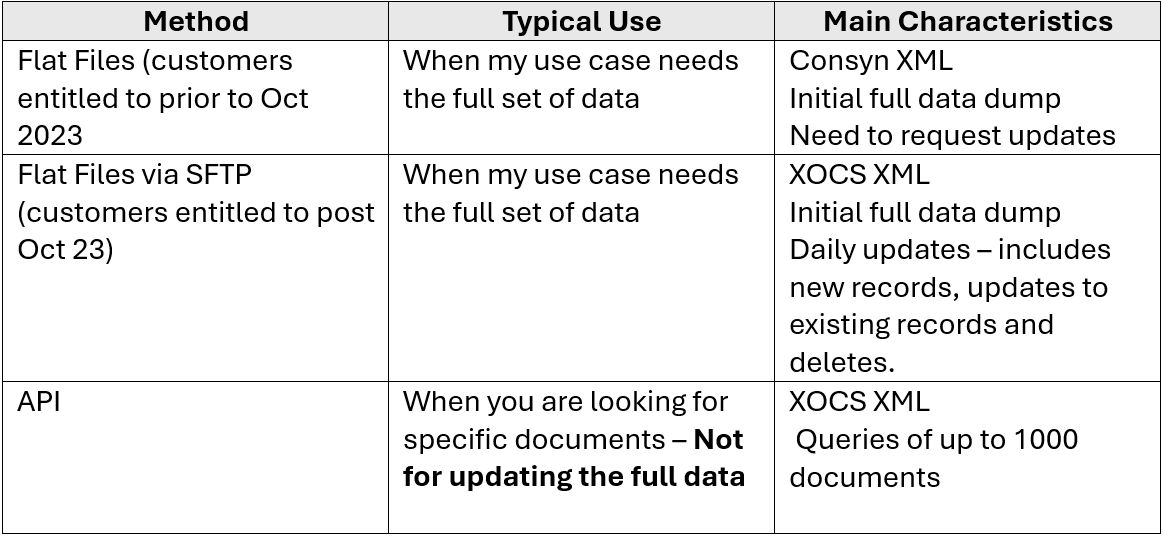
Science Direct Data is commonly used in a corporate setting to support research which broadly falls into three use-case categories: Search, Discovery and Prediction.
Search: e.g. semantically enrich content to improve the identification of relevant facts within literature.
Discovery: e.g. generate novel insights from literature by creating a knowledge graph from utilizing Elsevier data.
Prediction: e.g. create an algorithm using Elsevier data to predict facts that are not observed within the source literature.
Article retrieval: e.g. use known DOIs to get full text for articles, previously identified using other resources e.g. Embase.
A ScienceDirect (via Flat File or API) is delivered in XML format, which includes simple tables that can be rendered in XML. However, complex tables, images, figures, and supplementary data are not included in the full-text content delivery. Images are available to purchase as a flat file separately (see – Overview of ScienceDirect Journals Images)
Journals only content and not books.
Articles such as obituaries, tables of contents etc.. have been removed to help reduce noise within the dataset.
The following ScienceDirect datasets are available:
- Corporate Edition
- 24 subject areas including Chemistry, Medicine and Dentistry, Engineering and Geology (which can be purchased on their own on in combination with others)
- Premium branded proprietary collections such as CellPress, Clinics, Seminars and the Lancet family of journals
- Premium Society collection
- Masson and Doyma collections
A full list of what is available can be found here.
For every proper article (excluding indexes, older book reviews, letters), we have an abstract in XML available as the minimum XML asset. Some but not all titles also have references available in XML.
For most articles, the following journal article artifacts are included in the XML: article heads, body, references/citations, keywords, simple tables (if captured in XML, included directly within XML file; if complex, is captured as an image: a table caption and a reference with an ID is put into the XML in place of the table), image IDs (no images in XML), and figure IDs (no figures in XML). By default, we do not provide access to complex tables figures, images, or supplementary data.
There is a higher incidence of PDF-only full-text content for pre-2006 publications; From 1995-2006, we phased in XML full-text for our journals. Where a PDF is of poor quality and Elsevier has received a complaint, we do our best to replace it. Availability is subject to having a suitable hard copy for scanning.
The Data for Research and Discovery Support team is the initial point of contact for all offerings of the Data as a Service portfolio.
Did we answer your question?
Related answers
Recently viewed answers
Functionality disabled due to your cookie preferences